

Most small clinics don't have a data problem. They have a "twelve systems that half-talk to each other" problem. The EHR knows one version of a patient's phone number, the reminder tool knows a different one, the billing system has an old address, and the front desk keeps a spreadsheet because none of the above is trustworthy enough to act on.
That's the real shape of data integration architecture for SMB clinics: not a grand centralized warehouse, but a practical set of rules about which system wins when two disagree, how data moves between them, and how you catch the moment something quietly breaks. Get those rules right and you can swap vendors, add tools, and grow to a second location without the whole thing collapsing. Get them wrong and you spend your Tuesdays reconciling reports that should have matched.
This is the blueprint I'd hand a practice manager who's tired of being the human integration layer.
Why clinic data gets messy in the first place
The mess isn't from carelessness — it's structural. A clinic runs on systems that were each bought to solve one job: scheduling, charting, claims, reminders, payments. Each one thinks it owns the patient record. None of them was designed to defer to another.
So you end up with what I'd call silent divergence. Nobody makes a bad decision. The scheduling tool captures a new cell number during a confirmation call. The EHR never hears about it. Six weeks later a lab result goes to a dead number, and the patient shows up angry because "nobody told them." No single system is wrong. They're each right about different things at different times.
-
- Two systems both act like the master. The EHR and the practice management system both store demographics, and edits happen in both places.
-
- One-directional syncs pretending to be two-directional. Data flows EHR → reminder tool but never back, so front-desk corrections disappear.
-
- Manual re-keying as the actual integration. Someone copies a payer ID from a PDF into three places. That person is the API.
-
- No record of when a sync last succeeded. When a feed dies, you find out from a patient, not a dashboard.
At a single-provider practice you can survive this on memory and hustle. The trouble is that neither scales.
What actually breaks as you grow
The jump from one location to two is where informal data-handling falls apart. Not because the volume doubles, but because the coordination problem changes shape entirely.
Eliminate appointment gaps and no-shows.
GoCliny streamlines every patient interaction from booking to billing—seamlessly.
- Unified appointment scheduling
- Automated patient reminders
- Staff calendar & task management
No credit card required
With one site, one front desk, and one biller, reconciliation happens in someone's head. Add a second site and suddenly two front desks are editing the same patient records, two billers are working overlapping claims, and the "obvious" answer to which record is correct is no longer obvious. The person who used to hold it all together can't be in two buildings at once.
-
Reporting stops matching. Site A's no-show number and the combined dashboard figure disagree. Nobody can explain the gap.
-
Duplicate patients multiply. The same person gets registered twice because Site B couldn't see Site A's record fast enough.
-
Claims leak. A charge posts in one system, the payer info lives in another, and the mismatch shows up as a denial three weeks later.
-
Trust collapses. Once staff stop believing the reports, they rebuild shadow spreadsheets — and now you've got a third version of the truth.
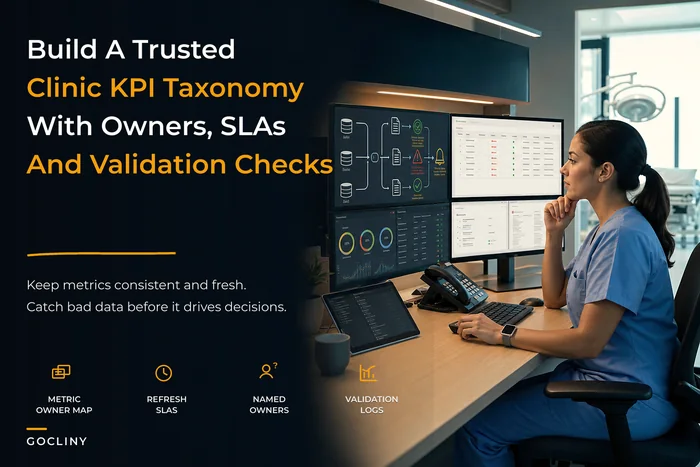
That last step is the expensive one. The whole point of building a single source of truth with a clear KPI taxonomy and owner matrix is to stop staff from needing private spreadsheets. But a source of truth is only as good as the integration plumbing feeding it. If the plumbing is guesswork, the taxonomy is decoration.
The core idea: source-of-truth rules before tools
Before you touch a single API, you decide — on paper — which system owns each type of data. This is the step almost everyone skips, and it's the one that makes everything else sane.
The principle: every field has exactly one system of record. Not "usually the EHR." Exactly one, written down, no exceptions. Other systems may hold a copy, but they defer to the master on conflict.
| Data domain | System of record | Systems that hold copies | Conflict rule |
|---|---|---|---|
| Clinical notes, results | EHR | None (read-only exports) | EHR always wins |
| Demographics (name, DOB) | EHR | PM, reminder tool | EHR wins; edits routed back to EHR |
| Contact info (phone, email) | Practice mgmt | EHR, reminder tool | Most-recent-verified wins |
| Appointments / schedule | Scheduling system | EHR, reminders | Scheduling system wins |
| Insurance / payer IDs | Practice mgmt | Clearinghouse | PM wins; clearinghouse read-only |
| Payments / balances | Billing/RCM | PM | Billing wins |
| Consent / communication prefs | Reminder/comms tool | EHR | Comms tool wins |
Two things make this table actually work. First, contact info is often better owned by the practice management or front-desk system, not the EHR — because that's where corrections happen live, during calls. Fighting that reality creates more divergence than accepting it. Second, notice the conflict rule column. "Most-recent-verified wins" is a real rule you can enforce with a timestamp and a verification flag. "EHR wins" is a real rule. "We'll figure it out" is not a rule.
Once this table exists, most integration arguments just go away. When two systems disagree, you don't debate — you check the table.
Moving data between systems: patterns that hold up
With ownership settled, the question becomes how copies stay current. There are really only a few patterns worth using at clinic scale, and the trick is matching the pattern to how time-sensitive the data actually is.
Webhooks for events that need to happen now. A new appointment booked, a cancellation, a payment posted — these are events. When they fire, the owning system pushes a small message to the systems that care. This is what keeps a same-day cancellation from sitting invisible while a waitlisted patient goes unfilled. Webhooks are fast, but they're fire-and-forget, which means you need a fallback for the ones that don't arrive.
Scheduled pulls for bulk reconciliation. Every night, pull the full appointment list, the full patient roster, the day's charges. This is your safety net. Webhooks handle live stuff; the nightly pull catches whatever the webhooks dropped. Any clinic that relies on webhooks alone eventually loses data during an outage and can't tell.
Polling only when you have no choice. Some older EHRs and payer portals give you nothing but a login and a report screen. In those cases you poll on a schedule and accept the lag. Fine for insurance eligibility checked the night before; not fine for anything real-time.
-
Scheduling system emits a webhook on any appointment change.
-
A lightweight middleware receives it, validates the payload, and writes to the copy systems.
-
If the write fails, the event goes into a retry queue — 1 min, 5 min, 30 min.
-
Every night, a full pull reconciles the whole day and flags anything the live events missed.
-
Mismatches get logged to a table a human actually reviews the next morning.
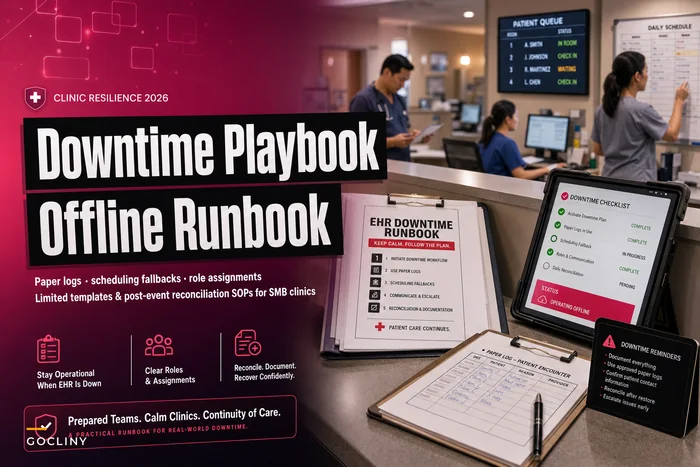
Step 5 is the one people forget. Automation that fails silently is worse than a manual process, because at least a manual process has someone noticing when something feels off. The same logic underpins a good EHR downtime playbook with offline runbook and reconciliation — you plan for the feed to break, because it will.
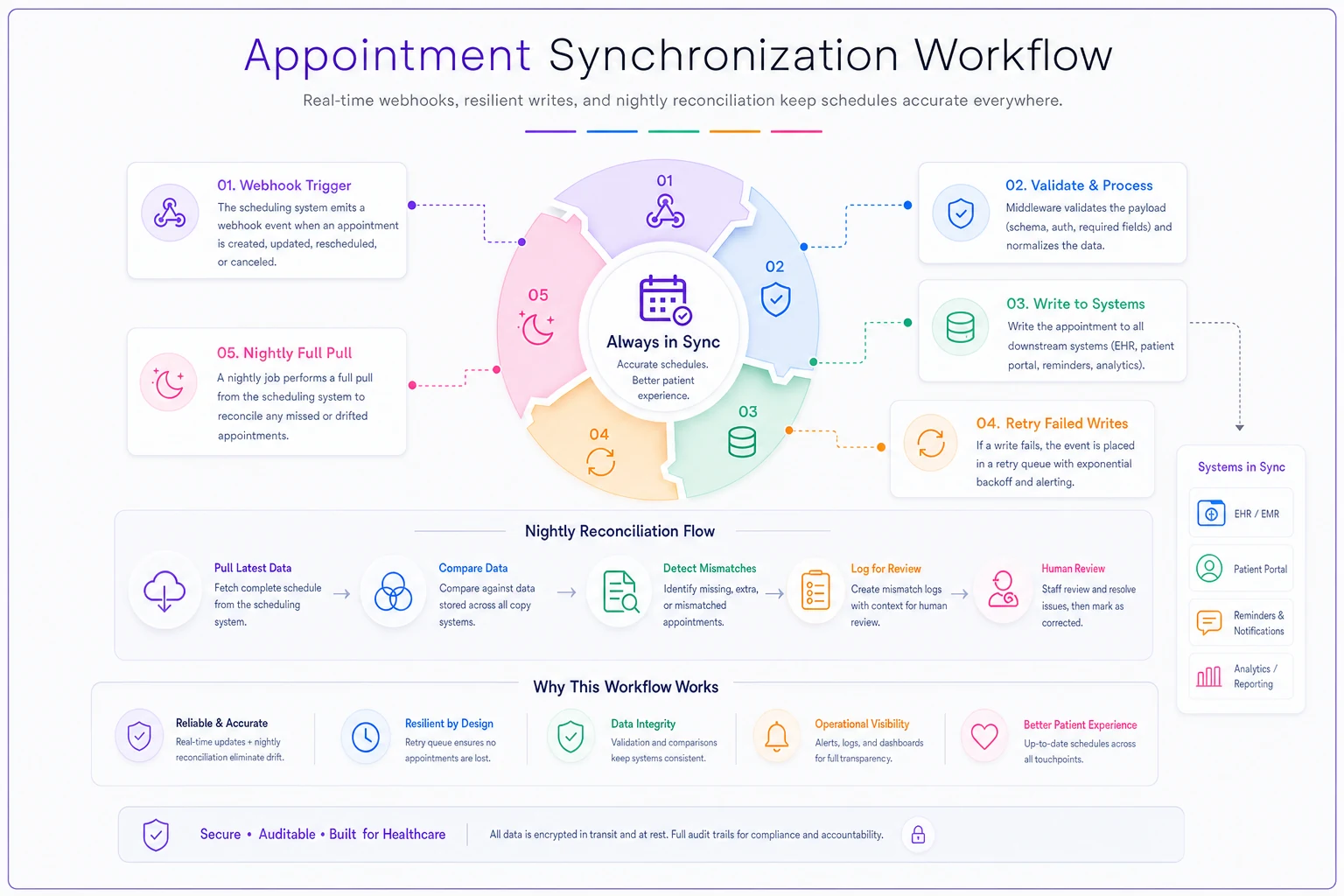
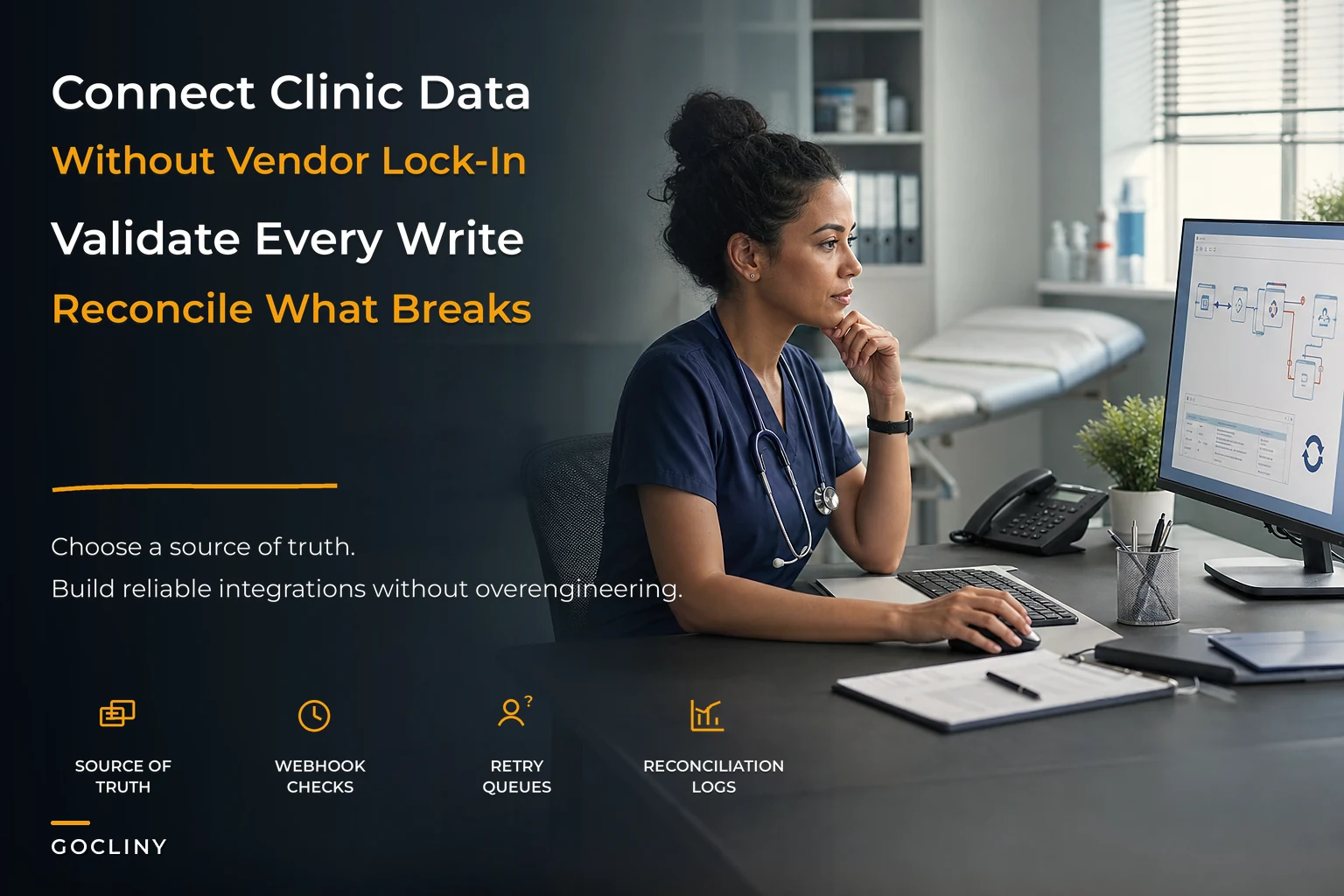
Diagram of the appointment sync flow.
Lightweight ETL checks that catch problems before patients do
You don't need a data engineering team. You need a handful of checks that run automatically and flag when something's off. Smoke detectors, not a fire department.
The goal is to catch the three things that actually hurt clinics: missing data, duplicated data, and stale data.
-
- Row-count sanity. Did today's appointment pull return roughly what you'd expect? If yesterday had around 180 appointments and today's sync returns 12, something broke — don't act on it.
-
- Freshness check. When did each feed last update successfully? Any feed older than its expected window gets flagged.
-
- Duplicate detection. Same DOB + same last name + same phone across two records? Flag for merge review.
-
- Orphan detection. Charges with no matching appointment. Appointments with no matching patient. These are your future denials.
-
- Referential match. Every payer ID on a claim should exist in the payer master. Ones that don't get held before submission.
-
- Null spikes. A sudden jump in blank phone numbers usually means a field mapping broke upstream.
None of these are fancy. All of them save real money. An orphaned-charge check alone tends to surface billable work that would otherwise quietly never get submitted.
Sample SQL validation checks
If your data lands anywhere queryable — a reporting database, a warehouse, even a structured export — these checks are worth scheduling. Treat them as starting points and adjust table and column names to match your setup.
Freshness: has each feed updated recently? SELECT sourcesystem, MAX(loadedat) AS lastload, DATEDIFF(hour, MAX(loadedat), GETDATE()) AS hoursstale FROM etlloadlog GROUP BY sourcesystem HAVING DATEDIFF(hour, MAX(loaded_at), GETDATE()) > 26; -- expected daily
Duplicate patients across the roster: SELECT lastname, dateofbirth, phone, COUNT() AS dupes FROM patients GROUP BY lastname, dateofbirth, phone HAVING COUNT() > 1;
Orphaned charges (charge with no matching appointment): SELECT c.chargeid, c.patientid, c.servicedate, c.amount FROM charges c LEFT JOIN appointments a ON c.patientid = a.patientid AND c.servicedate = a.apptdate WHERE a.apptid IS NULL;
Payer IDs on claims that don't exist in the payer master: SELECT cl.claimid, cl.payerid FROM claims cl LEFT JOIN payermaster p ON cl.payerid = p.payerid WHERE p.payerid IS NULL;
Row-count drop vs. trailing average (catch a broken sync): SELECT loaddate, rowcount, AVG(rowcount) OVER (ORDER BY loaddate ROWS BETWEEN 7 PRECEDING AND 1 PRECEDING) AS avgprev7 FROM dailyapptcounts WHERE rowcount < 0.5 * ( SELECT AVG(rowcount) FROM dailyapptcounts WHERE loaddate >= DATEADD(day, -7, GETDATE()) );
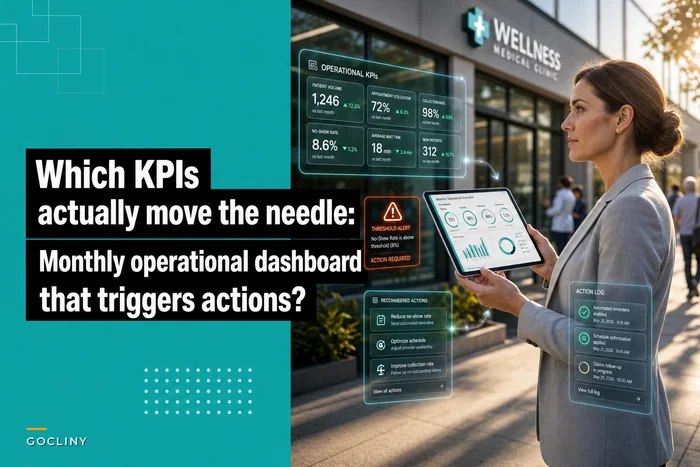
Run these on a schedule, dump results into one review table, and have someone look at it with their morning coffee. That's the whole discipline. Checks that live in a report nobody opens don't count — and a validation failure should trigger a real task, not just sit in a log. That connects directly to the question of which KPIs actually move the needle and drive action.
Vendor data-contract templates
The other half of a vendor-agnostic setup is what you demand from vendors before you sign. Most clinics negotiate on price and features, then get surprised when the vendor won't hand over their own data cleanly at the end. Bake these terms into procurement and you keep the ability to leave.
-
- Data ownership. In writing
the clinic owns all patient and operational data, full stop.
-
- Export format and cadence. You can pull a complete export, on demand, in a standard format (CSV/JSON/HL7/FHIR as relevant) — not a locked PDF report.
-
- API/webhook access. Documented endpoints, rate limits stated up front, and webhook support for the events you care about.
-
- Field-level schema. A data dictionary listing every field, type, and meaning. "We'll send you the fields" is not a schema.
-
- Change notice. Advance written notice before any breaking API or schema change — 30 days minimum.
-
- Offboarding terms. A full export within a fixed number of days at termination, and a defined data-deletion process afterward.
-
- Uptime and support. Stated availability and a support path for integration failures, not just clinical questions.
-
- Security and BAA. HIPAA-compliant handling, a signed Business Associate Agreement, and breach-notification timelines.
A short vendor-evaluation checklist to run before signing:
-
- [ ] Can we get a full data export on our own, without asking their support team?
-
- [ ] Is there real API/webhook documentation, or just a sales promise?
-
- [ ] Do they give notice before breaking changes?
-
- [ ] What's the exact offboarding timeline in the contract?
-
- [ ] Is a BAA included and signed?
-
- [ ] Have we tested an actual export during the trial, not just seen a demo?
That last box is the one that separates theory from reality. Vendors demo beautifully. Pull a real export during the trial and you'll learn more in ten minutes than in three sales calls.
A short real scenario
A two-location primary care group — roughly 330–360 visits a week between both sites — kept fighting a reporting gap. The combined no-show rate on the dashboard never matched what either site felt on the floor. Front-desk staff had, predictably, started keeping their own spreadsheets to track "the real numbers."
The root cause was boring: contact info was being edited in the EHR at one site and in the practice management system at the other, with a one-way sync overwriting corrections nightly. Reminders were going to stale numbers, no-shows were logged inconsistently, and nobody owned the conflict.
The fix wasn't a new platform. It was a source-of-truth table (contact info owned by the PM system, most-recent-verified wins), a nightly reconciliation pull to back up the live sync, and a duplicate-patient check that flagged merges each morning. Within about two months the dashboard and the floor agreed, the shadow spreadsheets faded out, and reminder-related no-shows dropped by a meaningful margin — not a miracle, just fewer messages going into the void.
The interesting part: no vendor changed. The architecture around the vendors changed.
When this makes sense — and when it doesn't
When it's worth building. If you run more than one location, more than one biller, or more than three systems that share patient data, you're already paying for the lack of structure in reconciliation time and denied claims. A source-of-truth table and a few validation checks pay for themselves quickly.
When it's overkill. A solo provider with one EHR that also handles scheduling and billing doesn't need a middleware layer. For them, "the EHR wins, always" is the architecture. Don't build integration plumbing for data that never leaves one system.
Who should not do this alone. If nobody on staff can read basic SQL and no one owns the data-quality review, don't stand up automated checks that will silently rot. Either assign a clear owner or bring in help. An unmonitored check is arguably worse than no check at all — it just makes you stop looking.
Where to start next week
You don't roll this out all at once. Order matters more than speed.
-
Write the source-of-truth table. One page. Which system owns what, and the conflict rule for each. This alone resolves most day-to-day disputes.
-
Map your current data flows. Sketch what actually moves where, one-way vs. two-way. You'll find at least one "sync" that's really a person retyping something.
-
Add three validation checks. Freshness, duplicates, orphaned charges. Route results to one review table.
-
Audit your vendor contracts against the checklist. Flag any vendor that can't hand you your own data.
-
Assign an owner. Someone reviews the check results daily and owns follow-up.
The clinics that stay flexible aren't the ones with the fanciest tools. They're the ones who decided, in writing, which system tells the truth — and who built enough plumbing and enough checks that they can swap any single vendor without the whole operation holding its breath. That's the entire goal of pragmatic integration: not perfection, just a setup that bends instead of breaking when something inevitably changes.
The clinics that stay flexible aren't the ones with the fanciest tools. They're the ones who decided, in writing, which system tells the truth — and who built enough plumbing and enough checks that they can swap any single vendor without the whole operation holding its breath. That's the entire goal of pragmatic integration: not perfection, just a setup that bends instead of breaking when something inevitably changes.
Ready to transform your practice workflow?
Join 2,000+ healthcare providers using GoCliny to increase efficiency, improve patient satisfaction, and grow revenue.