

Most clinics don't lack awareness of their risks. Ask any practice manager and they'll rattle off the big ones in thirty seconds — a denied-claims backlog, a provider calling in sick during a packed day, the EHR going dark, a payer reprocessing contract changes. The problem isn't knowing the risks exist. It's that this knowledge lives in people's heads, scattered spreadsheets, and the muscle memory of whoever happened to handle the last fire.
So when something actually breaks, the clinic re-learns how to respond from scratch. Different person, different day, different improvised fix. That's the gap a clinic operational risk register is supposed to close — not by adding more documentation nobody reads, but by turning "we sort of know about this" into "here's exactly who owns it, how we'll see it coming, and what we do in the first 30 minutes."
This article is about building that single catalog and wiring it to the two things that make it actually work: financial and quality thresholds that tell you when to react, and escalation tiers that tell you who gets pulled in.
Why clinics end up with risk knowledge instead of a risk system
Walk into a clinic that's been running five-plus years and risk management has usually become tribal knowledge. The billing lead knows which payer tends to claw back payments. The front-desk supervisor knows which referral sources send incomplete intakes. The office manager knows the EHR vendor's support line is useless after 4pm.
None of that is written down in one place. It works — until the person holding that knowledge is out, or the clinic adds a second location, or volume climbs to the point where informal early-warning signals stop reaching the right people in time.
The pattern worth noticing: risk doesn't hurt clinics at the moment it appears. It hurts when detection and response are slow. A claim denial trend spotted in week one costs a fraction of the same trend caught in week six. A no-show spike noticed on Tuesday is a scheduling adjustment; noticed at month-end it's a revenue hole you can't backfill.
A real register isn't a compliance binder. It's a response-speed tool. The whole point is to compress the time between "something is drifting" and "the right person is executing a known play."
What actually breaks when you scale without one
A single-provider practice can survive on tribal knowledge because the feedback loops are short — the owner sees everything. By the time you hit three or four providers, two front-desk staff, and a billing function, those loops stretch out and signals get lost.
Eliminate appointment gaps and no-shows.
GoCliny streamlines every patient interaction from booking to billing—seamlessly.
- Unified appointment scheduling
- Automated patient reminders
- Staff calendar & task management
No credit card required
-
Ownership gets fuzzy. When one person did everything, "who handles this" was obvious. With a team, a denied-claims spike can sit untouched because billing assumes the provider will fix the coding and the provider assumes billing is appealing it.
-
Detection lags reality. Nobody's watching the specific numbers that signal a problem. The clinic finds out about a prior-auth bottleneck when a patient's procedure gets cancelled, not when the auth queue first started backing up.
-
Response gets reinvented every time. The second EHR outage gets handled completely differently than the first because the person who figured it out last time is off that day.
-
Small risks compound. A minor eligibility-verification gap feeds a denials problem, which feeds a cash-flow problem, which feeds a stressed billing team that starts cutting corners.
That last point is the one most clinics underestimate. Risks aren't independent — they chain. A staffing shortage degrades phone triage, which pushes patients to walk-ins, which overloads providers, which increases documentation errors, which increases denials. A register that treats each risk as a standalone line item misses the connective tissue, which is exactly why ownership and escalation tiers matter more than the catalog itself.
The four parts every register entry needs
A risk register entry that only names the risk is useless. The entries that actually get used in a crisis have four components, and skipping any one of them is where most clinics' registers quietly rot into shelf-ware.
-
A detection signal. What specific, checkable thing tells you this risk is materializing? "Denials over 8% of submitted claims this week." "More than 3 providers below 70% booked for next week." "Auth queue aging past 48 hours." If you can't state the number you'd watch, you don't have detection — you have hope.
-
A named owner. Not a department. A role, ideally a specific person. The owner is responsible for the runbook executing, not necessarily doing every step themselves.
-
A runbook. Ordered steps to contain and recover. Keep it short. Written for the person who'll be stressed and distracted when they open it.
-
Thresholds and escalation tier. The dollar or quality impact that decides how far up the chain this goes and how fast.
Here's a compact view of how those pieces fit together across a few common clinic risks:
| Risk | Detection signal | Owner | Threshold → tier | First recovery move |
|---|---|---|---|---|
| Claim denial spike | Weekly denial rate > 8% | Billing lead | > $5k exposure → Tier 2 | Pull denial reason codes, isolate top driver |
| EHR/system downtime | System unreachable > 15 min | Ops manager | Any clinical impact → Tier 2 | Switch to offline runbook, log encounters manually |
| Provider absence (day-of) | Call-out before 7am | Scheduling lead | > 20 affected visits → Tier 2 | Trigger cross-coverage, start rebooking by urgency |
| Prior-auth bottleneck | Auth queue aging > 48 hrs | Clinical ops | Any procedure at risk → Tier 2 | Escalate flagged auths, notify affected patients |
| Eligibility-verification gap | Unverified visits > 10% daily | Front desk lead | > $3k at-risk charges → Tier 1 | Batch re-verify, flag self-pay fallbacks |
| Security/privacy event | Any suspected breach | Compliance owner | Any PHI exposure → Tier 3 | Contain access, start incident log, notify leadership |
Notice that the thresholds aren't uniform. A privacy event jumps straight to the top tier regardless of dollar value because the regulatory and reputational exposure dwarfs the immediate cost. A denial spike escalates on money. A downtime event escalates on clinical impact. The escalation logic has to match the nature of the harm, not force everything onto a single dollar scale.
Thresholds are where most registers go wrong
The hardest part isn't listing risks or even writing runbooks. It's setting thresholds that are tight enough to catch problems early but loose enough that you're not escalating noise.
Set them too sensitive and your Tier 2 pager goes off every afternoon over normal variation. People start ignoring it, and when something real happens it's useless — the clinical version of alert fatigue. Set them too loose and you're back to finding out about problems at month-end.
A workable approach is anchoring thresholds to your own baseline, not to industry averages. If your clinic's normal denial rate runs around 5–6%, a threshold at 8% catches a genuine deviation. For another practice running at 9% normally, that same threshold would fire constantly. Thresholds should reflect what "normal" looks like for your clinic, then get tightened as your baseline improves.
Anchor watch and action thresholds to your clinic's historical baseline and schedule a quarterly review to adjust them.
-
A watch threshold that flags the owner to pay attention but doesn't escalate.
-
An action threshold that triggers the runbook and the escalation tier.
That gap between watch and action gives the owner room to catch something while it's still small, without dragging leadership into every blip. In practice, the watch threshold is where most problems quietly get resolved before anyone else ever hears about them.
Escalation tiers: who gets pulled in, and when
Tiers exist so people don't have to improvise the chain of command mid-crisis. A simple three-tier model covers most clinics:
Tier 1 — Handled by the owner. The owner executes the runbook and logs it. No one above needs to be involved. Most eligibility gaps, routine denial drift, and minor scheduling shuffles live here.
Tier 2 — Owner plus manager, same-day coordination. Something with real financial or operational impact that needs more than one person or crosses team lines. A denial spike with meaningful exposure, a day-of provider absence affecting a full schedule, a system outage with workarounds in progress.
Tier 3 — Leadership and potentially outside parties. Anything with regulatory, legal, or significant reputational weight. A suspected privacy breach, an extended outage, a safety event. These pull in the practice owner, compliance, and sometimes legal or vendors.
The mistake clinics make is skipping the tier definition and assuming "serious stuff goes to the boss." Without defined tiers, two things happen: trivial issues bubble up and eat leadership's time, or genuinely serious issues get sat on by someone who didn't want to overreact. Defined tiers remove the judgment call about whether to escalate — the threshold already answered that.
How the register connects to the playbooks you already have
A risk register isn't a replacement for your specific response plans — it's the index that points to them and tells you when to open them.
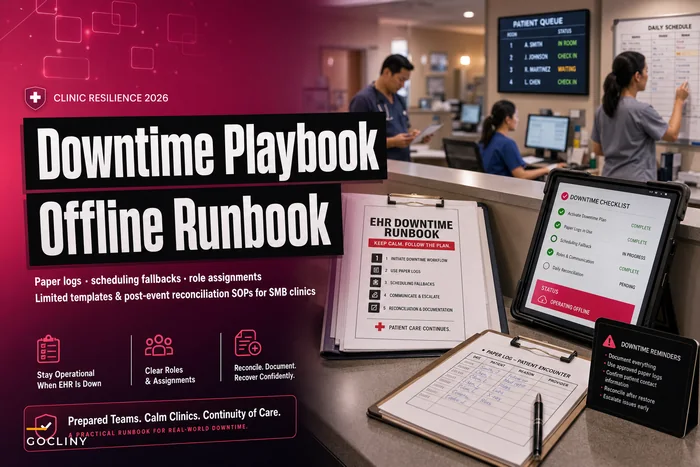
Your downtime entry doesn't need to contain the entire offline procedure. It needs the detection signal, the owner, the threshold, and a link to the full plan. If you've already built a proper EHR downtime playbook with an offline runbook and reconciliation steps, the register entry simply triggers it and routes the escalation. Same with security events — the register flags the signal and tier, then hands off to your detailed clinic cybersecurity response procedures for the actual containment steps.
The right mental model: the register is the switchboard, the runbooks are the rooms. When you open a new location, risk goes up across the board — new staff, untested workflows, unfamiliar local payers — which is exactly why a site launch plan that anticipates revenue shocks should feed new entries into the register rather than exist as a separate, forgotten document. Growth should add rows to the catalog, not orphan plans in a drive nobody opens.
This diagram shows the flow from a detection signal through ownership, threshold checking, runbook trigger, and escalation routing.
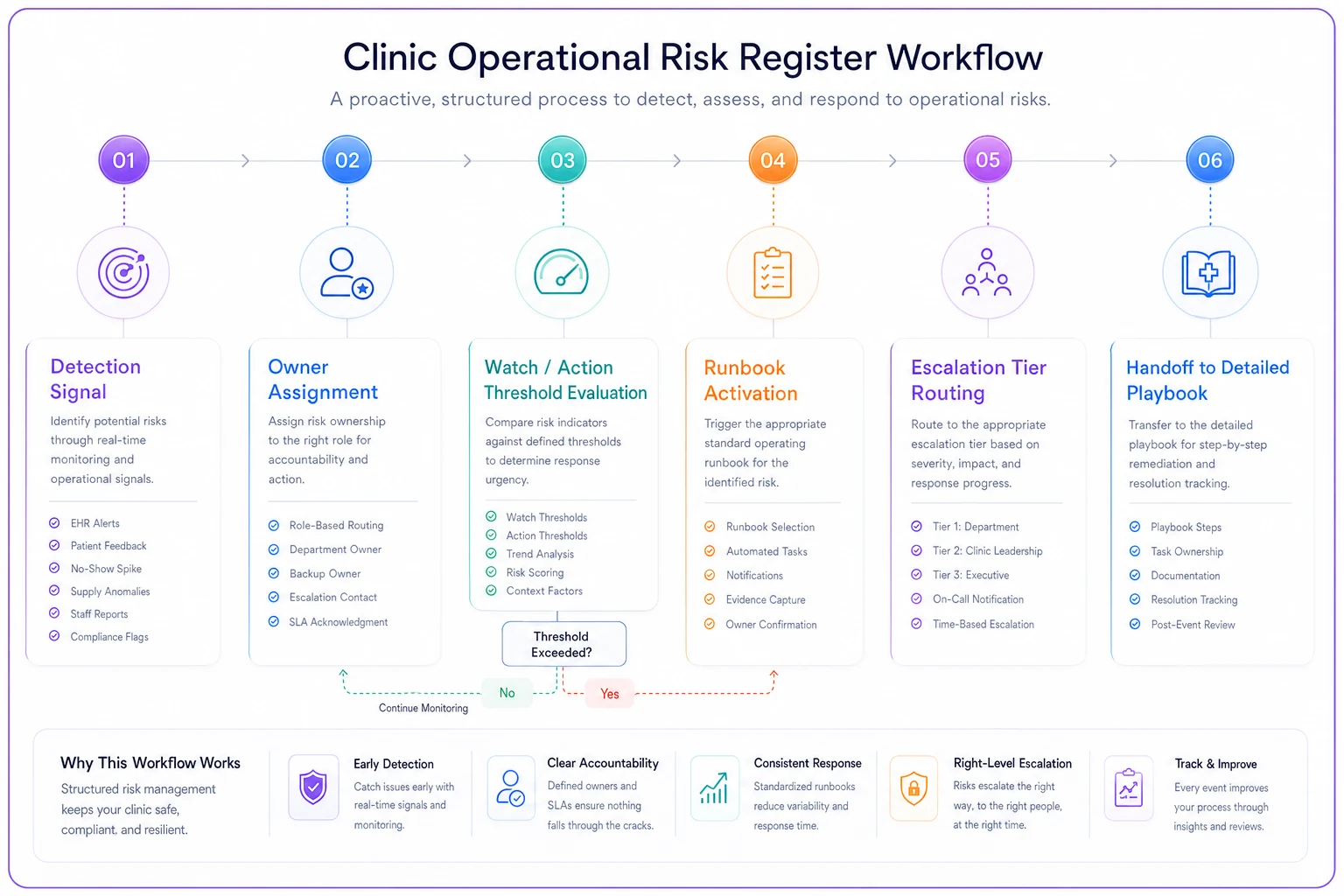
When the register points to the right playbook, the person receiving the alert can act immediately rather than trying to remember what worked before.
A real scenario: catching a denial trend before it compounded
A three-provider primary care clinic, roughly 330–360 visits a week, kept getting blindsided by denial waves. The pattern was always the same — billing would flag a problem near month-end, by which point three or four weeks of claims had gone out with the same error. A single coding or eligibility issue would quietly ride along on hundreds of claims before anyone caught it.
They built a lightweight register with exactly one well-instrumented entry to start: weekly denial rate, owned by the billing lead, with a watch threshold at 6% and an action threshold at 8% tied to a short runbook — pull reason codes, isolate the top driver, confirm whether it's coding or eligibility, loop in the relevant provider if it's documentation.
A few weeks in, the weekly rate ticked to around 7%. Under the action threshold but into the watch zone. The billing lead looked, found a specific modifier being dropped on a common visit type, and flagged it to the provider that same week. Instead of a month of claims going out wrong, the problem was caught in the first week.
Hard savings in any single instance were modest — somewhere in the low thousands of dollars of rework avoided. But the real shift was that denials stopped being a month-end surprise. Over a couple of quarters, the clinic's denial rate drifted down into the 4–5% range, not because they got dramatically better at coding, but because they started catching drift while it was still small. The register didn't fix denials — it shortened the time to notice them.
Where AI-assisted tooling fits (and where it doesn't)
The honest version: you can run a perfectly good risk register in a spreadsheet, and plenty of small clinics should start there. Don't buy software to avoid the thinking. Which risks, which thresholds, which owners — that's the part that matters, and no tool does it for you.
Where operational software earns its place is the detection and routing layer, once your catalog has more than a handful of live entries. Watching a dozen thresholds across billing, scheduling, intake, and auth queues by hand is exactly the kind of work that slips when the clinic gets busy — which is precisely when you most need the signals. AI-assisted monitoring helps here: detection queries run continuously against your operational data, flag the owner when a watch or action threshold trips, and route the escalation to the right tier automatically instead of relying on someone remembering to check a report.
The value isn't the automation itself. It's that early-warning signals keep firing on the clinic's worst days, when the people who'd normally notice are heads-down handling the chaos. A platform that centralizes the register, live metrics, and runbooks means the response doesn't depend on who happens to be in the building. But the structure has to come first — software amplifies a good register and does nothing for a bad one.
When this is worth building — and when it's overkill
Build a real register when: you've got multiple providers, more than one or two people touching billing and scheduling, or you're adding a location. The coordination problem is real at that scale and the register pays for itself the first time a signal reaches the right person early.
Keep it minimal when: you're a solo or two-person practice with tight feedback loops. You probably need three to five entries covering your genuinely painful risks — not a 40-row catalog that becomes a chore nobody maintains. A register you don't update is worse than no register, because people trust it and it's stale.
Don't bother at all if you're going to build it, print it, and never touch it again. The register is a living operations tool or it's wasted effort. If no one owns keeping it current, skip the exercise and just make sure your two or three worst risks have a named owner and a known response.
The real payoff
A clinic operational risk register works because it changes what happens in the first 30 minutes of a problem. Instead of figuring out who's responsible, what the plan is, and whether this is serious enough to escalate — all while the clock runs and the impact grows — the catalog has already answered those questions.
Start with your five worst risks. Give each one a detection signal you can actually check, a named owner, a two-threshold trigger, and a short runbook. Wire the escalation tiers so the "do we call the boss" question is already settled. Then add rows as you grow and as new risks reveal themselves. The goal isn't a complete catalog of everything that could go wrong — it's a short, maintained, owned list of the things that do go wrong, caught early enough to contain them cheaply.
A clinic operational risk register works because it changes what happens in the first 30 minutes of a problem. Instead of figuring out who's responsible, what the plan is, and whether this is serious enough to escalate — all while the clock runs and the impact grows — the catalog has already answered those questions.
Start with your five worst risks. Give each one a detection signal you can actually check, a named owner, a two-threshold trigger, and a short runbook. Wire the escalation tiers so the "do we call the boss" question is already settled. Then add rows as you grow and as new risks reveal themselves. The goal isn't a complete catalog of everything that could go wrong — it's a short, maintained, owned list of the things that do go wrong, caught early enough to contain them cheaply.
Ready to transform your practice workflow?
Join 2,000+ healthcare providers using GoCliny to increase efficiency, improve patient satisfaction, and grow revenue.