


Opening a new clinic site rarely fails because of the clinical side. The exam rooms get built, equipment shows up, providers are solid. What breaks is everything in the gap between "we signed the lease" and "we're actually getting paid for the work we're doing." That gap is where new sites quietly bleed cash — and most of the damage is self-inflicted. Not because anyone was careless, but because the launch was sequenced in the wrong order.
The core problem is that clinic launches get planned forward. You pick an open date, then work toward it: build-out, hire, order supplies, flip the sign on. But revenue doesn't care about your open date. Revenue cares about whether providers are credentialed with payers, whether billing is submitting clean claims, and whether you have enough runway to survive the lag between seeing patients and actually collecting on those visits. When you plan forward, those things become afterthoughts. When you plan backward from the first dollar collected, they become the spine of the whole project.
This is a systems article, not a to-do list. The point is to show how launch pieces connect — and where they snap under pressure when a site scales faster than its back office can handle.
Why "open date" is the wrong anchor
The open date feels like the finish line, so the entire team orients around it. Marketing promotes it. Providers block their calendars for it. The front desk gets trained for it. Everyone's proud when the doors open on schedule.
Then week three arrives and nobody's been paid.
This usually happens because credentialing was treated as a parallel task instead of a gating one. Payer enrollment for a new provider or a new location tax ID can take anywhere from 60 to 150 days depending on the payer and state. If you opened 45 days after submitting enrollment, you're now seeing patients you can't bill — or you're holding claims hoping retro-effective dates line up. Sometimes they do. Often they don't, and you eat the write-off.
The fix is to stop treating the open date as the anchor. The real anchor is first clean payment received. Everything else gets scheduled backward from that point. When you flip the mental model, credentialing stops being "something HR is handling" and becomes the thing that literally determines when you can open without losing money.
Build the calendar backward from revenue, not forward from the lease
A backwards-timed launch calendar starts at the end state — steady collections — and works in reverse, with each milestone mapped to a revenue KPI it either protects or unlocks. This isn't about adding more tasks. It's about forcing the sequence to respect the money timeline instead of the construction timeline.
Eliminate appointment gaps and no-shows.
GoCliny streamlines every patient interaction from booking to billing—seamlessly.
- Unified appointment scheduling
- Automated patient reminders
- Staff calendar & task management
No credit card required
A rough version looks like this:
| Weeks before "first clean payment" | Milestone | Revenue KPI it protects |
|---|---|---|
| ~20 weeks | Submit payer enrollment + new location NPI/tax ID setup | Days-to-first-billable-claim |
| ~16 weeks | Finalize fee schedule, load contracts into billing system | Clean claim rate |
| ~12 weeks | Billing system test claims (dummy submissions per payer) | First-pass acceptance rate |
| ~10 weeks | Hire + onboard front desk and MA roles | Point-of-care collection rate |
| ~8 weeks | Credentialing verification checkpoint (go/no-go) | Billable provider-days available |
| ~6 weeks | Soft-launch scheduling (low volume, known-good payers) | Cash conversion lag |
| ~2 weeks | Full schedule open | Visit volume vs. forecast |
| Week 0 | First clean payment received | Collections ramp |
The week counts shift by specialty and payer mix — don't treat them as fixed. The point is that each milestone is tied to a number, and if you miss the milestone, you know exactly which number is about to get hit. A delayed credentialing checkpoint doesn't just mean "we're behind." It means billable provider-days are about to go negative and your cash conversion lag is about to stretch.
Below is a workflow diagram showing the backward-timed launch sequence.
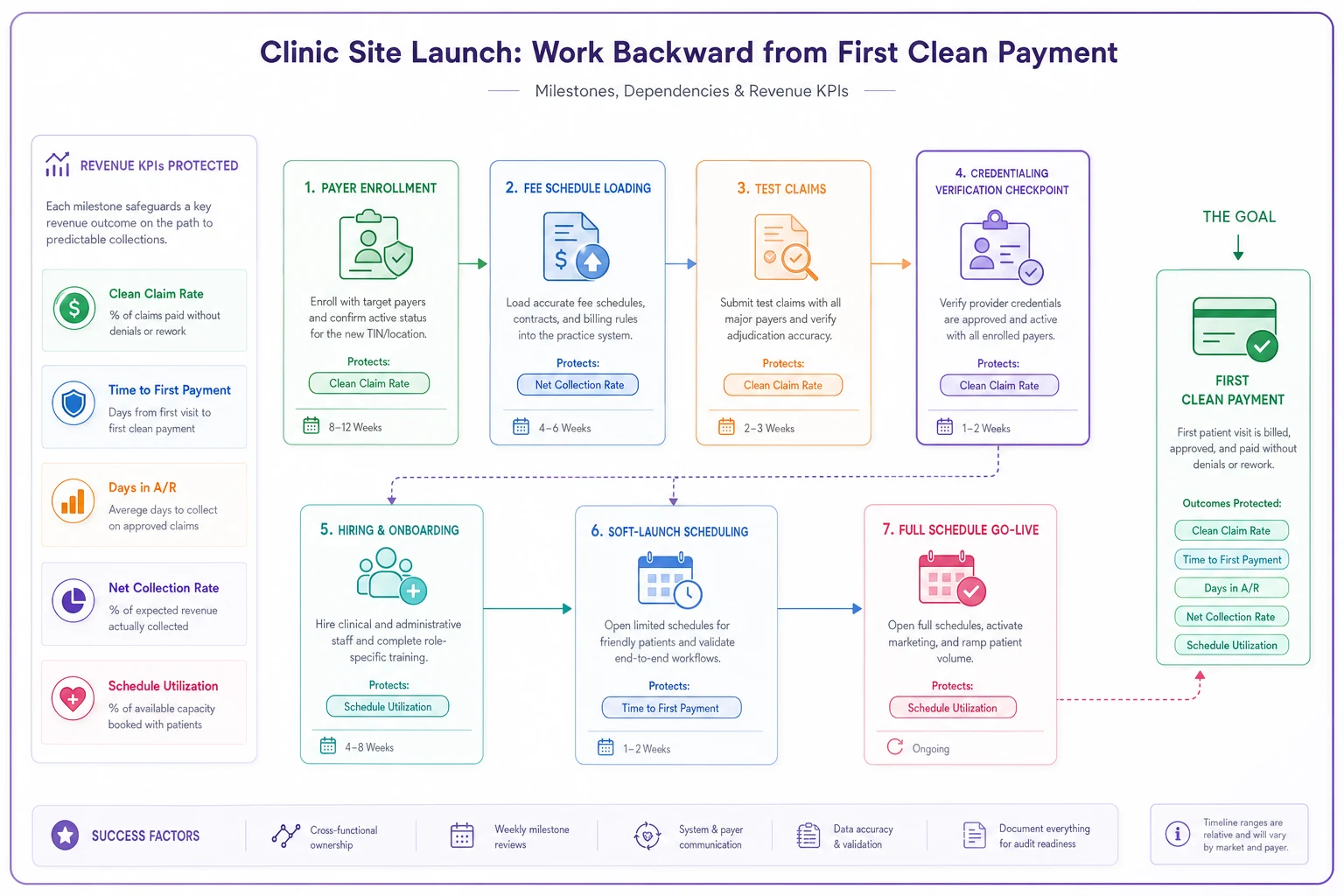
If you haven't modeled what that collection ramp actually looks like for your payer mix, do that before you set any dates at all. A solid clinic revenue forecasting model for payer mix and seasonality tells you how steep the ramp is and how long you're underwater — which is the entire reason the backward calendar exists.
Credentialing and billing readiness gates
A gate is different from a task. A task gets checked off. A gate stops the launch if it isn't met. New sites get into trouble when credentialing and billing readiness are tracked as tasks — green checkmarks on a project board — instead of hard stops that block the open date.
Here's what actually goes wrong. The provider is "credentialed" according to the spreadsheet, but credentialed means different things to different payers. Sometimes it means the application was submitted. Sometimes it means approved but not yet loaded in the payer's claims system. Sometimes it means approved at the group level but not linked to the new location's tax ID. All three show up as "done" if nobody defines the gate precisely.
A real credentialing gate answers one question: can we submit a claim for this provider, at this location, to this payer, and get paid? Not "did we submit the application." If the answer isn't yes for your top payers by volume, the gate is closed — regardless of what the project board says.
The billing readiness gate people skip
The one almost everyone skips is the test claim gate. Before you open, you submit a handful of real-structure test claims — correct provider, correct location, correct codes — to each major payer and confirm they come back accepted. This catches problems that credentialing status alone hides: tax ID mismatches, fee schedule errors, NPI linkage gaps, place-of-service code issues for a new address.
Picture this: a two-provider site opens, credentialing shows approved across the board, patients start flowing. Four weeks in, it turns out the largest commercial payer has the new location linked to the wrong NPI, and every claim from that payer has been rejecting. That's four weeks of visits — easily 200-plus claims — now stuck in rework, and the cash that was supposed to arrive in week six shows up closer to week ten or later. A single morning of test claims would have caught it before it compounded.
Staffing and float-pool rules for a ramping site
New sites have a staffing paradox. On day one you have very few patients and too much staff. By week eight, if demand hits forecast, you're short. Staff for week eight on day one and you're burning payroll against near-zero revenue during the exact weeks your cash is tightest. Staff for day one and you're underwater on coverage the moment volume arrives.
The way out is to treat early-stage staffing as a float problem, not a hiring problem. Instead of fully staffing the new site from the start, you lean on cross-trained floaters from existing sites to cover the ramp, converting to dedicated hires only as volume justifies it. That keeps payroll elastic during the riskiest cash period.
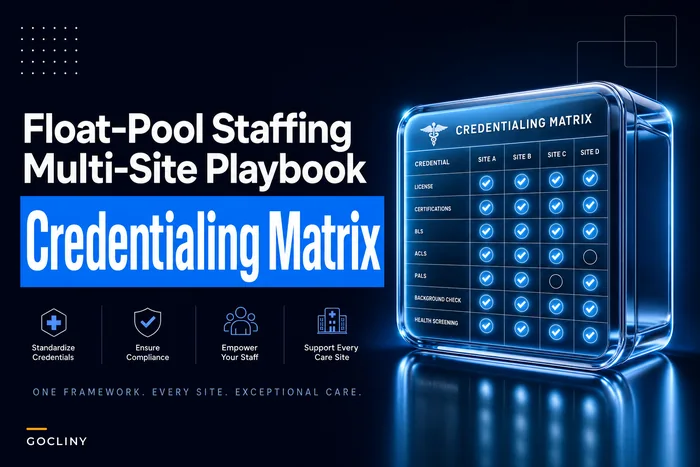
This only works if the float infrastructure already exists. If your floaters aren't credentialed across sites or trained on the new location's workflows, you can't actually move them. The mechanics of making that work — cross-site credentialing, shift-fill priority, training reciprocity — are their own discipline, covered in depth in the float-pool staffing playbook for multi-site clinics. For a launch, the key rule is straightforward: a new site shouldn't stand up a full dedicated team until it crosses a defined volume threshold. Before that, it borrows capacity.
-
Define a volume trigger (e.g., sustained daily visits above a set number for two consecutive weeks) before converting a floated role to a dedicated hire.
-
Keep at least one experienced floater on-site during the first two weeks, regardless of volume, to catch workflow breaks early.
-
Never float your newest employees into a brand-new site — new site plus new employee is two unknowns stacked on each other.
-
Build the fallback explicitly
if the dedicated hire falls through, which site loses a floater to cover, and for how long.
Prioritize cross-site credentialing for floaters before launch so they can actually cover shifts when needed.
The onboarding timeline for whoever lands at the new site permanently matters too. A site that opens with half-trained staff generates its own revenue leaks — missed charges, botched collections, rescheduling chaos. A structured 30/60/90 onboarding system with competency SLAs keeps the new team from drifting during the period when nobody has bandwidth to closely supervise them.
The vendor handoff checklist
Launches have a surprising number of vendor dependencies, and failures almost always happen at the seams between vendors — not inside any single one. The EHR vendor finishes their part. The clearinghouse finishes theirs. The payer portal is set up. But nobody confirmed the data actually flows end to end: EHR → clearinghouse → payer → remittance back → posted in your system.
Each vendor will tell you their piece is "live." That's not the same as the chain working. The handoff checklist confirms the connections, not the components.
-
EHR New location configured, provider schedules built, place-of-service codes correct, templates loaded.
-
Clearinghouse New tax ID and NPIs registered, payer connections active, test claim submitted and accepted.
-
Payers Enrollment confirmed at the claims-system level (not just the approval letter), electronic remittance (ERA) enrollment complete so payments post automatically.
-
Payment processing Card-on-file and point-of-care collection hardware live and tested with a real transaction.
-
Patient communication tools Reminders, confirmations, and intake forms tied to the new location, tested with a dummy patient.
-
Phones/scheduling Calls route correctly, online scheduling points to the right calendar, after-hours handling defined.
The checkpoint that catches the most problems is ERA enrollment. If electronic remittance isn't set up, payments land but don't auto-post, and your team ends up manually reconciling during the exact weeks they're slammed with a new-site ramp. That's how a site looks like it's "not collecting" when the money is actually sitting unapplied in a remittance queue somewhere.
A 30/60/90 stabilization plan tied to cash preservation
The first 90 days are not about optimization. They're about survival and reading signals early enough to react. A new site burns cash before it generates it — that's just the math of the collection lag — so the stabilization plan should be organized around protecting runway, not chasing growth targets.
-
Days 1–30 — Protect the claim pipeline. The single job of month one is making sure claims go out clean and come back accepted. Watch first-pass acceptance rate daily. Any payer rejecting more than a small fraction of claims is a fire — stop and fix the root cause before volume compounds it. Keep staffing lean and floated. Don't open the full schedule; keep volume low enough that errors are still catchable.
-
Days 31–60 — Watch the cash conversion lag. Claims are flowing by now, so the question becomes: how long from visit to cash? If your forecast assumed collections start arriving around day 45 and they're not, you need to know why now, not at day 90. This is also when you evaluate the first float-to-dedicated conversion decision based on actual volume versus forecast.
-
Days 61–90 — Stabilize to steady state. Volume should be approaching the forecast curve, collections should be ramping, and you're converting borrowed capacity to dedicated staff where justified. This is also where you formally review the launch against the backward calendar: which gates slipped, what did it cost, and what gets fixed before the next site.
What makes this work is reviewing cash position weekly during these 90 days, not monthly. Monthly reviews are too slow when you're underwater — by the time the month-end report surfaces the problem, you've burned four more weeks of runway.
A real scenario
A small orthopedics-adjacent practice opened their second location. Build-out finished on time, both new providers were "credentialed" per the project board, and they opened the full schedule on day one because demand from the existing site was strong.
The problem surfaced around week five. Their two biggest commercial payers hadn't linked the new location's tax ID in their claims systems yet — approval letters existed, but claims were rejecting. Because they'd opened at full volume, they had roughly 300 visits' worth of claims stuck when they discovered it. Cash that should have started arriving around day 45 didn't meaningfully show up until closer to day 80. They covered the gap with a line of credit they hadn't planned to touch — an unplanned five-figure draw, plus the interest and the stress that comes with it.
When they opened their third site, they ran it backward. Test claims to every major payer before opening. A real credentialing gate defined as "can we get paid," not "did we apply." A soft launch at low volume for the first two weeks using floated staff instead of a full dedicated team. The collection ramp still lagged — that's unavoidable — but it lagged on schedule, which meant they'd budgeted for it. No surprise credit draw, no 300-claim rework pile. Same practice, same payers, completely different cash experience. The only thing that changed was the order of operations.
When this level of rigor makes sense — and when it doesn't
A full backward-timed, gated launch playbook is worth the effort when you're opening a location with its own tax ID, new provider enrollments, or a meaningfully different payer mix. Those are the situations where credentialing lag and cash timing can genuinely threaten the business.
It's overkill if you're adding a provider to an existing location that's already credentialed and billing cleanly — the gates mostly collapse into a single enrollment task. And it's the wrong tool if your constraint isn't launch sequencing at all but something structural, like a payer contract that doesn't cover your costs or a billing operation that already leaks. Fix the leaking bucket before you pour a second site into it. A new location will only scale whatever problems you already have.
Bringing it together
A clinic site launch is a coordination problem wearing a construction problem's clothes. The visible work — the build-out, the hiring, the signage — runs on one timeline. The money runs on a completely different one, driven by credentialing lag, claim acceptance, and collection conversion.
Plan forward from the open date and those two timelines drift apart, turning the gap into a cash shock. Plan backward from first clean payment and the money timeline sets the pace, with everything else falling in line behind it. That reordering is the whole idea.
The sites that survive their first 90 days aren't the ones with the nicest build-outs. They're the ones where credentialing was a gate instead of a checkbox, staffing stayed elastic through the ramp, the vendor chain was tested end to end, and someone was watching cash weekly instead of waiting for the monthly report. None of that is glamorous. All of it is the difference between a launch that compounds your practice and one that quietly drains it.
A clinic site launch is a coordination problem wearing a construction problem's clothes. The visible work — the build-out, the hiring, the signage — runs on one timeline. The money runs on a completely different one, driven by credentialing lag, claim acceptance, and collection conversion.
Plan forward from the open date and those two timelines drift apart, turning the gap into a cash shock. Plan backward from first clean payment and the money timeline sets the pace, with everything else falling in line behind it. That reordering is the whole idea.
The sites that survive their first 90 days aren't the ones with the nicest build-outs. They're the ones where credentialing was a gate instead of a checkbox, staffing stayed elastic through the ramp, the vendor chain was tested end to end, and someone was watching cash weekly instead of waiting for the monthly report. None of that is glamorous. All of it is the difference between a launch that compounds your practice and one that quietly drains it.
Ready to transform your practice workflow?
Join 2,000+ healthcare providers using GoCliny to increase efficiency, improve patient satisfaction, and grow revenue.