


The moment a clinic adds a second location, something quietly changes that nobody writes down: decisions that used to happen in a hallway now have to travel. A front-desk lead who used to walk twenty feet to ask the office manager about a refund now sends a message that sits unread for six hours. A provider who used to flex the schedule on a busy Tuesday now waits for "corporate" to approve a change that'll be irrelevant by Thursday.
Growth rarely breaks because of clinical quality. It breaks because nobody agreed on who owns which decision, and the authority map that worked fine with one site turns into a fog machine at three or four. This post is about building the actual governance layer — decision rights, funding and exception rules, escalation ladders, and the KPIs that keep it honest. Not governance theory. The drop-in version.
A multi-site clinic governance framework isn't an org chart with nicer boxes. It's a system that answers, in writing, three questions for every recurring decision: who decides, who gets consulted, and what happens when the normal path doesn't work.
Why decision rights blur the second you scale
Single-site clinics run on proximity and memory. Everyone knows that Dana approves comped visits, that the senior provider overrides the schedule when things get weird, and that anything involving real money goes to the owner. None of it is documented because none of it needs to be.
Then a second site opens, often staffed by people who've never worked with Dana. They inherit the outcomes of the old rules without the context. So they improvise. One site starts comping visits generously because the new manager is conflict-averse; another refuses almost everything because the manager is protective of revenue. Same company, two completely different patient experiences — and leadership doesn't notice until a patient complains about being treated differently at two locations.
This is the core problem: decision authority that lives in people's heads doesn't replicate — it mutates. Every new site becomes a slightly distorted copy, and the distortions compound. By site four you're not running one clinic four times. You're running four clinics that happen to share a logo.
-
Spending authority. Who can buy supplies, approve overtime, or bring on a new vendor without asking?
-
Schedule changes. Who can block a provider's calendar, add a session, or move a template?
-
Patient exceptions. Refunds, write-offs, payment plans outside policy, priority scheduling for a frustrated patient.
-
Staffing moves. Who approves a float, a shift swap across sites, a last-minute coverage ask?
-
Policy deviations. The "just this once" decisions that quietly become precedent.
None of these are dramatic on their own. The damage is cumulative — a slow buildup of inconsistency that nobody can trace back to a single bad call.
Start with an operational RACI, but make it decision-based
Most RACI charts fail in clinics because they're built around tasks ("post payments," "confirm appointments") instead of decisions. Tasks tell you who does the work. They don't tell you who gets to say yes when something is ambiguous — and ambiguity is where multi-site operations leak.
Eliminate appointment gaps and no-shows.
GoCliny streamlines every patient interaction from booking to billing—seamlessly.
- Unified appointment scheduling
- Automated patient reminders
- Staff calendar & task management
No credit card required
-
Responsible — the person who actually executes the decision
-
Accountable — the single person who owns the outcome (only ever one)
-
Consulted — who must be asked before the decision is final
-
Informed — who needs to know after
Here's a trimmed example of a decision-based RACI for a four-site primary care group:
| Decision | Responsible | Accountable | Consulted | Informed |
|---|---|---|---|---|
| Refund under $150 | Site front-desk lead | Site manager | — | Regional billing |
| Refund $150–$500 | Site manager | Regional manager | Billing lead | Owner |
| Provider schedule template change | Site manager | Regional manager | Affected provider | Scheduling team |
| Same-day overtime approval | Site manager | Site manager | — | Regional manager |
| New recurring vendor | Regional manager | Owner/CFO | Site manager | Finance |
| Comp/write-off of visit | Site manager | Regional manager | Billing lead | Owner |
| Cross-site float request | Float coordinator | Regional manager | Both site managers | Scheduling |
The most important column is Accountable, and the most common mistake is putting two names in it. If two people are accountable, nobody is. When a decision goes sideways, you want exactly one person who should have caught it.
Notice how refunds split by dollar threshold. That's deliberate. Thresholds are what let you push authority down to the site level for routine stuff while keeping the risky decisions visible. A site manager who can approve a $90 refund without waiting on anyone handles 90% of cases instantly. The 10% that actually need a second look escalate cleanly.
Funding charters: who can spend what, without asking
Decision rights mean nothing if money still routes through one bottleneck. In most struggling multi-site groups, the owner is still personally approving supply orders for every location — which feels responsible but guarantees delays, stockouts, and resentful managers.
A funding charter is a short document per role that states spending authority in plain numbers. It should cover:
-
A hard dollar limit per transaction a role can approve alone
-
A monthly aggregate limit (so nobody splits a $2,000 purchase into fifteen $140 ones)
-
Categories that are always pre-approved (routine consumables, standard cleaning supplies)
-
Categories that always require escalation regardless of amount (capital equipment, anything with a contract, anything touching PHI systems)
A realistic charter for a site manager might read: approve up to $500 per transaction and $4,000 per month on pre-approved operating categories; anything involving a contract, a new vendor, or clinical equipment escalates to regional regardless of cost.
One pattern worth internalizing: tie spending authority to the cost of the delay, not just the cost of the purchase.
Tie spending authority to the cost of the delay, not just the cost of the purchase.
A $200 printer repair that halts check-in for a day costs far more than $200. The charter should let the site fix it on the spot. A $200 "trial" of a new software tool, on the other hand, can create a contract and a security liability — that escalates even at the same dollar amount. Dollar limits alone are a blunt instrument; category rules give them precision.
Exception charters: the part everyone forgets
The normal-path rules almost run themselves once they're set. The entire framework lives or dies on how you handle exceptions, because exceptions are where staff either feel empowered or feel punished for using judgment.
An exception charter answers: what happens when the standard answer is wrong for this specific situation?
Without one, you get two failure modes. In rigid clinics, staff follow the rule even when it clearly harms the patient, then defend themselves with "that's the policy." In loose clinics, everyone makes their own exceptions and consistency evaporates. Neither is governance.
A workable exception charter has four parts:
-
Who can grant an exception at each level, and up to what magnitude
-
What must be documented when an exception is granted (one line is fine — reason, decision, who approved)
-
A review trigger — if the same exception gets requested more than X times, the underlying rule gets revisited
-
A no-blame clause for exceptions made in good faith within someone's granted authority
That last point matters more than it looks. If staff get burned for making a reasonable exception, they stop making them and start escalating everything — which clogs the ladder you just built. Governance that punishes judgment trains people to stop thinking.
The review trigger is where most of the real value sits. When your refund exception gets requested eleven times in a month for the same reason, that's not eleven exceptions — that's a broken policy telling you to fix it. Exceptions are data. Most clinics throw that data away.
Escalation ladders that actually resolve things
Escalation paths fail for a boring reason: they tell you who to escalate to but not how long you wait or what happens if that person is unavailable. So a patient complaint escalates to a regional manager who's in meetings all day, and it just sits.
A good escalation ladder has three things at every rung: a named role (not a person), a time window, and a fallback if that role doesn't respond in time.
Here's a sample ladder for a patient-facing service issue across sites:
-
Front-desk lead resolves if within authority. Window
immediate.
-
If not resolvable → Site manager. Window
same business day. Fallback: regional manager if site manager is out.
-
If financial impact exceeds site authority or involves a clinical concern → Regional manager. Window: next business day. Fallback: operations director.
-
If it involves legal, licensing, or a safety event → Operations director / owner immediately, no waiting on lower rungs.
And a parallel ladder for operational disruptions (system down, staffing gap, supply crisis):
-
On-site staff attempts documented workaround. Window
30 minutes.
-
→ Site manager coordinates. Window
1 hour.
-
→ Regional manager pulls cross-site resources. Window
2 hours.
-
→ Operations director if more than one site is affected or care is at risk.
The time windows are what separate a real ladder from a wall diagram. They create accountability without requiring anyone to hover. If a rung blows its window, the fallback activates automatically — the issue never gets stranded because one person was busy.
This connects directly to how cross-site staffing gets coordinated. If your escalation ladder says "regional manager pulls cross-site resources," that only works if the mechanics underneath it exist — which is exactly the kind of thing a float-pool staffing system with cross-site credentialing and shift-fill priority rules is built to support. Governance and logistics have to agree with each other or the ladder is just aspirational.
Making governance measurable: KPIs tied to access and revenue
A governance framework nobody measures quietly decays back into hallway improvisation. The fix is a small set of KPIs that tell you whether the decision rights are working — not whether people like them.
The trap is measuring governance for its own sake ("exceptions logged this month"). Tie your governance metrics to the two things that actually matter to a clinic: access and revenue.
A practical governance scorecard:
| KPI | What it tells you | Healthy signal |
|---|---|---|
| Avg. decision resolution time by rung | Is the ladder flowing or clogging | Most decisions resolve at the lowest rung, fast |
| % of decisions escalated unnecessarily | Are authority limits set too low | Trending down over time |
| Exception rate by category | Which rules are secretly broken | Stable or declining; spikes get reviewed |
| Cross-site variance on comps/refunds | Are sites applying rules consistently | Sites cluster within a tight band |
| Revenue leakage from unauthorized write-offs | Is spending authority holding | Near zero outside charter limits |
| Access delay from pending approvals | Is governance slowing patient care | Minimal schedule holds waiting on sign-off |
The most revealing metric here is cross-site variance. When Site A comps visits at three times the rate of Site B, that's not a personality difference — it's a sign the rule isn't clear enough to replicate, or the authority limits are mismatched. Variance is the earliest warning that your framework is mutating as it scales.
Getting these numbers reliably means your data has to come from somewhere trustworthy. If each site reports comps differently or defines "exception" differently, your scorecard is noise. This is where a disciplined KPI taxonomy with clear owner matrices and validation checks stops being optional and becomes the foundation the whole governance layer sits on.
A real scenario: four sites, one fuzzy authority map
A regional dental group — four offices, roughly 55 staff — had grown from a single practice over three years. Clinically excellent. Operationally, decisions were a mess. Every refund over fifty dollars, every overtime approval, and every supply order above a token amount routed to the owner's phone. She was fielding somewhere around 40–50 approval pings a day across all sites.
Two things were quietly bleeding money. First, delays: supply reorders waited on approval, so one site ran short on a common consumable twice in a quarter and had to reschedule patients. Second, inconsistency: one office manager, tired of waiting, had started writing off small balances to avoid friction — somewhere in the $2k–$3k range over a few months that nobody had authorized.
They built a decision-based RACI and funding charters over about two weeks. Site managers got a $400 single-transaction limit on pre-approved categories, authority over same-day overtime, and refund authority up to $150. Anything above those thresholds followed a three-rung escalation ladder with same-day windows.
The owner's daily approval pings dropped to a handful — the ones that genuinely needed her. Supply-driven reschedules stopped. The unauthorized write-offs surfaced in the first cross-site variance review, got addressed, and the refund policy was tightened with a documented exception path so managers stopped freelancing. Revenue didn't spike overnight. What changed was that the operation stopped leaking in a dozen small, invisible ways — and the owner got her attention back.
When this makes sense — and when it's overkill
When a governance framework is worth it: you're running two or more sites, or you're about to open a second. The moment you can't resolve a decision by walking across the room, you need the authority map written down. It's also worth building when sites are already diverging — different patient experiences, different financial behavior, different interpretations of the same rule.
When it's overkill: a single site with a tight team that genuinely knows the rules. Formalizing a full RACI and escalation ladder for eight people in one building adds bureaucracy without solving anything real. Don't build governance for scale you don't have yet — but do write down the authority rules before you open site two, because retrofitting is far harder than drafting.
Who should not roll this out cold: any group in the middle of a chaotic period — a system migration, heavy turnover, a billing crisis. Governance changes are change-management projects, and dropping a new authority map on an already-stressed team usually gets ignored or resented. Stabilize first, then layer in governance deliberately. If you've struggled to make operational changes stick before, the mechanics in a proper change-management system with 30/60/90 adoption roadmaps and reinforcement loops matter more than the framework document itself.
Dropping it in: a short rollout sequence
You don't need a six-month project. A focused rollout looks roughly like this:
-
List your top 15–20 recurring decisions that carry money, access, or risk. Don't aim for completeness — aim for the ones causing actual friction today.
-
Assign one accountable owner per decision. If you can't name a single person, that decision is already broken.
-
Set dollar and category thresholds for spending authority at each level. Push routine authority down; keep contracts and clinical equipment up.
-
Write the exception charter — who can deviate, what gets documented, when a rule gets reviewed.
-
Build two escalation ladders (patient-facing and operational) with named roles, time windows, and fallbacks.
-
Pick five governance KPIs and attach them to access and revenue, not activity counts.
-
Pilot at one site for 30 days, adjust the thresholds causing the most back-and-forth, then standardize across sites.
The adjustment step is where most of the real value hides. Your first thresholds will be wrong — too tight somewhere, too loose somewhere else. The pilot exists to find those, not to prove the framework is perfect.
Visual workflow of the rollout sequence:
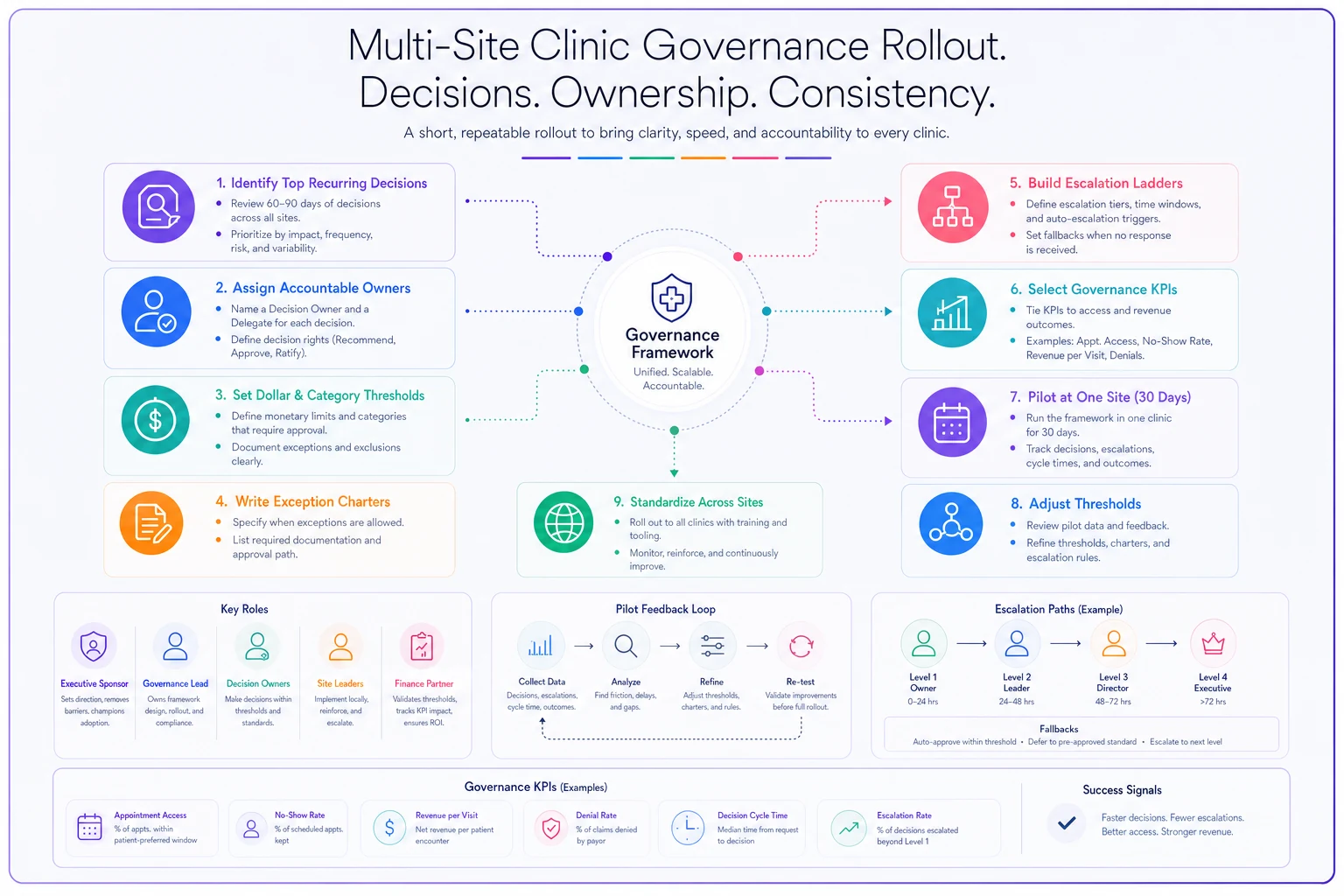
Pilot at one site for 30 days, adjust the thresholds causing the most back-and-forth, then standardize across sites.
The point of all of this
Governance in a multi-site clinic isn't about control. It's about letting good people make fast, consistent decisions without waiting on someone who's three rungs away and buried. The clinics that scale cleanly aren't the ones with the strictest rules — they're the ones where everyone knows exactly which decisions are theirs to make and exactly what to do when they hit the edge of their authority.
A written multi-site clinic governance framework turns the thing that usually breaks — distributed judgment — into the thing that makes you faster than competitors still routing every refund through one overloaded phone. Start with the decisions you already argue about most. Those are the ones costing you quietly, and they're the easiest to fix first.
Ready to transform your practice workflow?
Join 2,000+ healthcare providers using GoCliny to increase efficiency, improve patient satisfaction, and grow revenue.