

Most clinics don't fail at change because the idea was bad. They fail because the rollout had no owner after the kickoff meeting, no real way to tell if anyone actually adopted it, and no plan for week three when the energy wears off and everyone drifts back to what they were doing before.
A practice buys a new scheduling rule, a new intake form, a new collections script — and for about ten days it works. Then a provider calls out sick, the front desk gets buried on a Monday morning, and someone falls back on the old workaround because it's faster right now. Nobody decides to abandon the change. It just erodes. By day 30 the clinic is running the old process with a new tool sitting untouched.
A real clinic change management system isn't a memo or a lunch-and-learn. It's an operational structure with readiness gates, adoption milestones, coaching that actually happens, and metrics that connect behavior back to revenue and patient access. What follows is the version that survives contact with a busy clinic floor.
Why change dies in small practices specifically
Big health systems have change-management departments. Small and mid-size practices have a manager already doing three jobs, plus whoever happened to be in the room when the decision got made.
That structural gap is the root cause of most failed rollouts. When nobody explicitly owns adoption, it becomes everybody's problem — which means it's nobody's problem. The new workflow competes against muscle memory, and muscle memory wins by default.
There's a second issue that's easy to overlook. Small clinics push every change through the same five people. The front desk lead, the billing person, one or two providers, the office manager. When you load a change onto people already at capacity, and that change adds even ten minutes of friction per day during the learning curve, they'll drop it — not out of resistance, but out of survival.
A typical example: a practice rolls out a point-of-care collections script. Week one, collections tick up. Week two, a provider runs behind, the front desk skips the script to keep the line moving, and within a month the script only gets used "when there's time," which is never. The change didn't fail because it was wrong. It failed because there was no reinforcement layer holding it in place under pressure.
The four phases that actually hold change together
Before the milestones and scripts, it helps to see the full arc. A change that sticks moves through four operational phases, and skipping any one of them is where clinics lose the thread.
Eliminate appointment gaps and no-shows.
GoCliny streamlines every patient interaction from booking to billing—seamlessly.
- Unified appointment scheduling
- Automated patient reminders
- Staff calendar & task management
No credit card required
| Phase | What it's for | What breaks if you skip it |
|---|---|---|
| Pre-launch readiness | Confirm the change is possible before you ask people to do it | Staff hit blockers on day one and lose trust immediately |
| Launch + first 30 days | Establish the new behavior as the default | People "try it" but never fully switch |
| 30–60 day reinforcement | Catch drift while it's still small | The workaround quietly becomes the real process |
| 60–90 day stabilization | Make the new way the only way, then measure impact | You can't tell if the change actually did anything |
Most clinics do a version of phase two — a kickoff, some training — and nothing else. The readiness work before and the reinforcement work after are where adoption is actually won or lost.
Here's a simple visual to keep the phases and checkpoints clear.
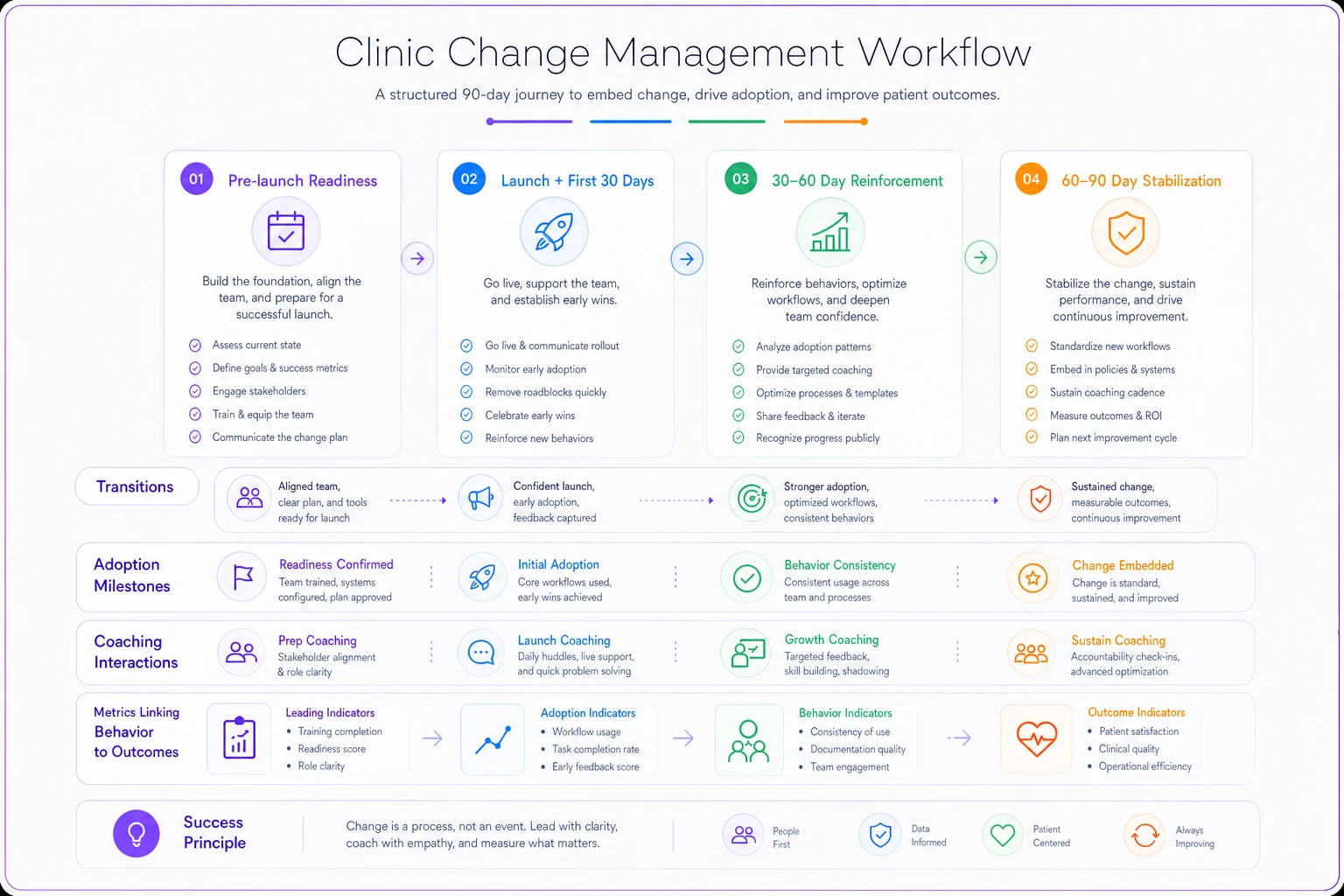
The readiness work before and the reinforcement work after are where adoption is actually won or lost.
Pre-launch readiness: the gate before you announce anything
The biggest mistake in clinic change is announcing before you're ready. The moment you tell staff "starting Monday we're doing X," you've spent credibility. If Monday arrives and the form isn't built, the EHR field isn't configured, or nobody trained the fill-in receptionist, you don't get that trust back easily.
-
Ownership is assigned. One named person owns adoption — not the change itself, but whether people are actually doing it at day 30, 60, and 90.
-
The workflow is documented in plain language. Not a policy paragraph. The actual step-by-step, including what to do when the exception happens.
-
The tooling is built and tested. Whatever field, template, or trigger the change relies on already exists and someone has run a real transaction through it.
-
The "why" ties to something staff care about. Fewer denials, shorter lines, less rework — not "leadership wants this."
-
A fallback is defined. What do staff do when the new process can't be followed? If the only fallback is "revert to old way," you've guaranteed drift.
-
Baseline metrics are captured. You cannot prove a change worked if you never measured before. Get the numbers you'll compare against later.
-
Coverage is planned. Who runs the new process when the trained person is out? Rollouts that only live in one person's head die the first time that person takes PTO.
The baseline point deserves emphasis. Practices constantly launch changes and then argue three months later about whether it helped. If you capture your current collection rate, no-show percentage, or claim rework volume before you start, the debate ends. This connects directly to having a clean measurement layer — which is why a defined monthly operational dashboard that triggers actions makes change management dramatically easier. You're not scrambling to find numbers; they're already tracked.
The 30/60/90 adoption roadmap
Onboarding new staff and adopting new processes follow the same rhythm — establish, correct, stabilize. If you already run a structured 30/60/90 competency system for onboarding, this will feel familiar, because the same cadence that trains a person also trains a behavior.
-
Day 0–30
Establish the default.
The goal isn't perfection, it's usage. You want the new process happening most of the time, even if it's slow. Measure frequency of use, not quality yet. Target somewhere around 70–80% adoption. Anything lower means there's a blocker you haven't found. Daily quick check-ins the first week, then twice weekly after that. -
Day 30–60
Correct the drift.
This is when workarounds surface. Now you measure consistency and quality — is the process being followed correctly, including on busy days and when the backup covers? Target 85–90% adoption with the error rate dropping. This phase is mostly coaching, which is why the scripts below matter. -
Day 60–90
Stabilize and prove impact.
Adoption should be at 90%+ and stable enough that you're not actively pushing it anymore. Now compare against your baseline. Did denials drop? Did collections improve? Did access open up? If adoption is high but the metric didn't move, the change itself was wrong — and that's genuinely useful information, not a failure.
One thing people miss: the 30-day and 60-day checks measure different things on purpose. Early on, punishing quality kills momentum — you want people trying. Later, tolerating sloppiness lets the process rot. The metric has to evolve or you'll either crush adoption early or ignore erosion late.
Manager coaching scripts that don't feel like surveillance
Coaching is where change management usually collapses in small practices, because the manager is uncomfortable and staff feel policed. The fix is keeping the conversation focused on the process, not the person.
When someone skipped the new process (first 30 days): > "I noticed the new intake step didn't happen on a couple of yesterday's check-ins. I'm not worried about it — I just want to know what got in the way. Was it a time thing, a system thing, or is the step itself awkward?" That last question matters most. Half the time staff skip a step because the step is badly designed, not because they're being difficult. If you don't ask, you'll coach the person when you should be fixing the workflow.
When drift shows up around day 45: > "This was going really well for the first few weeks and I've seen it slip a bit when we get busy. That tells me the process might be too heavy for peak times. Walk me through what a slammed Monday looks like — where does it break?"
When someone's doing it well: > "You've been consistent with the new collections script even on the rough days — that's exactly what makes this stick for everyone. Would you be willing to show the new front-desk hire how you handle it when there's a line?" That third one is underrated. Turning your best adopter into a peer trainer does more for stabilization than any manager reminder, because it moves the process into the culture rather than keeping it top-down.
Reinforcement rituals: the part everyone forgets
Reinforcement is the difference between a change that lasts three weeks and one that lasts three years. It's also the cheapest part of this whole system, which makes it ironic that it's the part most often skipped.
-
A 5-minute standing huddle item. One line in the daily huddle
"Adoption on the new process is at X%, here's the one spot we're slipping." Visible, quick, no blame.
-
A weekly one-number update. The adoption owner posts a single metric where the team can see it. Not a report — one number.
-
A monthly "what's sticking, what's slipping" review. Fifteen minutes to decide whether to keep, adjust, or kill the change based on the 60/90-day data.
-
A named person who owns the drift check. Someone whose explicit job is noticing when usage drops and asking why before it becomes the norm.
The common thread behind all of these: change survives when someone is watching the behavior, not just the outcome.
The common thread behind all of these: change survives when someone is watching the behavior, not just the outcome. Outcomes lag. By the time collections drop, the process has been dead for weeks. Watching adoption directly gives you a head start.
Adoption KPIs mapped to revenue and access
This is where change management stops being a soft skill and becomes an operational discipline. Every change should tie to a metric a practice owner actually cares about — money in the door or patients getting seen.
| Change area | Adoption KPI (behavior) | Outcome KPI (revenue/access) |
|---|---|---|
| Point-of-care collections script | % of visits where script was used | Point-of-care collection rate, aged A/R |
| New intake/eligibility check | % of appointments with completed check | Denial rate, rework hours |
| Updated scheduling rule | % of bookings following the rule | Slot utilization, third-next-available appointment |
| Rescheduling/recovery workflow | % of cancellations worked within SLA | Recovered revenue, fill rate |
The two-column split matters. The left column tells you if people are doing it. The right column tells you if it's working. You need both, because they fail in different ways. High adoption with a flat outcome means the change was wrong. Low adoption with a good outcome usually means something else shifted and you got lucky. Only high adoption plus an improved outcome proves the change earned its place.
A real scenario: a three-provider primary care office
A three-provider primary care practice rolled out an eligibility-and-estimate step at check-in — the front desk would verify coverage and give patients a rough cost estimate before the visit. First attempt: no readiness work, no reinforcement. It lasted about two weeks before the front desk quietly stopped doing it on busy mornings.
Second attempt used the full structure. They spent a week on readiness — building the estimate template, defining what to do when eligibility didn't return in time, and capturing a baseline denial rate that was sitting around 9–10%. Launch targeted 75% usage in the first 30 days; they came in around 80%. At the day-45 coaching check, drift showed up on Mondays exactly as expected, so they trimmed the step for walk-ins and kept the full version for scheduled visits.
By day 90, adoption held around 92% without daily prompting. The denial rate settled closer to 6%, and front-desk collections improved somewhere in the range of $2k–$3k a month — not dramatic, but consistent and, more importantly, durable. The difference between attempt one and attempt two wasn't the process. It was identical. The difference was that the second time, someone owned adoption and watched the behavior for a full 90 days.
When this level of structure makes sense — and when it doesn't
Not every change needs a 90-day roadmap. Applying this to a minor tweak will annoy your staff and burn the credibility you need for the big changes.
Use the full system when the change touches revenue, patient access, or clinical safety — collections, scheduling logic, intake, coding workflows, anything that costs real money or delays care when it goes wrong.
Skip most of it when the change is low-stakes and self-evident — a new label on a shelf, a room reassignment, a minor form field. Announce it, confirm it happened, move on.
This is a bad idea when you're pushing five changes at once. Adoption capacity is finite. A practice that launches everything simultaneously adopts nothing. Sequence your changes and let each one stabilize before the next.
Who should not do this yet: a clinic with no baseline metrics at all. If you can't measure your current denial rate or collection rate, fix the measurement layer first. Change management without a baseline is just hoping.
Bringing it together
The clinics that sustain change aren't the ones with the best ideas or the newest tools. They're the ones that treat adoption as an operational process — with an owner, a timeline, coaching that fixes workflows instead of blaming people, and metrics that connect behavior to dollars and access.
The 30/60/90 structure works because it matches how people actually absorb new habits — establish, correct, stabilize — and because it keeps you watching long after the excitement fades, which is precisely when most changes quietly die. Build the readiness gate, run the milestones, coach the drift, and tie every change to a number someone cares about. Do that, and week three stops being where your rollouts go to die.
The 30/60/90 structure works because it matches how people actually absorb new habits — establish, correct, stabilize — and because it keeps you watching long after the excitement fades, which is precisely when most changes quietly die. Build the readiness gate, run the milestones, coach the drift, and tie every change to a number someone cares about. Do that, and week three stops being where your rollouts go to die.
Ready to transform your practice workflow?
Join 2,000+ healthcare providers using GoCliny to increase efficiency, improve patient satisfaction, and grow revenue.