

Most multi-site clinics build their float pool backwards. They spin up a shared roster of MAs, nurses, and providers who can "cover any location," then discover — usually mid-crisis on a Tuesday when two sites are short — that half the pool can't legally work at half the locations. Somebody's BLS lapsed. The float RN was never credentialed for the surgical suite at the north office. The per-diem provider's collaborative practice agreement only names one supervising physician, and that physician is at a different site that day.
The staffing itself isn't the hard part. Bodies exist. The hard part is that a float pool creates a permissions problem, a training problem, and a prioritization problem all at once — and most SMB clinics only address the first one after something breaks. This playbook covers the parts nobody documents until they've been burned: the credentialing checklist that has to clear before someone floats, the cross-site privileges matrix, training reciprocity rules so people don't get retrained on the same competency five times, and a shift-fill priority algorithm that stops the loudest manager from winning every coverage decision.
If you haven't already built your surge-response layer, the mechanics here sit downstream of it — this is the "who can actually go where" question that a good continuity playbook for cross-coverage and rapid redeployment assumes you've already answered.
Why clinic float-pool staffing breaks in ways single-site staffing never does
At one location, credentialing is basically invisible. Everyone's badged, everyone's scoped to that building, and the manager knows off the top of her head who can run a rooming workflow versus who can assist a procedure. You don't need a matrix because you are the matrix.
The moment you share staff across two or more sites, three things stop being obvious.
Location-specific privileges stop traveling with the person. A provider credentialed at Site A is not automatically credentialed at Site B, even inside the same TIN. Payer enrollment, facility privileges, and state-level supervision rules can all be site-attached. Nobody notices until a claim from Site B gets denied because the rendering provider wasn't enrolled at that location's NPI.
Equipment and workflow competency stops being uniform. Site A runs one EHR configuration and a specific injection protocol; Site B has a different rooming layout, a different POC lab analyzer, and a slightly different check-in flow. A "fully trained" MA at Site A is a partially-trained MA the second she floats east.
Coverage decisions become political. With one site, whoever's short is short. With four sites competing for the same six-person float pool, every manager thinks their gap is the emergency. Without a written priority rule, the pool goes to whoever texts the staffing coordinator first — which is almost never the same as who needs it most.
The pattern across multi-site SMB clinics is that they treat the float pool as a scheduling convenience when it's actually a compliance surface. Every float assignment is a small assertion that this person is legally and operationally qualified to do this work at this location today. Most clinics can't prove that assertion in under ten minutes, and that's the whole problem.
The pre-float credentialing checklist (clear this before anyone floats)
This is the gate. Nobody enters the eligible-to-float pool for a given site until every item below is confirmed and dated. The dates matter more than the checkmarks — a credential that was valid at onboarding but lapsed six months ago is worse than useless because it creates false confidence.
Eliminate appointment gaps and no-shows.
GoCliny streamlines every patient interaction from booking to billing—seamlessly.
- Unified appointment scheduling
- Automated patient reminders
- Staff calendar & task management
No credit card required
Build the checklist as a recurring verification, not a one-time onboarding step.
-
- [ ] License active and in-scope for the state and role (verify expiration date, not just presence)
-
- [ ] BLS/ACLS/PALS current as required by role, with expiration logged
-
- [ ] Facility privileges granted at the destination site, not just the home site
-
- [ ] Payer enrollment linked to the destination location's NPI/group (this is the one that quietly kills revenue)
-
- [ ] Supervision / collaborative agreement covers a provider physically present at the destination site on floating days — critical for NPs, PAs, and some RN scopes
-
- [ ] EHR access provisioned for the destination site's instance or department (read/write, correct role, correct schedule)
-
- [ ] Site-specific protocol sign-offs completed (injection protocols, specimen handling, POC lab operation for that site's equipment)
-
- [ ] Badge / physical access to the destination building and restricted areas
-
- [ ] Emergency and code roles understood for the destination floor plan
-
- [ ] Malpractice coverage confirmed for work performed at the additional location
The mistake here is running this once at hire and assuming it holds. Credentials expire on rolling dates; enrollments lag when a new site opens; EHR access gets revoked during quarterly cleanups and nobody re-grants it for the float pool because the float pool isn't "assigned" anywhere. Build the checklist as a recurring verification, not a one-time onboarding step, and attach an expiration date to every single line.
The cross-site privileges matrix
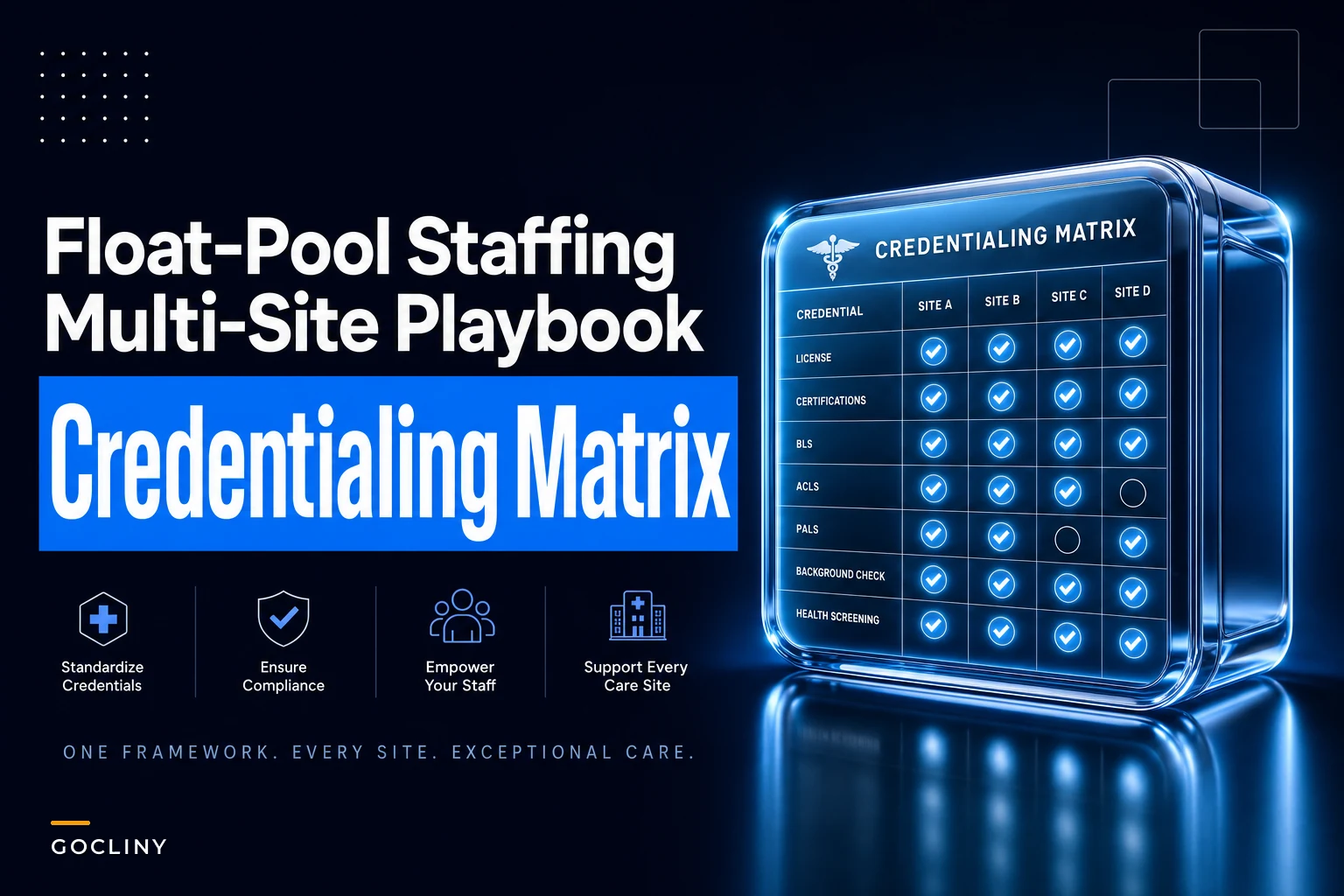
Once individuals clear the checklist, you need a single view of who can work where, doing what. This is the artifact that lets a staffing coordinator answer a coverage question in seconds instead of texting four managers. Keep it brutally simple: rows are people, columns are site + capability pairs, cells are one of three states.
| Staff | North – Rooming | North – Procedures | South – Rooming | South – POC Lab | West – Injections |
|---|---|---|---|---|---|
| MA — J. Reyes | ✅ | ✅ | ✅ | ⚠️ (exp 11/30) | ❌ |
| RN — T. Okafor | ✅ | ✅ | ✅ | ✅ | ✅ |
| MA — D. Alvarez | ✅ | ❌ | ⚠️ (EHR pending) | ❌ | ❌ |
| NP — S. Bhatt | ✅ | ✅ | ⚠️ (no on-site supervisor Tue/Thu) | n/a | ✅ |
-
✅ = cleared and current
-
⚠️ = conditionally eligible — the note tells you exactly what blocks full clearance
-
❌ = not eligible, do not assign
The ⚠️ state is the whole point. Most clinics run a binary "trained / not trained" list, which forces every partial case into a yes-or-no that's usually a lie. In reality, most float staff are conditionally eligible for most sites — cleared on skill, blocked on one credential. A matrix that captures why someone is a ⚠️ turns a vague "she can't really go to South" into an actionable "her POC lab sign-off expires 11/30, renew it and she's a full ✅."
Notice S. Bhatt's South entry: fully skilled, fully licensed, but blocked Tuesdays and Thursdays because no supervising physician is on-site those days. That's not a training gap — it's a scheduling-dependent privilege. If it's not in the matrix, someone will float her to South on a Thursday and create a supervision violation. Time-dependent conditions belong right in the cell.
Training reciprocity rules: stop retraining the same competency five times
The silent tax in float-pool operations is redundant training. Each site manager wants "their" competency check before trusting a floater, so an MA who's been running rooming for three years gets re-shadowed at every location she floats to. Multiply that across a six-person pool and four sites and you've burned dozens of hours re-certifying skills people already have.
Reciprocity fixes this by separating portable competencies from site-specific competencies.
-
- Portable competencies transfer automatically across sites once validated at any location: core clinical skills, general BLS, standard rooming workflow, phlebotomy technique, patient communication. Certified at one site means certified everywhere — no re-shadow.
-
- Site-specific competencies never transfer and must be signed off locally: this building's EHR configuration, this site's specific equipment, this location's emergency codes and floor plan, any protocol that genuinely varies by site.
The rule that makes this stick: a manager may not require re-validation of a portable competency. If a receiving manager wants to add a check, it has to be justified as genuinely site-specific and added to the site-specific list — where it applies to everyone, not just floaters. This kills the "I just want to see her work before I trust her" habit that quietly triples training load.
-
A portable competency validated at any site counts everywhere, but expires on the same schedule regardless of location. No re-checking on transfer; do re-check on the calendar.
-
Site-specific sign-offs are additive and location-locked. Getting the West injection protocol doesn't imply the North procedure protocol, even though both are technically "injections."
If your onboarding system already tracks competencies with dated sign-offs, reciprocity is mostly a matter of tagging each competency as portable or site-specific. The 30/60/90 competency SLA structure from the onboarding playbook is the natural place to add that tag — same tracking infrastructure, one extra field.
The shift-fill priority algorithm
When two or more sites need the same floater and the pool can't cover both, you need a rule that decides — not a group text. Run these steps in order and stop at the first tiebreaker that resolves.
-
Patient-safety floor first. Any site that will drop below its minimum safe staffing ratio wins immediately, regardless of anything below. Non-negotiable. Overrides revenue.
-
Clinical urgency of the affected slots. A site losing a same-day acute or urgent template outranks a site losing routine follow-ups. Weight by what's actually on the schedule, not headcount alone.
-
Full eligibility of the available floater. If Floater A is a full ✅ at Site X but a ⚠️ at Site Y, prefer the assignment where they're fully cleared. Never resolve a coverage gap by pushing someone into a conditionally-eligible slot.
-
Revenue-at-risk of the exposed slots. Higher-value procedure and new-patient slots outrank low-margin routine visits when safety and urgency are tied.
-
Recovery difficulty. Send the floater to the gap that's harder to backfill through other means. If Site X can pull a cross-trained front-desk-to-rooming person and Site Y cannot, cover Y.
-
Rotational fairness tiebreaker. If everything above is genuinely tied, the site that received the last contested float goes to the back of the line. This is the only fairness rule — it's a tiebreaker, not a driver.
Here's a quick visual of the decision workflow.
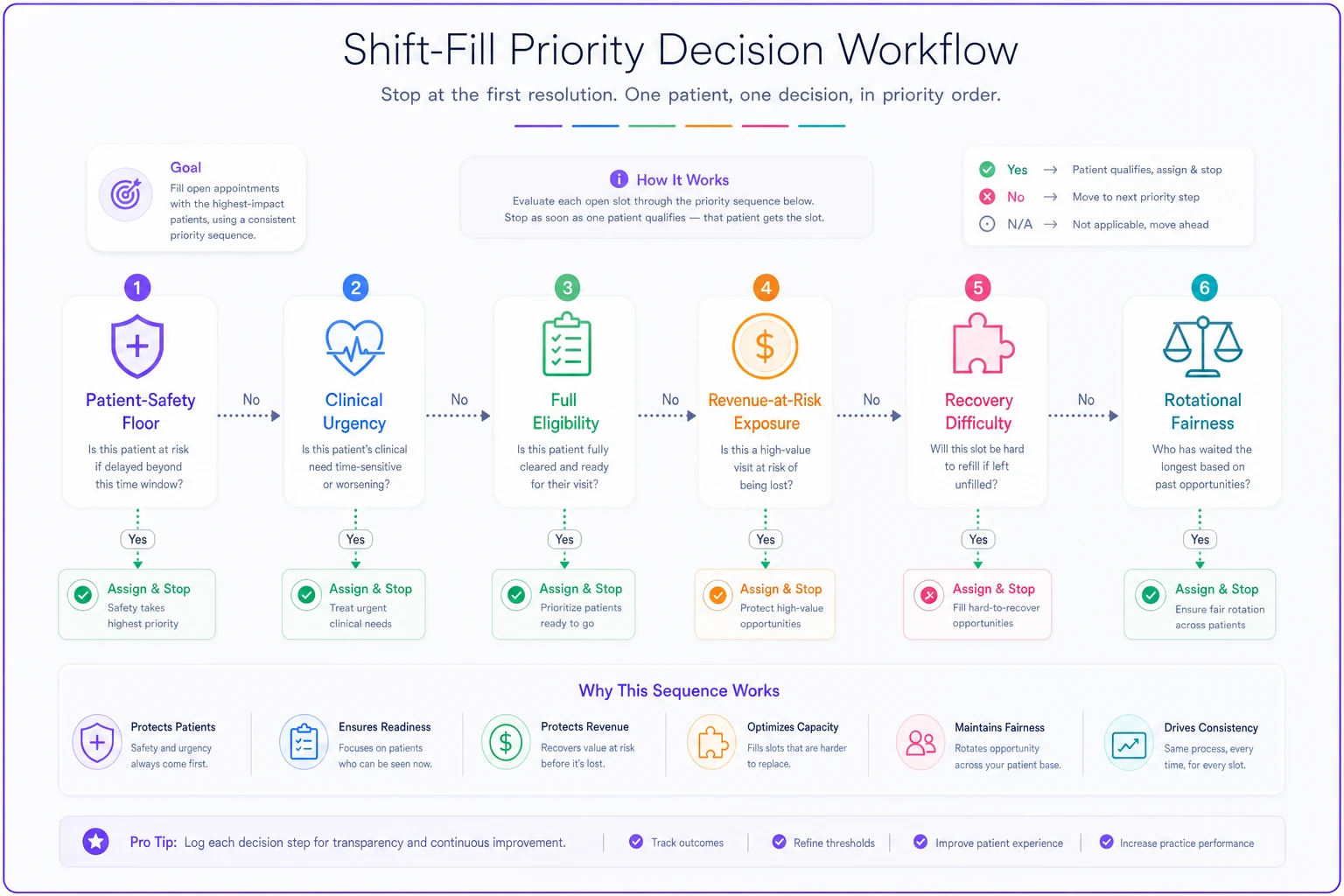
The failure mode this prevents is common: without a written order, coordinators default to steps 5 or 6 because those feel neutral and less confrontational, and safety or urgency get skipped entirely. Writing out the order forces the uncomfortable-but-correct decision — the loud manager with routine follow-ups loses to the quiet one about to breach a safe ratio.
Sample manager approval workflows for SMB constraints
Big systems route float requests through a centralized staffing office. SMB clinics don't have one — the "staffing coordinator" is usually a practice manager wearing a third hat. The approval workflow has to be fast enough that it doesn't become the bottleneck it's trying to prevent.
Standard workflow (planned coverage, 24+ hours out):
Requesting manager submits the gap (site, role, date, slots at risk) → coordinator checks the privileges matrix and shift-fill priority → coordinator assigns and notifies both the floater and the losing site → losing-site manager gets a heads-up, not a veto. Coordinator's decision stands because it followed the written priority rule.
Same-day / urgent workflow (under 4 hours):
Any manager can pull a full-✅ floater from the matrix without pre-approval if the assignment satisfies step 1 or 2 of the priority algorithm (safety floor or acute urgency). Notify the coordinator after, not before. Speed beats process when a safe ratio is on the line — but the pull is logged, and if it violated priority order, that's a review conversation later, not a mid-crisis argument.
Escalation workflow (contested, both sites at safety floor):
If two sites both hit the step-1 safety floor and the pool can't cover both, it escalates to the clinical lead or medical director — not the loudest manager. At that point you're deciding which site reduces schedule, canceling or rescheduling routine slots to protect acute ones, rather than pretending the floater can be in two places.
The design principle across all three: the losing site gets notified, not consulted. Consultation feels collaborative but it reintroduces the negotiation the priority algorithm exists to eliminate. If the rule was followed, there's nothing to negotiate.
Where lightweight software actually earns its place
None of this requires an enterprise credentialing suite — and that's usually the wrong tool for an SMB pool anyway. Too heavy, too slow to update, too much overhead for a four-site group.
What actually helps is keeping the credentialing checklist, the privileges matrix, and competency expirations in one place where the dates watch themselves: the ⚠️ that flips to ❌ the day a certification lapses, the "no on-site supervisor Thursday" condition that flags before someone gets misassigned, the reciprocity tags that stop redundant re-training from piling up. AI-assisted operational tools earn their place mostly on the boring, high-consequence end of this — surfacing the credential about to expire or the enrollment gap about to deny a claim before either becomes a Tuesday-morning fire. The judgment calls stay human; the tracking that humans reliably forget doesn't have to.
A real scenario
A three-site primary care and urgent care group ran a shared pool of about eight MAs and two per-diem NPs. Their float process was a group chat and a shared spreadsheet updated whenever someone remembered. Over one quarter they hit two denied-claim clusters from NPs rendering at a site where enrollment hadn't been linked to that location's group NPI — somewhere in the range of $4k–$6k in rework and delayed collections — plus a near-miss where an NP was almost scheduled at a site with no supervising physician present that day.
They didn't buy anything fancy. They built the pre-float checklist, converted the spreadsheet into a real ⚠️/✅/❌ privileges matrix with expiration dates in every cell, tagged competencies as portable versus site-specific, and wrote the six-step priority order on one page. The reciprocity change alone gave back somewhere around 10–14 hours a month that had been going into redundant shadowing. Contested coverage decisions stopped being arguments because the priority rule made the call. The enrollment-gap denials went to zero the following quarter — not because the tracking was clever, but because "check destination-site enrollment" was finally a required line nobody could skip.
When a float pool is worth the overhead — and when it isn't
A shared float pool makes sense when your sites are close enough that travel doesn't eat the coverage benefit, when demand spikes hit sites at different times so the pool actually redistributes rather than everyone being short at once, and when you have enough volume that a dedicated per-site buffer would sit idle most of the week.
It's a bad fit when your sites run wildly different specialties or protocols — the site-specific competency load gets so heavy that "floating" means near-full retraining, and reciprocity buys you almost nothing. It's also a poor fit if you can't commit to keeping credentials and enrollments current across all sites. A float pool with stale credentialing is a compliance liability disguised as flexibility, and you're better off with rigid per-site staffing until the tracking discipline exists.
The clinics that get the most out of a pool aren't the ones with the biggest rosters. They're the ones who treat every float assignment as a claim they have to be able to defend — right person, right site, right scope, right date — and who built the boring infrastructure to prove it before they needed to.
Ready to transform your practice workflow?
Join 2,000+ healthcare providers using GoCliny to increase efficiency, improve patient satisfaction, and grow revenue.