

Most clinics don't have a waitlist problem. They have a waitlist decision problem. The list itself is just a list. The mess starts when a slot opens and three different people — a scheduler, a nurse, a provider's MA — each have a different idea of who should get it. One goes by "who's been waiting longest." Another goes by "whoever answers the phone first." A third quietly bumps a patient because their spouse works in the building.
By the end of the month nobody can explain why patient A got seen in nine days and patient B, who called earlier and looked sicker on paper, waited five weeks. That's the real issue with waitlist prioritization in a clinic setting — not the volume, but the inconsistency of how you assign scarce slots.
This piece covers building a prioritization rubric that scores clinical urgency, time-on-list, and payer constraints; setting auto-allocation thresholds so routine cases don't need a human decision; writing staged outreach templates that actually convert; and — the part almost everyone skips — auditing the whole thing so you can prove it was fair.
Why waitlist decisions quietly turn unfair
Unfairness rarely comes from bad intentions. It comes from ambiguity under time pressure.
A slot opens at 8:10am for a 9:00 no-show recovery. The scheduler has maybe 40 minutes. They don't have time to re-rank 200 people on a list. So they grab the "easy yes" — someone they know picks up their phone, someone whose insurance they don't have to double-check, someone who's flexible about timing. That patient is almost never the highest-priority patient. They're the most convenient patient.
Do that a few hundred times over a quarter and the list develops a hidden bias. Patients who work jobs where they can't take calls, patients with plans that require prior auth, patients who are polite and don't call back to nag — they drift toward the bottom. Meanwhile squeaky wheels and easy-to-reach patients get pulled forward. None of it was intentional. It just accumulated.
The second driver is that "urgency" lives in the provider's head and "wait time" lives in the system. Nobody has combined them into a single number. So schedulers optimize whichever one is visible to them — usually wait time, or whoever the last provider mentioned in passing. The clinical signal and the fairness signal never sit in the same field.
What a real prioritization rubric looks like
The fix is boring on purpose: turn the decision into a score. Not a philosophy — a number a front-desk person can calculate, or better, one the system calculates automatically.
Eliminate appointment gaps and no-shows.
GoCliny streamlines every patient interaction from booking to billing—seamlessly.
- Unified appointment scheduling
- Automated patient reminders
- Staff calendar & task management
No credit card required
Three inputs matter for most outpatient clinics: clinical urgency, time-on-list, and payer/access constraints. You weight them, add them up, sort by the total. Here's a version that works well as a starting point and holds up to a compliance reviewer:
| Factor | What it captures | Weight | How it's scored |
|---|---|---|---|
| Clinical urgency | Provider or triage-assigned acuity | 50% | 0–50 (routine=10, semi-urgent=30, urgent=50) |
| Time-on-list | Days since request created | 30% | 1 point/day, capped at 30 |
| Payer/access constraint | Auth timing, network limits, benefit expiry | 20% | 0–20 (flag-based) |
A patient who's clinically urgent will outrank someone who's simply been waiting a long time — which is correct. But time-on-list has a cap and a floor, so a routine patient can't be stuck forever. Once someone crosses roughly 30 days, their time score maxes out and starts pulling them up the list regardless of urgency. That single rule prevents the "polite patient who waits five months" problem.
A few things that come up in practice:
-
Urgency must come from a clinical source, not the scheduler. If your front desk is estimating acuity, you've moved the fairness problem, not solved it. Tie the urgency score to a triage field a nurse or provider owns.
-
Payer constraints belong in the score, not as a separate side conversation. A patient whose prior authorization expires in six days genuinely is more time-sensitive to schedule. That's not favoritism — it's an access reality. Scoring it keeps it transparent instead of whispered.
-
Don't over-engineer the weights. 50/30/20 is a fine place to start. Tune it after a month of data, not before.
Tie the urgency score to a triage field a nurse or provider owns.
Don't over-engineer the weights. 50/30/20 is a fine place to start. Tune it after a month of data, not before.
Auto-allocation thresholds: let the routine cases decide themselves
Scoring is half the battle. The other half is deciding which decisions need a human at all.
In practice, the vast majority of slot-fills are uncontroversial. A cancellation opens, one patient is clearly at the top of the ranked list, and there's no reason for a person to deliberate. Forcing manual picks every time is where delays and inconsistency creep back in.
So you set thresholds:
-
Clear-winner auto-allocation. If the top-ranked patient's score is meaningfully higher than the second — say a gap of 15+ points — the system offers the slot to them automatically through staged outreach. No human decision required.
-
Close-call escalation. If the top two or three scores fall within a narrow band (under roughly 8 points), flag it for a human. Ties are exactly where judgment and fairness questions live.
-
Urgency override. Any patient flagged as urgent skips the queue mechanics and routes straight to a clinical reviewer, regardless of score. You never want a formula sitting between an urgent patient and a provider.
-
Constraint hold. If the top patient has an open payer flag (auth pending), the system either holds or moves to the next eligible patient based on a rule you set — but it logs why.
The point isn't to remove humans from the process. It's to spend human attention only where it changes the outcome. When slot-recovery runs alongside this, the two systems reinforce each other — the 2-hour slot-recovery playbook handles the speed of filling an opening, while the prioritization rubric handles who gets offered it first.
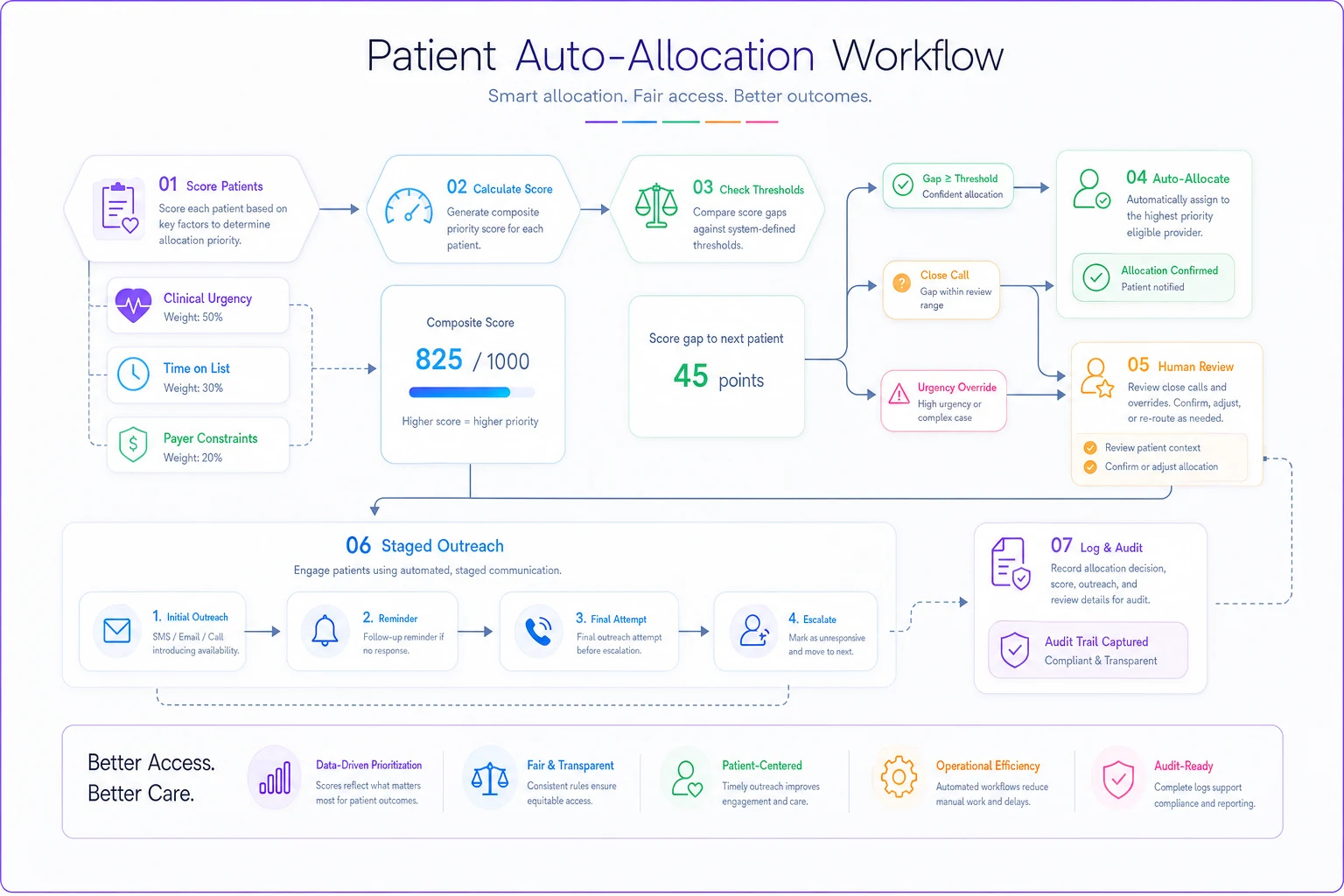
This diagram shows the flow from scoring to auto-offer, escalation, and logging so you can audit decisions.
Staged outreach: because the top patient doesn't always answer
A ranked list is useless if the #1 patient doesn't pick up. Most waitlist systems fall apart here — they offer the slot to one person, wait, and the slot goes cold.
Staged outreach fixes this by moving down the list on a timer without abandoning fairness:
-
Stage 1 (0–20 min) Offer to the top-ranked patient via their preferred channel. Text-first for most, call for older or urgent patients.
-
Stage 2 (20–45 min) If no response, offer to patient #2 while keeping #1's offer open. First confirmed booking wins.
-
Stage 3 (45+ min) Widen to the next 2–3 patients simultaneously if the slot is same-day and at risk of going empty.
The template language matters more than most people expect. Vague messages convert badly. Compare:
> "A slot has opened up. Please call to schedule."
> "Dr. Patel has an opening tomorrow (Tue) at 2:15pm. Reply YES to take it or NO to stay on the list — this offer holds for 20 minutes."
The second gives a specific slot, a deadline, and a low-friction reply. It also reassures the patient that saying no doesn't cost them their place. That reassurance is a fairness feature, not just a courtesy — patients who fear losing their spot say yes to bad times, then no-show.
One thing that often gets missed: log the reason every offer moves down a stage. "No answer." "Declined — timing." "Declined — cost." That log becomes your audit trail and, separately, tells you whether your outreach channels are actually reaching people.
The part everyone skips: fairness audits
You can have a solid rubric, clear thresholds, and well-crafted outreach templates and still drift into unfair outcomes, because rules bend the moment they meet real people working fast. The only way to know is to look back.
A fairness audit is a monthly review built around one question: did our actual allocations match our rules? You're checking for slots given out of order without a documented reason.
Pull every slot filled last month and check:
-
Was the patient offered the slot at or near the top of the ranked list at that moment?
-
If not, is there a logged override reason — urgency, patient-requested delay, payer hold?
-
Are overrides clustering around any one scheduler, provider, or patient group?
That last bullet is the one that matters most. If 70% of manual overrides trace back to two staff members, that's usually not a bad-actor story — it means the rule is unclear or the workflow is painful and people are routing around it. Fix the rule or the tool, not the person.
Tracking this manually is genuinely tedious, which is why it doesn't happen at most clinics. It's much easier when allocation decisions, override reasons, and outreach stages are all captured automatically in one place — the same principle behind a dashboard where the numbers actually trigger action instead of sitting in a report nobody reads. An override rate that quietly climbs from 8% to 25% is exactly the kind of drift a monthly check catches before it becomes a pattern.
When this system makes sense — and when it doesn't
This makes sense when:
-
You routinely have more demand than same-week capacity
-
Multiple people touch scheduling decisions
-
You have any payer mix complexity (auth, network, benefit timing)
-
You've ever had to explain a scheduling decision to a patient or auditor
This is overkill when:
-
You're a single-provider practice filling slots the same day off a short list
-
Your no-show and cancellation volume is low enough that slots rarely reopen
-
One person owns all scheduling and holds the context in their head reliably
Who should not rush into full automation: clinics that haven't yet defined urgency at the clinical level. If your acuity scoring is guesswork, automating on top of it just makes the guessing faster and harder to unwind. Get the triage input trustworthy first, then build allocation rules around it.
A real scenario
A three-provider orthopedic practice was carrying a waitlist of roughly 180–220 patients at any given time. Average time-to-appointment for non-urgent referrals sat around five weeks, and they were getting sporadic complaints — patients who'd clearly waited longer than others seen faster, with no explanation anyone could give.
They built the rubric above, set a 15-point auto-allocation gap, and switched to staged text-first outreach with a 20-minute hold. Nothing fancy on the tech side at first — a scored spreadsheet plus templated messages still moved the needle.
Over about three months, average time-to-appointment for routine patients dropped to just under four weeks. The bigger change was the tail: patients who used to slip to 8–10 weeks essentially disappeared once the time-on-list cap started pulling them up automatically. Slot offers converted better too — somewhere in the 15–20% range — mostly because the messages were specific and the hold-your-place reassurance cut down on panic no-shows. When a patient questioned a scheduling decision, the front desk could pull up the score and the override log and actually answer.
The takeaway
A waitlist is only as good as the rules you use to draw from it. Convenience-based allocation feels efficient in the moment and quietly produces unfair, indefensible outcomes over a quarter. Scoring urgency, wait time, and payer constraints into one ranked number — then setting thresholds so routine picks happen automatically and close calls reach a human — turns an unpredictable list into predictable access.
Start with the rubric. Add staged outreach so the top patient not answering doesn't cold your slot. Then commit to the monthly audit, because that's the only piece that tells you whether the rules survived contact with a busy front desk. Do those three things and "why did they get seen before me?" stops being a question you dread — because you'll always have the answer.
Ready to transform your practice workflow?
Join 2,000+ healthcare providers using GoCliny to increase efficiency, improve patient satisfaction, and grow revenue.