

A patient cancels their 2:15pm at 12:50pm. The provider now has a 45-minute hole worth anywhere from $120 to $400 depending on visit type, and the clock is already against you. Most front desks respond by pulling up the schedule, sighing, and moving on. By 1:45 the slot is dead.
The frustrating part is the demand almost always exists. Someone on your waitlist wants that slot. A patient who's been putting off a follow-up would take it if you called them. The problem is never demand — it's that filling a same-day slot requires a fast, ordered outreach sequence, and almost nobody has one written down. They improvise, and improvisation loses to the clock every time.
This is a tight operational problem with a tight operational answer. Below is a two-hour, channel-ranked recovery sequence with actual scripts, consent language, and the conversion numbers you should expect at each step. If you've already worked on your cancellation cadence and no-show design, this is the reactive companion to it — what you do the moment a slot opens instead of how you prevent the gap in the first place.
Why the first 20 minutes decide everything
Same-day slot recovery has a brutal decay curve. The value of an open slot drops roughly in proportion to how much lead time the person you're contacting actually has to show up.
A slot opening 3 hours out is very fillable. One opening 45 minutes out is only fillable by someone nearby, flexible, or already planning to be in the area. A slot that opens 20 minutes before the appointment is essentially gone unless you can convert it to telehealth.
What you see across a lot of clinics is the front desk treating all cancellations the same — same slow process whether there's four hours of runway or forty minutes. That's the core mistake. The response has to be triaged by how much time you have, because that determines which channel even makes sense.
Here's the rough shape of it:
| Time until slot | Best primary channel | Realistic fill odds | Notes |
|---|---|---|---|
| 3+ hours | Broadcast SMS to segment | High | Enough lead time for travel; batch it |
| 90 min – 3 hrs | SMS then ringdown | Moderate–high | The sweet spot; most winnable |
| 45–90 min | Ringdown + manual calls | Moderate | Only nearby/flexible patients |
| Under 45 min | Manual calls + telehealth pivot | Low unless telehealth | Convert to virtual or absorb the gap |
The whole point of ranking by channel is speed-to-contact. SMS is fastest and least intrusive, so it goes first. A ringdown — auto-dial to a targeted list — is second because it reaches people who don't read texts quickly. Manual calls are last because they're the most expensive in staff time, and you only want them for the highest-value or hardest-to-reach slots.
Segment your waitlist before you ever need it
You cannot build a good outreach list at 12:50pm while the phone is ringing. The segmentation has to already exist. A single undifferentiated waitlist is nearly useless because it doesn't tell you who to contact first.
Eliminate appointment gaps and no-shows.
GoCliny streamlines every patient interaction from booking to billing—seamlessly.
- Unified appointment scheduling
- Automated patient reminders
- Staff calendar & task management
No credit card required
Tag it along a few practical dimensions:
-
Geographic proximity — patients within about 15 minutes of the clinic get contacted first for short-notice slots
-
Visit-type match — a slot for an established-patient follow-up shouldn't go to someone needing a new-patient intake that takes twice as long
-
Flexibility flag — patients who explicitly said "call me anytime something opens" convert 3–4x higher than general waitlisters
-
Telehealth-eligible — patients whose visit reason can legitimately go virtual, which becomes your lifeline for sub-45-minute slots
-
Provider preference — don't offer a Dr. Reyes slot to someone who only sees Dr. Okafor
Keep the 'flexible + nearby' list compact so your first blast only targets the most likely yeses.
A real example: a mid-size family practice with roughly 300 monthly bookings kept one flat waitlist and filled maybe 1 in 5 open slots. Once they split it into "flexible + nearby," "telehealth-eligible," and "general," their same-day fill rate on 90-minute-notice slots climbed to somewhere around 40–50% — mostly because the first text went to people who could actually say yes.
The consent problem nobody handles until it bites them
Before any of this works, you need documented opt-in consent to text and auto-dial patients about openings. This is the part clinics skip and then panic about later.
You want two things captured at intake or check-in:
-
General appointment communication consent — permission to send appointment-related SMS and calls.
-
Slot-opening / waitlist consent — explicit permission to contact them proactively when an earlier appointment becomes available.
Keep the language plain. Something like:
> "May we text or call you if an earlier appointment opens up that matches what you need? Message and data rates may apply. Reply STOP anytime to opt out."
For the waitlist opt-in at the front desk:
> "We can add you to our short-notice list. If a slot opens sooner than your scheduled date, we'll text you first — you'd just reply YES to grab it. Want me to add you?"
Two rules that keep you out of trouble: every automated message must include an easy opt-out, and you honor it immediately across every channel. And never send slot-opening messages to anyone who only consented to basic appointment reminders. Keep those consent tiers separate in your records. When a clinic gets a complaint, it's almost always because someone got a "we have an opening!" blast when all they agreed to was a reminder.
The two-hour recovery sequence, step by step
Here's the actual ordered sequence for a slot with roughly 90 minutes to 3 hours of runway. Compress the timing if you have less lead time.
-
T+0 to T+3 min — Fire the targeted SMS. The moment the cancellation is confirmed, send a broadcast SMS to your top segment — flexible, nearby, visit-type match. Not the whole waitlist. Maybe 5–12 people. First-come-first-served framing.
-
T+3 to T+15 min — Watch for replies, confirm the first YES. Whoever replies YES first gets the slot. Reply immediately with confirmation and the exact time. Send a quick "just filled, thanks!" to anyone else who responds late so they're not left hanging.
-
T+15 min — If unfilled, widen the SMS. No takers from the top segment? Push the same message to the broader eligible list, still consent-checked. More people, same script.
-
T+30 min — Trigger the ringdown. Still open? Launch an auto-dial ringdown to the flexible segment. A short recorded prompt: "This is [Clinic]. An appointment just opened today at [time]. Press 1 to claim it, and we'll call you right back to confirm." This catches people who don't check texts.
-
T+45 to T+75 min — Manual calls to high-intent patients. Now the front desk personally calls the 3–5 highest-probability patients: the ones who've explicitly asked to be reached, or high-value visit types worth the labor. A real human voice closes these.
-
T+75 min onward — Pivot to telehealth or release. If the slot is clinically eligible, convert it to a telehealth visit and offer it to your virtual-ready list — this expands who can say yes because travel disappears. If nothing lands, mark it as absorbed and move on. Don't burn another hour chasing a dead slot.
A quick visual of the sequence:
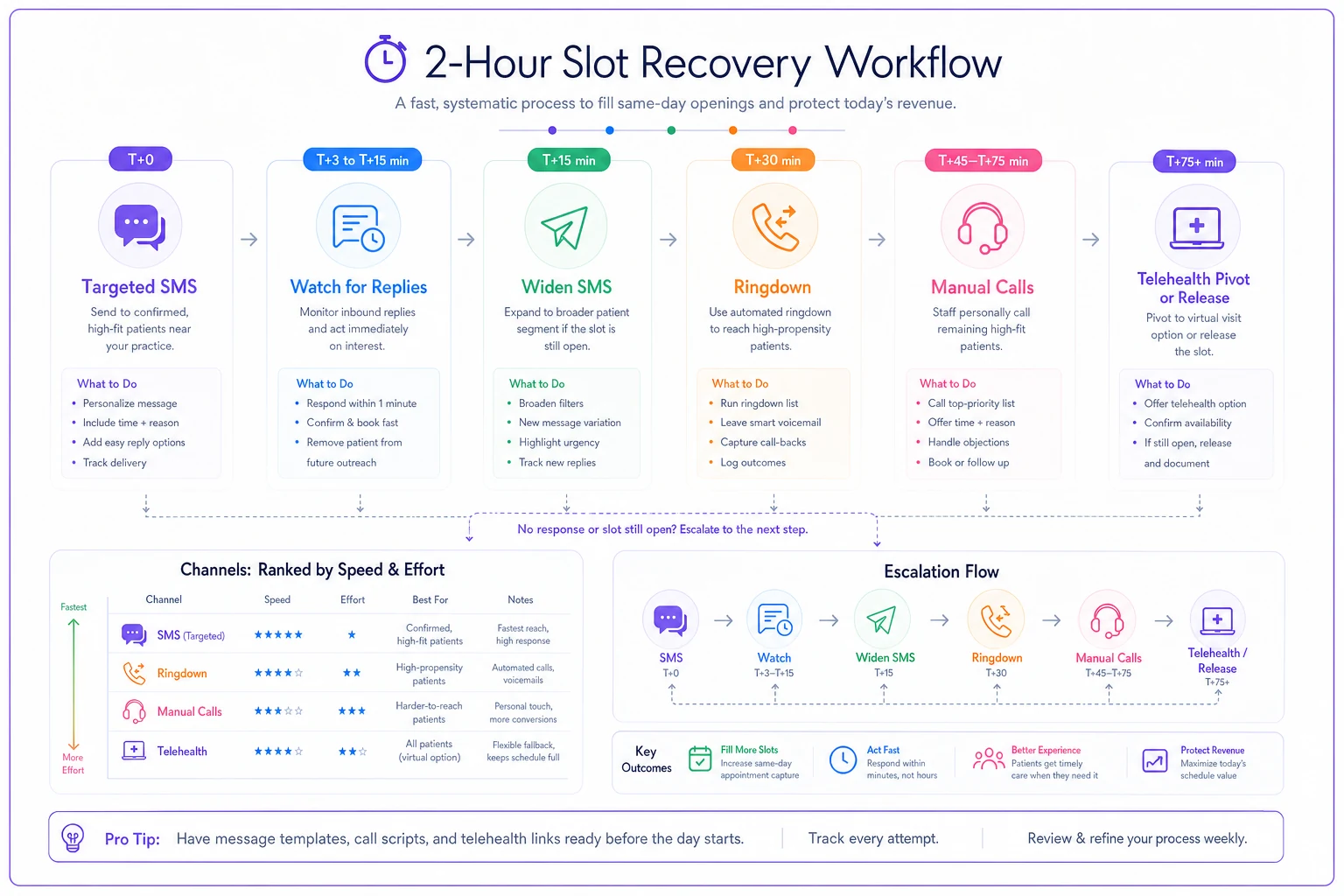
The sequence works because each step escalates in effort only after the cheaper channel fails. You're not making 12 phone calls for a slot a single text could have filled.
The scripts that actually convert
The SMS wording matters more than people think. Vague texts underperform badly.
Opening SMS (top segment):
> "Hi [First name], this is [Clinic]. A [visit type] opened today at [time] with [Provider]. Want it? Reply YES and it's yours — first reply gets it."
Confirmation reply:
> "You're all set for [time] today with [Provider]. See you soon! Reply C to cancel if plans change."
Telehealth pivot SMS:
> "Hi [First name] — we have a same-day telehealth slot at [time] with [Provider]. No travel, just a video visit from home. Reply YES to book."
Manual call opener (not word-for-word, but the beats):
Greet by name → "A slot just opened today at [time] and I thought of you since you'd been wanting to get in sooner" → confirm the time works → book it live while they're on the phone → send confirmation text.
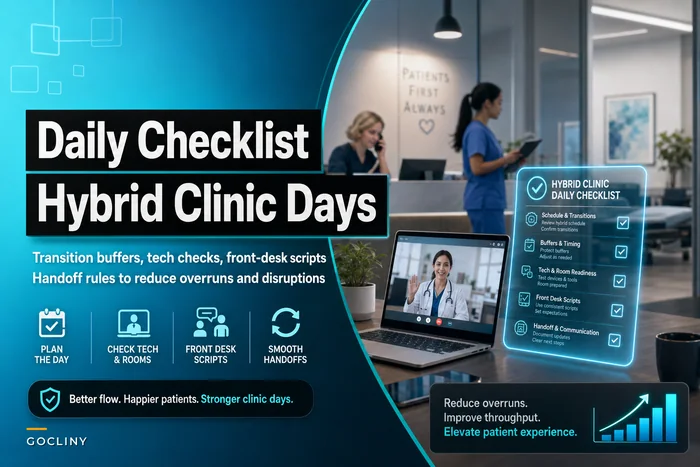
The telehealth pivot is the highest-leverage script in the set. When physical travel is off the table, the pool of people who can say yes to a slot 40 minutes out gets much larger. If you run mixed in-person and virtual days, the mechanics of clean same-day telehealth handoffs are worth pinning down in advance — the hybrid clinic day checklist covers the buffer and transition side of that so a rushed conversion doesn't create a scheduling mess downstream.
Conversion benchmarks to measure yourself against
Rough expectations based on operational patterns across primary care and specialty practices. Treat these as targets, not guarantees — your panel and geography will move them.
-
Targeted SMS to a flexible, nearby segment 25–40% fill rate on the first blast. This alone handles a big chunk of your recoverable slots.
-
Broadened SMS adds maybe another 10–15 percentage points, with slightly lower quality — more no-shows on same-day fills from the general list.
-
Ringdown typically converts a modest slice, somewhere in the 5–15% range of remaining slots, but it's cheap and hands-off.
-
Manual calls high conversion per contact — often 40% or more — but low volume because you can only make a few before the window closes.
-
Telehealth pivot this is the one that salvages under-45-minute slots. On eligible visit types, conversion can land in the 30–50% range because you've removed the travel barrier entirely.
If your combined same-day fill rate across all channels is sitting below 20%, the problem is almost always segmentation or speed. You're texting the wrong people or texting them too slowly. Above 45–50% and you're running a genuinely good recovery operation.
Staff rules that keep it from falling apart
The sequence only works if one person owns it and knows the rules cold. Vague ownership means the SMS goes out 25 minutes late, which is often the difference between filling the slot and not.
-
One owner per shift. The moment a cancellation is confirmed, one named person runs the sequence. Not "the front desk" — a specific person.
-
Fire the SMS within 3 minutes. This is the single highest-impact rule. Delay kills fill rates faster than anything else.
-
First YES wins, no negotiating. Whoever replies first gets the slot. Don't hold it while someone "thinks about it."
-
Onboard walk-ins fast. If the filled slot is a new patient, have a compressed same-day intake path ready so paperwork doesn't eat the visit time.
-
Know the telehealth-eligible list by visit type. Staff should not have to guess whether a reason can go virtual. Keep a simple reference sheet.
-
Stop chasing at the cutoff. Past the point where someone realistically can't arrive in time, release the slot. Chasing dead slots wastes the staff you need for the next one.
The sequence only works if one person owns it and knows the rules cold. Vague ownership means the SMS goes out 25 minutes late, which is often the difference between filling the slot and not.
When this playbook makes sense — and when it doesn't
When it makes sense: you have a real waitlist or a panel of patients who want earlier appointments, cancellations happen often enough to matter — even a couple a day adds up fast — and you have consent infrastructure or can build it. If each open slot is worth $150 or more, the labor pays for itself many times over.
When it's a bad idea: if you don't have documented consent, do not start blasting texts. Fix consent first, full stop. And if your cancellation volume is genuinely tiny — a slot or two a week — a full ordered sequence is overkill. A couple of manual calls will do.
Who should skip this entirely: practices with no real waitlist demand. If nobody wants your slots sooner, better outreach isn't the answer. That's a demand and scheduling problem upstream, and no script fixes it.
A quick real scenario
A two-provider dermatology practice was losing roughly 6–8 same-day slots a week to cancellations and filling maybe one or two. At an average visit value in the $180–$260 range, that's somewhere north of $1,000 a week walking out the door.
They did three things: split the waitlist into "flexible/nearby," "telehealth-eligible," and "general"; captured slot-opening consent at check-in; and assigned one front-desk owner per shift to fire an SMS within a few minutes of any cancellation. No new headcount.
Within about six weeks their same-day fill rate went from roughly 20% to somewhere in the 45–55% range. The telehealth pivot handled a surprising number of the short-notice slots — teledermatology follow-ups that patients happily took from home. Recovered revenue landed somewhere around $2,500–$3,500 a month. The change wasn't a new tool. It was an ordered sequence and one person responsible for running it fast.
The one thing to fix first
If you take a single thing from this, make it the three-minute SMS rule paired with a pre-segmented list. Everything downstream — the ringdown, the manual calls, the telehealth pivot — is a backstop for when the fast, cheap first move doesn't land. Most clinics never get the first move right, so they never see how much of the problem it solves on its own.
Last-minute slot recovery isn't about heroics at the front desk. It's about deciding, before the cancellation ever happens, exactly who gets contacted, in what order, through which channel, and how fast. Write it down, assign one owner, and the slots start filling themselves.
Last-minute slot recovery isn't about heroics at the front desk. It's about deciding, before the cancellation ever happens, exactly who gets contacted, in what order, through which channel, and how fast. Write it down, assign one owner, and the slots start filling themselves.
Ready to transform your practice workflow?
Join 2,000+ healthcare providers using GoCliny to increase efficiency, improve patient satisfaction, and grow revenue.