

The phone rings. A patient describes chest tightness that "comes and goes." Your scheduler, three calls deep and behind on the morning rush, hears "follow-up" instead of "possible cardiac event" and offers a slot two weeks out. Nobody meant to make a mistake. But the script they were following didn't have a fork in it for that moment — so they defaulted to the thing they do 90 times a day: schedule and move on.
That gap between what the patient said and what the front desk did with it is where most phone-based clinical risk lives. And it's also where a surprising amount of revenue quietly drains out, because the same vague scripts that miss urgency also miss the difference between a high-intent same-week caller and someone just shopping around.
This is a working guide to phone triage scheduling scripts — the exact question sequences, the decision thresholds that split "schedule now" from "escalate to clinical," the time-to-schedule SLAs that keep bookings from going stale, and the canned responses that keep your team consistent under pressure. Plus how to actually audit whether any of it is being followed.
Why generic scripts fail at the exact moment they matter
Most clinics have "scripts," but they're really just greetings and closing lines. "Thanks for calling, how can I help you?" and "Is there anything else I can do for you today?" The middle — the part where a human decides whether a caller is a routine booking or a clinical concern — gets left to judgment.
-
The caller buries the important detail mid-story. "My knee's been bothering me since the trip, oh and I've had this shortness of breath too, anyway can I see Dr. Patel about the knee?"
-
The caller downplays the symptom because they don't want to be dramatic. "It's probably nothing, but…"
-
The scheduler is new or covering and doesn't yet have the instinct to catch yellow flags.
What you see across a lot of front desks is that schedulers usually know the danger words — chest pain, sudden weakness, worst headache of my life. What they don't have is a forced checkpoint that makes them ask before they book. Without that checkpoint, the busy-day default always wins, and the default is "book it."
A real call-flow map fixes this by making the safety question unskippable. Not by adding twenty questions to every call — that approach slows everything down and gets quietly abandoned by week two — but by inserting one deliberate branch early enough to catch the calls that matter.
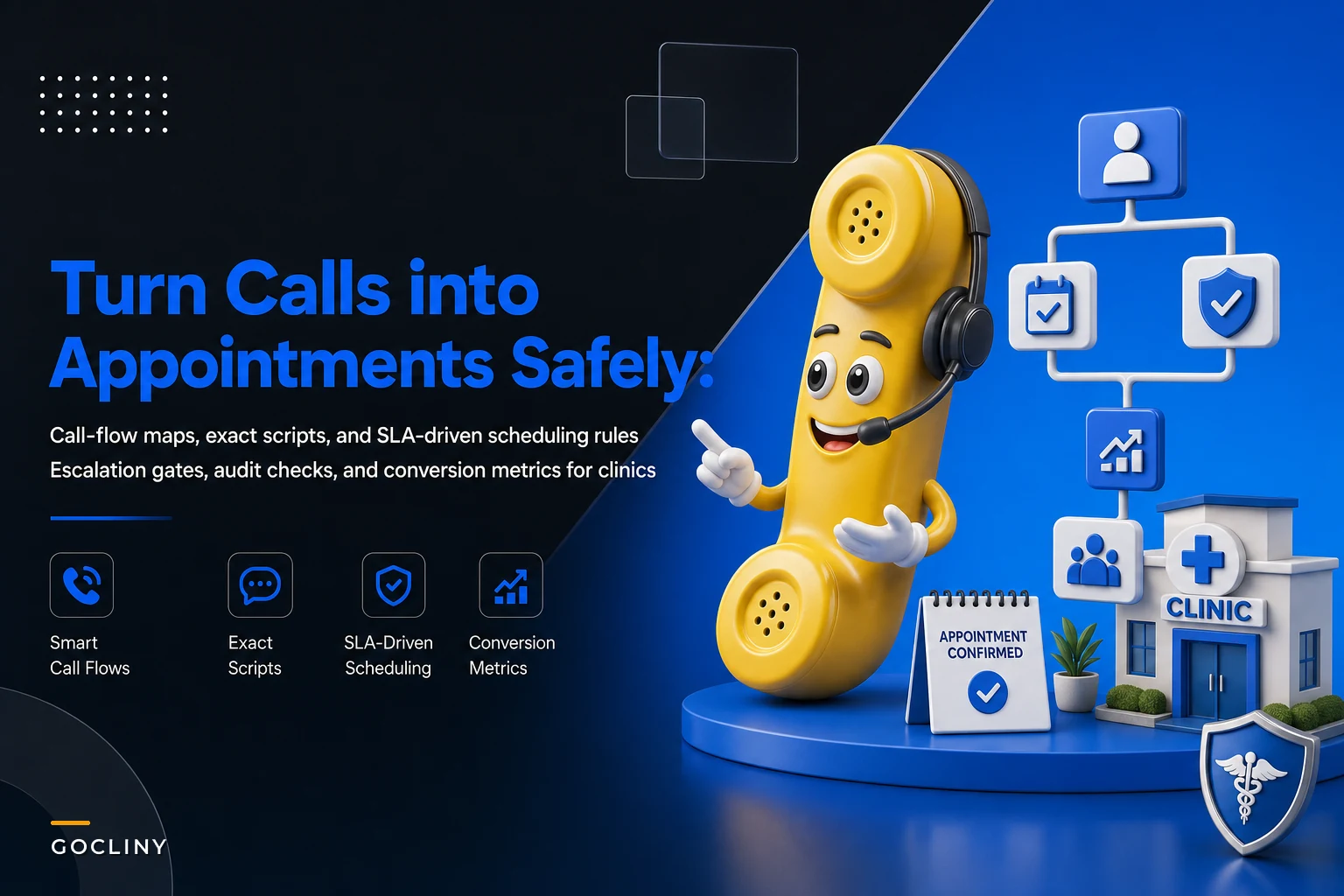
The three-branch call-flow, in plain terms
Every inbound clinical call should resolve into one of three paths within the first 60–90 seconds:
Eliminate appointment gaps and no-shows.
GoCliny streamlines every patient interaction from booking to billing—seamlessly.
- Unified appointment scheduling
- Automated patient reminders
- Staff calendar & task management
No credit card required
-
Schedule — routine, non-urgent, book it now.
-
Escalate — clinical concern that needs a nurse or provider to weigh in before anything gets booked.
-
Redirect — emergency (send to ED / call 911) or wrong venue (urgent care, specialist referral, pharmacy).
The whole point of the map is to sort callers into those three buckets reliably, using the same questions every time, regardless of who picks up the phone.
> "I can help you get scheduled. First, so I put you with the right person — can you tell me in a sentence or two what's going on today?"
> "And just to make sure I'm not missing anything — are you having any chest pain, trouble breathing, sudden weakness or numbness, or a headache that came on suddenly and severe?"
That second question is the checkpoint. Short, consistent, asked before the calendar opens. If the answer touches any of those, the scheduler doesn't negotiate a slot — the flow forces an escalation or redirect.
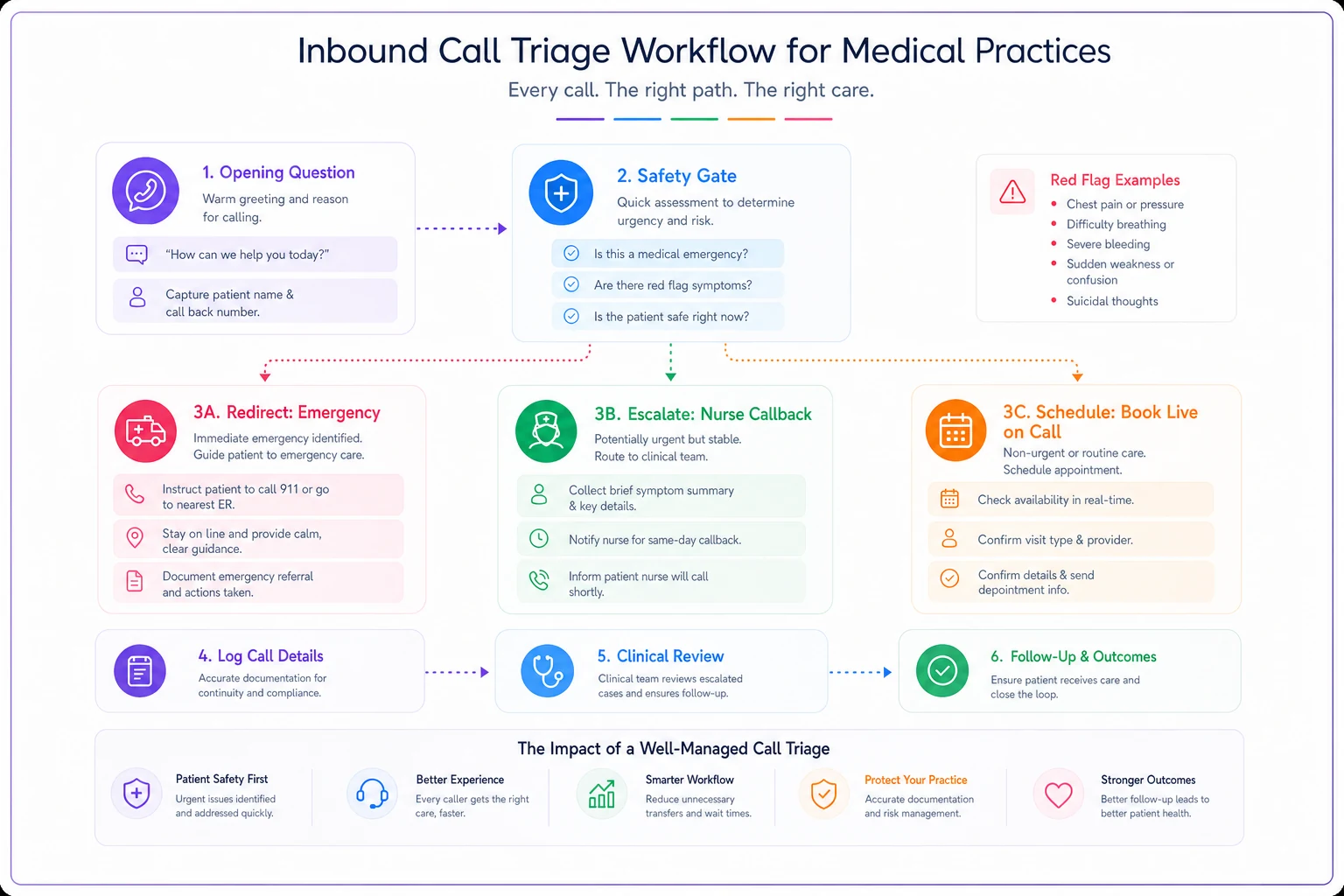
Use that map to force the safety gate before the calendar opens so routing is consistent no matter who answers.
Decision thresholds: what actually triggers an escalation
"Use your judgment" isn't a threshold. A threshold is a specific, written trigger that removes the judgment call from a non-clinical person's hands. Here's how to draw those lines so a scheduler never has to decide whether something is "bad enough."
| Caller says / presents | Path | Action within |
|---|---|---|
| Chest pain, difficulty breathing, sudden weakness/numbness, sudden severe headache, uncontrolled bleeding | Redirect – emergency | Immediate: advise 911/ED, stay on line |
| New or worsening symptom the scheduler isn't sure about | Escalate – nurse callback | Warm transfer or 30-min nurse callback |
| Fever + specific condition (post-op, infant, immunocompromised) | Escalate – nurse callback | 30-min nurse callback |
| Medication refill needing clinical review | Escalate – queue | Same-day clinical queue |
| Routine follow-up, stable chronic condition, physical, established concern | Schedule | Book on call |
| Non-clinical (records, billing, forms) | Redirect – correct queue | Route, no clinical hold |
The rule that keeps this safe: when in doubt, escalate — never split the difference by scheduling far out. The dangerous middle option is "I'll book you for next week and mention it to the nurse." That satisfies the scheduler's instinct to resolve the call while leaving a potential problem sitting for days. Kill that option in the script. It's either safe-to-book now, or it goes to clinical. No "book it and flag it" for symptom-driven calls.
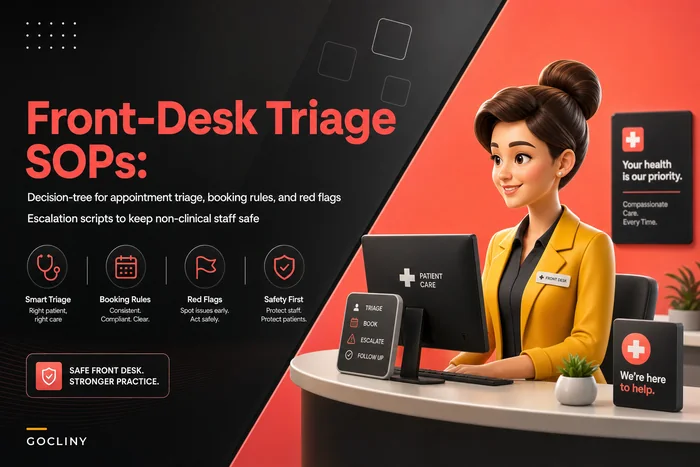
For the deeper version of how urgency gets ranked and who prioritizes what at the desk, that logic pairs directly with your front-desk triage SOPs for prioritizing appointment requests and escalating clinical urgency safely — the call-flow is essentially the phone-channel expression of those same SOPs.
Time-to-schedule SLAs (and why "we'll call you back" quietly kills bookings)
Escalation is the safety half. SLAs are the other half — the part that protects both the patient and the booking. Because here's what actually happens to an escalated call with no clock on it: the nurse is busy, the callback slides to end of day, the patient calls a different clinic in the meantime, and you've lost them clinically and financially.
-
Emergency redirect handled in-the-moment, no clock needed — but log it.
-
Nurse callback for escalations target within 30 minutes, hard cap at 2 hours.
-
Routine booking offered on the call if a suitable slot exists, book before the call ends. Don't say "I'll check and call you back" when you can see the calendar.
-
Nurse-cleared symptom that becomes bookable schedule within 4 business hours of clinical sign-off.
The biggest leak isn't dramatic. It's the routine caller who gets told "let me check with the doctor's schedule and get back to you" for something the scheduler could've booked immediately. Every one of those callbacks has maybe a 60–70% chance of ever converting, because life gets in the way and competing clinics answer faster. If the call-flow lets schedulers defer bookable calls, you're leaking appointments through pure process friction.
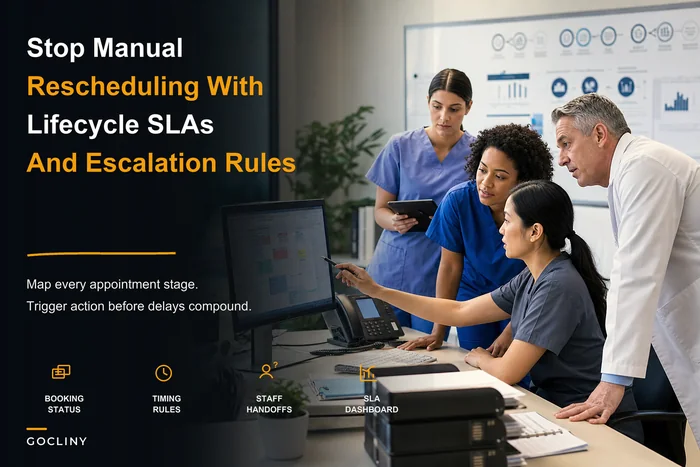
This is also where a clean handoff structure matters — an escalated call has to land somewhere with an owner and a deadline, not in a sticky-note void. If appointment handoffs are still informal, the appointment lifecycle design with SLAs, handoffs and SOPs is the backbone that makes these phone SLAs enforceable rather than aspirational.
Canned responses for the calls that repeat all day
Consistency isn't about robotic scripts — it's about not reinventing sensitive phrasing at 4:45pm when you're tired. A handful of pre-written responses for high-frequency, high-friction moments will do more for call quality than any training video. These are the ones worth pinning at every phone station:
-
Symptom that must escalate, without alarming the patient "That's something I want our nurse to hear directly so we get you to the right visit — I'm going to have her call you back within the next half hour. Is this the best number?"
-
Emergency redirect, calm and firm "Based on what you're describing, I don't want you to wait for an appointment. Please call 911 or go to the nearest emergency room now. Are you able to do that?"
-
No near-term slot for a routine request "The soonest with Dr. Lee is the 22nd. I can also put you on our earlier-opening list — if something frees up, we'll call. Want me to do both?"
-
Caller downplaying a yellow-flag symptom "I hear you that it's probably minor, and it likely is — but the shortness of breath is one our nurse checks personally. Two minutes with her and we'll know the right visit for you."
-
Refill needing review "I'll get that into the clinical queue today so the provider can review it — you should hear back by end of day. Anything change with how you're feeling since your last visit?"
That last question in the refill line isn't padding. It's a soft second safety net — refill calls are a common place where a symptom slips through because nobody asked.
A real scenario: what the fix looks like in practice
A two-provider primary care practice — somewhere around 900–1,000 inbound calls a month — kept running into two problems at once. On the safety side, they'd had a couple of near-misses where symptom calls got scheduled routinely, only caught because a nurse happened to overhear. On the revenue side, schedulers were deferring a chunk of bookable calls with "we'll call you back," and a lot of those never converted.
They rebuilt the phone flow around the three-branch map: a mandatory safety gate before any slot offer, hard escalation thresholds with no "book-and-flag" option, and a 30-minute nurse callback SLA. They also drilled the "book it live if a slot exists" rule hard.
-
Deferred callbacks dropped from around 30% of routine calls to under 10%, and same-call booking conversion climbed noticeably — they estimated recapturing somewhere in the range of 40–55 appointments a month that used to evaporate.
-
Escalations went up, which sounds bad but was the point — nurses were now seeing the borderline calls on purpose instead of by accident.
-
Zero symptom calls made it to a routine slot without clinical review during the audit window.
Nothing required more staff. It required removing the choices that let tired people make convenient decisions.
Auditing it — because a script nobody follows is worse than no script
Scripts drift the moment nobody's checking. Build a lightweight audit a supervisor can run in 20–30 minutes a week off call recordings or a short sampling.
Pull 10–15 calls per scheduler per week and score against a fixed checklist:
-
[ ] Was the safety gate question asked before any slot was offered?
-
[ ] For any symptom-driven call, did the scheduler avoid the "book-and-flag" workaround?
-
[ ] Were escalations routed to the correct queue (nurse callback vs emergency)?
-
[ ] Did the nurse callback happen within the 30-minute target? (Log the actual time.)
-
[ ] For routine bookable calls, was the slot offered live rather than deferred?
-
[ ] Was the emergency-redirect language used verbatim on any 911/ED call?
-
[ ] Was the call logged with its branch (schedule / escalate / redirect)?
Keep audits to a 20–30 minute sample so supervisors will actually do them.
Two audit numbers matter most, and they pull against each other — which is exactly why you track both. Safety-gate compliance should sit near 100%. A missed gate is a corrective conversation, not a coaching note. Live-booking rate you want climbing over time. Watch them together: if live-booking is high but safety-gate compliance is slipping, your team is optimizing for speed at the cost of the checkpoint, and that's the exact failure mode the whole flow exists to prevent.
One thing worth noting from watching these audits play out — resist scoring on tone or "friendliness." It feels productive but it buries the signal. Score the branches and the SLAs. Friendliness tends to take care of itself when people aren't panicking about what to say, because the canned responses hand them the words.
When this level of structure makes sense — and when it's overkill
This isn't for every practice at every stage.
It makes sense when you've got more than one person answering clinical calls, when you rely on float or cross-coverage staff who don't have years of instinct yet, when call volume is high enough that "book it and move on" pressure is real, or when you've had even one near-miss where a symptom got scheduled routinely. Multi-provider clinics basically always hit these marks.
It's overkill when a single seasoned clinical staffer takes every call and knows every patient — a very small solo practice with a nurse at the phone doesn't need a formal map to catch what they already catch instinctively. Adding it there just creates friction without much return.
Who should not do this halfway: anyone who writes the thresholds but never audits them. A call-flow map with no compliance check decays fast — within a couple of months it's back to greetings and closings with judgment filling the gap in between, which is exactly where things started. If you can't commit to the weekly sampling, tighten the escalation thresholds and skip the detailed scripting. A conservative "when in doubt, escalate" default will hold up on its own.
Bringing it together
The reason phone triage fails isn't that schedulers don't care or don't know the danger signs. It's that the busy-day default — book it, resolve the call, move to the next one — beats judgment every single time unless the process physically stops it. A working call-flow does three things: it forces the safety gate before the calendar opens, it removes the convenient middle option that lets risky calls slide, and it puts a clock on everything so nothing just sits.
Get those three right and you catch more of the calls that matter clinically while losing fewer of the ones that matter financially. Same phones, same staff — just fewer choices that were quietly costing you both.
Ready to transform your practice workflow?
Join 2,000+ healthcare providers using GoCliny to increase efficiency, improve patient satisfaction, and grow revenue.