

A clinic doesn't usually run out of exam gloves all at once. It runs out on a Tuesday afternoon, in the middle of a packed schedule, when the medium box in room 3 hits empty and the backup shelf has one half-crushed box of larges. Somebody runs to the other hallway. Somebody else texts a provider to "make it work." And the person who placed the last order swears they just bought gloves two weeks ago.
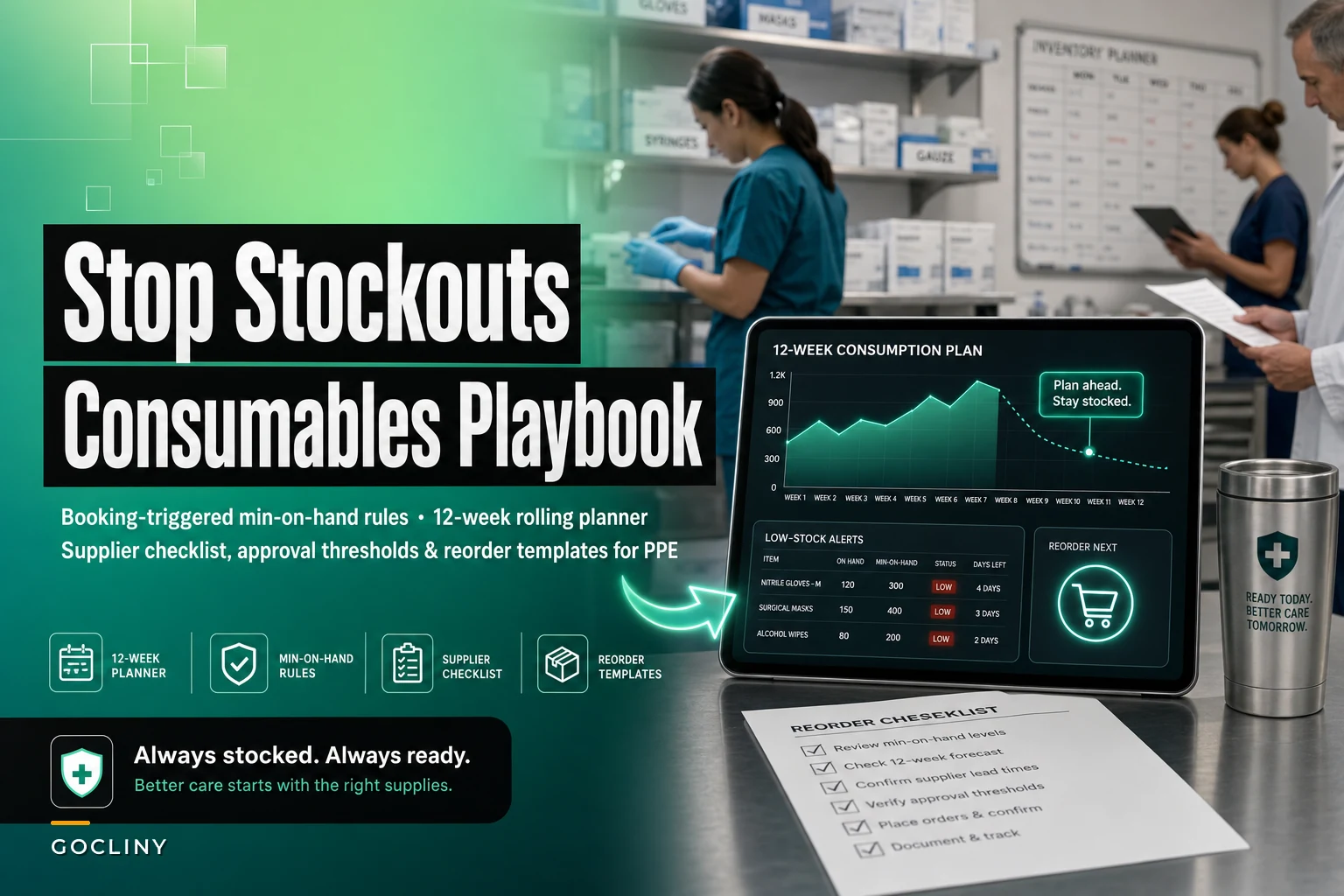
That pattern — small, recurring, avoidable stockouts — quietly eats time and money in almost every small practice. Not through dramatic shortages, but through dozens of little scrambles that never show up in any report. The fix isn't a fancy inventory system. It's a lightweight clinic consumables inventory playbook built around four plain-English rules: minimum-on-hand levels, a rolling consumption view, a short preferred-supplier list, and clear approval thresholds. This post walks through exactly how to build it.
Why clinics run out even when "someone orders supplies"
The person ordering supplies almost always does a decent job. The problem is that ordering decisions get made from memory, not from numbers.
Here's how it usually breaks down. One MA notices gloves are "getting low" and orders. Another sees the same low shelf a day later and orders again. Now you've got a glove surplus and a shortage of 4x4 gauze that nobody flagged because the gauze shelf looked fine from across the room. Visual checks are terrible at catching slow-burn depletion — the stuff that disappears steadily instead of dropping off a cliff.
Then there's seasonality. Flu season hits and your swab, PPE, and disposable thermometer-cover usage jumps 30–40% for eight weeks, but the reorder habits never adjust because they're based on "what we normally buy." If you've ever built out forecasting for patient volume, this is the same muscle — usage follows predictable patterns and you can plan for them. (The clinic revenue forecasting model for payer mix and seasonality gets into this on the revenue side; the consumption logic rhymes with it.)
The deeper issue is ownership. When everyone can order, no one owns the stock level. And when no one owns it, the only feedback loop is the stockout itself.
What a stockout actually costs
The direct cost of an emergency glove run feels tiny — maybe a $40 trip to the pharmacy supply store or a rush-shipping fee. That's not where the money goes.
Eliminate appointment gaps and no-shows.
GoCliny streamlines every patient interaction from booking to billing—seamlessly.
- Unified appointment scheduling
- Automated patient reminders
- Staff calendar & task management
No credit card required
A three-provider primary care clinic averaging around 55–60 visits a day is a useful baseline. A single mid-day stockout of a routine disposable pulls an MA off the floor for 15–20 minutes to hunt down backup, borrow from another room, or drive out. Do that two or three times a week — which is completely normal in a practice running on visual checks — and you're burning something like 2–3 staff-hours weekly on avoidable scrambling. Over a year that's a meaningful chunk of paid clinical-support time spent on supply chaos.
Then the softer costs:
-
Rush shipping and off-contract buying. When you're out, you pay whatever the fastest option costs. Buying reactively instead of through your preferred-supplier pricing can run 10–25% higher on rushed items.
-
Overstock from panic ordering. The reaction to a stockout is almost always to over-buy next time, which ties up cash and shelf space and leads to expired disposables you quietly toss.
-
Clinical flow disruption. A provider waiting on a speculum, a biopsy punch, or the right suture size doesn't just lose that minute — it ripples into the rest of the schedule.
None of these show up neatly on a P&L, which is exactly why they persist.
The four pieces of the playbook
The whole system is four components. You can build it in a spreadsheet in an afternoon. The point isn't sophistication — it's turning supply decisions into rules instead of guesses.
1. Minimum-on-hand rules (your floor)
For every consumable that would cause a problem if you ran out, set a minimum-on-hand number: the quantity that triggers a reorder. Not zero — the level where you should already be reordering so you never actually hit empty.
The formula is straightforward:
Minimum-on-hand = (average daily usage × lead time in days) + a small safety buffer
If you use about 2 boxes of medium gloves a day and your supplier takes 4 days to deliver, your base need is 8 boxes. Add a buffer of maybe 50% for demand swings and your minimum-on-hand is roughly 12 boxes. When you drop to 12, you reorder — you don't wait for the shelf to look scary.
The mistake people make here is setting one buffer size for everything. A critical item with a long lead time needs a fatter buffer than a cheap item that arrives next-day. Tier them.
2. The 12-week rolling consumption planner
This is the piece most clinics skip, and it's the one that makes the minimums actually accurate.
Each week, log what you consumed — not what you ordered, what you used. Keep a rolling 12-week window. That timeframe is long enough to smooth out weird weeks (a conference, a slow holiday stretch) but short enough to catch seasonal shifts before they bite you.
What the rolling view gives you:
-
A trustworthy average daily/weekly usage per item, which feeds your minimum-on-hand math
-
Early warning when usage is trending up (flu season, a new provider, a new service line)
-
A reality check on items where ordering and actual usage have drifted apart
A typical example: a clinic adds a second dermatology day a week. Within three weeks the rolling planner shows biopsy supplies and specimen containers climbing. Because the trend is visible, the minimums get bumped before the first stockout instead of after.
3. Preferred-supplier checklist
For each consumable category, decide your primary supplier and a backup — in advance, not in a panic. The checklist should capture:
-
Primary supplier + item/catalog number
-
Backup supplier + item number
-
Current unit price and pack size
-
Typical lead time
-
Any contract or GPO pricing you're entitled to
Reactive buying is where margin leaks. When you're out and stressed, you buy from whoever's fastest. A pre-set preferred-supplier list means even your "emergency" order goes to a known vendor at known pricing. It also stops the slow drift where three different staff members buy the same item from three different sources at three different prices.
4. Manager approval thresholds
Not every order needs a manager's eyes, and not every order should skip them. Set a dollar threshold.
A practical split that works for most small clinics:
-
Under ~$250 any trained staff member can reorder, as long as it's a preferred-supplier item at or below the set minimum. No approval needed.
-
$250–$1,000 requires a quick manager sign-off.
-
Over $1,000, or any off-list/new item requires manager approval plus a note on why.
This keeps routine restocking fast while catching the two things that actually cause problems: large spends and off-contract purchases. Remove friction from the boring 90% of orders so people follow the system, and add a checkpoint only where real money or policy is involved.
Putting it together: the weekly workflow
Here's how the four pieces run as a single routine. It takes one person about 20–30 minutes a week.
-
Count and log. On the same day each week, record on-hand counts for your tracked consumables. Enter them into the rolling planner.
-
Compare to minimums. Flag any item at or below its minimum-on-hand level.
-
Build the reorder list. For each flagged item, pull quantity and supplier straight from the preferred-supplier checklist.
-
Check the threshold. Anything under the staff threshold gets ordered immediately. Anything above routes to the manager with the numbers attached.
-
Update usage trends. Glance at the 12-week trend. If an item is climbing, adjust its minimum now.
Each step feeds the next. Counts feed the planner, the planner sets the minimums, the minimums trigger reorders, the supplier list prices them, and the thresholds govern who approves. No memory required.
Here's the workflow visually.
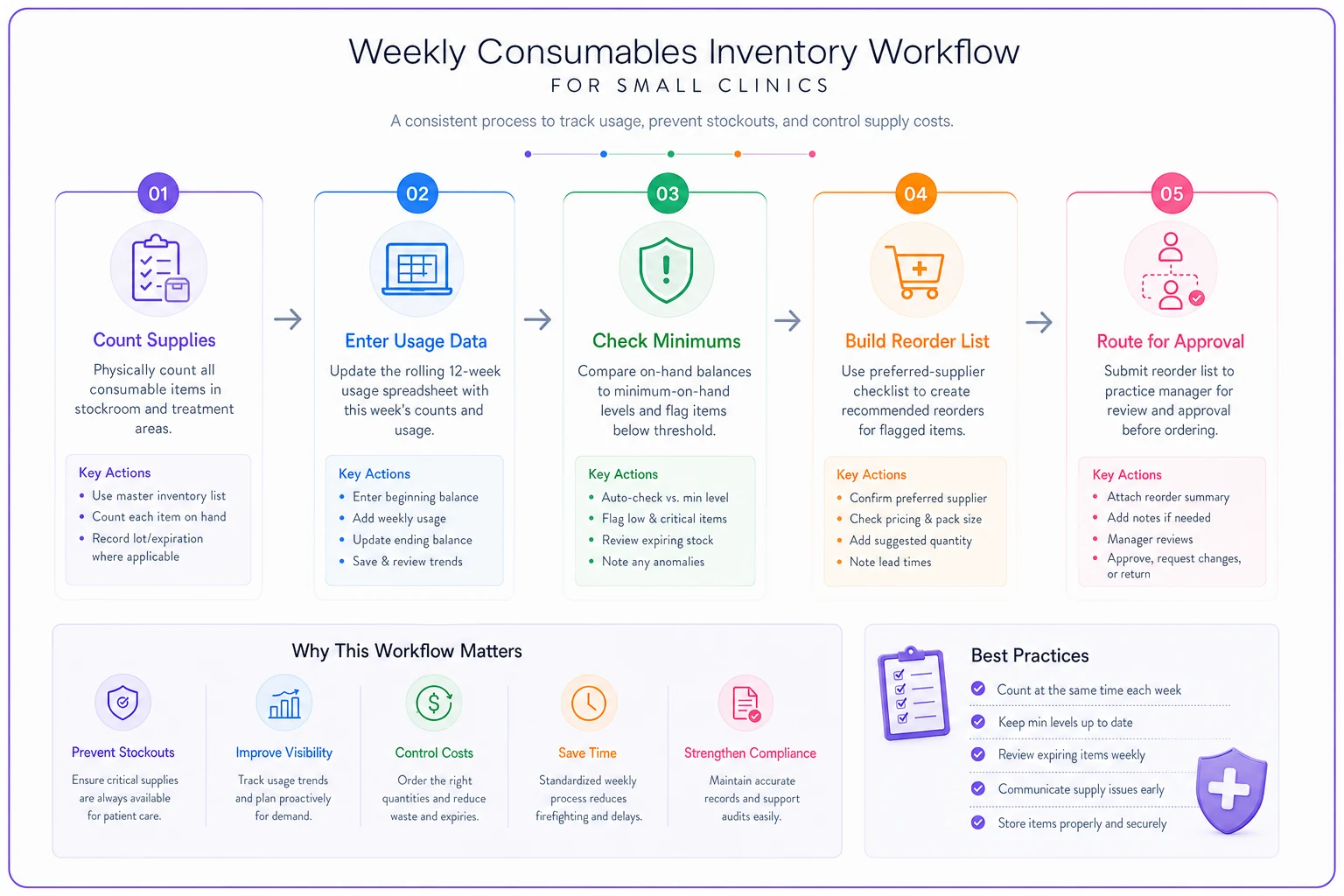
Do the weekly count on the same weekday and have the same person own it so the rolling 12-week data stays consistent.
This is also where software earns its keep without becoming the point. An AI-assisted operational platform can watch the consumption log and flag an item before it hits minimum, auto-draft the reorder from your preferred-supplier list, and route it to the right person based on the dollar threshold — so the weekly count becomes a quick confirmation instead of a from-scratch chore.
Useful, but the playbook still works on paper. The rules matter more than the tooling.
A reorder template you can copy
Keep the actual reorder record dead simple. Something like this per item:
| Item | Min-on-hand | Current count | Reorder qty | Preferred supplier | Unit price | Approval needed? |
|---|---|---|---|---|---|---|
| Exam gloves, M | 12 boxes | 10 | 20 | MedSupply Co (#4471) | $8.90/box | No (<$250) |
| 4x4 gauze | 15 packs | 14 | 24 | MedSupply Co (#2210) | $4.20/pack | No |
| Specimen containers | 6 cases | 5 | 8 | LabStock (#1180) | $62/case | Yes ($250–1k) |
| Isolation gowns | 8 cases | 6 | 10 | SafeGear (#3302) | $110/case | Yes |
One row per tracked consumable. The two columns that do the heavy lifting are min-on-hand and current count — the gap between them is your whole reorder decision.
A real scenario
A two-location family practice — about 45 and 60 daily visits across the sites — was dealing with constant small shortages: gloves, gauze, specimen cups, nasal swabs. Ordering was split across four staff with no shared list. They estimated two to four emergency supply runs or rush orders a week between the locations.
They built the playbook over about two weeks: set minimum-on-hand levels on roughly 30 high-use consumables, started a shared 12-week consumption log, locked in a preferred supplier and one backup per category, and set a $300 staff threshold.
Inside the first two months, emergency runs dropped to maybe one every couple of weeks, almost always tied to a genuinely unusual spike. Rush-shipping costs fell noticeably, and they found two items they'd been quietly double-ordering across locations. Nothing dramatic on any single line — but the daily low-grade chaos mostly disappeared, and the MAs stopped losing floor time to supply hunts.
That cross-site coordination piece matters more as you grow. The same "shared source of truth" thinking shows up in the float-pool staffing playbook for multi-site clinics, where the problem is people instead of supplies but the fix — shared rules instead of local memory — is the same shape.
When this is worth it (and when it isn't)
When it makes sense:
-
You're running on visual checks and "someone noticed we're low"
-
More than one person orders supplies
-
You've had any stockout of a clinical consumable in the last month
-
You run multiple sites or deal with seasonal volume swings
When it's overkill:
-
A true solo practice where one person physically touches every supply decision and already has a feel for it (though even then, a minimum-on-hand list for your five most critical items is cheap insurance)
-
A clinic with so little consumable variety that a wall-mounted whiteboard genuinely covers it
Who shouldn't bother building the full version: if you're replacing your practice management or inventory tooling in the next quarter, don't build an elaborate spreadsheet you'll abandon. Set minimums on your critical items as a stopgap and fold the full playbook into the new system.
The one habit that makes it stick
The system lives or dies on one thing: logging actual usage every week, on the same day, by the same role. Everything else — the minimums, the thresholds, the supplier list — stays accurate only if the consumption data stays current. Skip the weekly count for a month and your minimums slowly go stale, and you're back to ordering from memory.
Pick the day. Assign the owner. Keep the rolling 12 weeks honest.
Stockouts in a small clinic almost never come from a supply chain you can't control — they come from decisions made without numbers in front of you. Put the numbers in front of you, and the Tuesday-afternoon glove scramble just stops happening.
Ready to transform your practice workflow?
Join 2,000+ healthcare providers using GoCliny to increase efficiency, improve patient satisfaction, and grow revenue.