



The most frustrating part of a canceled surgery isn't the payer. It's that everyone in the practice knew the auth was pending, and nobody owned the clock.
A patient shows up pre-op fasting, family took the day off work, the surgeon has a block reserved — and someone in scheduling finds out that morning the authorization number never came back. Now you're eating the OR time, rebooking six weeks out, and the patient thinks your practice dropped the ball. From their perspective, you did.
For high-volume procedure practices — ortho, GI, pain management, urology, spine — this isn't an occasional miss. It's a structural leak. The same volume that makes these practices profitable is what makes prior auth impossible to track in a spreadsheet with three tabs and a color-coding scheme nobody's updated since Tuesday.
This piece is about one thing: building a prior authorization workflow procedures teams can actually run at volume, with hard timing anchors, owner-triggered reminders, and resubmission SLAs tied to your scheduling windows instead of floating in the void.
The real failure isn't the denial — it's the silence
The bigger killer is the auth that's just... sitting there. Submitted, "in review," no response, and the surgery date creeping closer while nobody's watching the specific gap between "we submitted" and "we should have heard back by now."
In real operations, this usually happens because auth tracking is organized around cases, not around time. Your coordinator knows patient Reyes needs an auth for a colonoscopy. What she doesn't have in front of her is: this payer's median turnaround is 5 business days, we submitted 9 days ago, the procedure is in 6 days, and this one is now in the danger zone.
A case-based view tells you what is pending. A time-based view tells you what's about to blow up. Almost every practice tracks the first and not the second.
Anchor everything to the procedure date, working backwards
The fix starts by flipping the mental model. Stop thinking "when did we submit." Start thinking "how many days until the procedure, and where should this auth be right now."
Eliminate appointment gaps and no-shows.
GoCliny streamlines every patient interaction from booking to billing—seamlessly.
- Unified appointment scheduling
- Automated patient reminders
- Staff calendar & task management
No credit card required
| Anchor | Timing | What has to be true | Owner |
|---|---|---|---|
| T-21 days | 3 weeks out | Auth submitted with complete clinical packet | Auth coordinator |
| T-14 days | 2 weeks out | Payer has acknowledged receipt / assigned reference # | Auth coordinator |
| T-10 days | ~1.5 weeks | If no decision, first status call placed | Auth coordinator |
| T-7 days | 1 week out | Approval in hand OR case escalated to lead | Auth lead |
| T-5 days | Danger zone | No approval = surgeon notified + patient flagged | Auth lead + scheduler |
| T-3 days | Final window | Go/no-go decision; fallback slot triggered if needed | Practice manager |
The exact numbers shift by specialty and payer mix. A practice with peer-to-peer-heavy payers might push the first status call to T-12. The point isn't these specific days — it's that every pending auth has a defined "where should this be right now" for its exact procedure date, and someone owns each checkpoint.
The mistake most teams make is setting one reminder ("check auths on Fridays") instead of anchoring reminders to individual procedure dates. A Friday sweep misses the auth for a Monday surgery that needed a status call on Wednesday.
Owner-triggered reminders, not calendar reminders
There's a subtle but important distinction here. Calendar reminders fire on a date. Owner-triggered reminders fire when a checkpoint is missed and land on a specific person's list until they clear it.
-
Procedure gets scheduled → system calculates all timing anchors backward from the date.
-
At each anchor, the workflow checks the auth status.
-
If the expected status is met (e.g., "submitted" by T-21), nothing happens. Silence is good.
-
If the expected status is not met, a task fires to the named owner for that checkpoint.
-
The task stays open, and visible on a shared board, until the status advances or someone escalates.
This is where an operational platform earns its keep — not by being clever, but by doing the backward-date math on every single case, every day, so a human doesn't have to remember which of 300-plus pending procedures crossed a threshold overnight. The system watches the clock; your coordinator works the exceptions. That's the only version of this that scales past a couple hundred cases a month.
Authorization templates: kill the "which documents again?" tax
A big chunk of auth delay isn't the payer at all — it's your own submission being incomplete, bouncing back for missing clinical notes, then re-entering the queue at the bottom.
-
Required CPT and diagnosis codes (with common failure pairings flagged)
-
Which clinical notes the payer historically demands (conservative-treatment history, imaging, failed-therapy documentation)
-
Medical-necessity language that has cleared this payer before
-
Whether this procedure/payer combo usually triggers a peer-to-peer, so you can pre-schedule the surgeon's availability
The payers that deny most aggressively are usually the most consistent about what they want. Once you've documented that Payer X always asks for six weeks of conservative care before approving an MRI-driven procedure, you stop losing three days per case relearning that lesson.
This is closely tied to clean coding upstream. If your codes are wrong at submission, no template saves you — the auth and the eventual claim both suffer. It's worth pairing this workflow with a real pre-submission QC step for coding so you're not authorizing one thing and billing another.
Fallback slots: protect the OR block from a single stuck auth
Some auths won't come through in time no matter how well you run the process. Peer-to-peers get scheduled a week out. Payers go quiet. A clinical note gets requested at T-8.
If your only plan is "hope it clears," a stuck auth doesn't just delay one patient — it burns a high-value OR block that can't be refilled on short notice.
Keep a short, rotating shortlist of pre-approved patients for each high-volume block and review it weekly so fallback swaps are fast and predictable.
The move is to designate fallback slots. For each high-volume block, keep a shortlist of patients whose auths are already approved and who can move up on 48–72 hours notice. When an auth hits the T-5 danger zone with no approval, the scheduler doesn't wait — they start the fallback conversation in parallel.
A practical example: a GI practice running two scope days a week, roughly 18–22 procedures per day, keeps a "ready-to-move" list of 5–6 pre-approved patients per week. When a Tuesday case stalls on auth, a fallback patient slides in, the block stays full, and the delayed patient gets rebooked into the next available slot rather than leaving a same-day hole.
Resubmission SLAs tied to the scheduling window
When an auth gets denied or bounced for missing info, the clock doesn't reset to comfortable. It resets to how many days you have left before the procedure. That number should drive your resubmission speed — not a generic "we resubmit within 5 business days" policy.
| Days until procedure at time of denial/RFI | Resubmission SLA |
|---|---|
| More than 14 days | Resubmit within 48 hours |
| 7–14 days | Resubmit within 24 hours |
| Under 7 days | Same-day resubmit + escalate to lead + prep fallback slot |
| Under 3 days | Escalate to manager immediately; assume fallback needed |
The common failure is treating every denial with the same urgency. A bounce-back at T-20 and a bounce-back at T-4 are completely different emergencies, and a flat SLA treats them identically — which means the T-4 case doesn't get the panic it deserves until it's too late.
The other half of this is closing the loop on why it bounced, so the same missing-note problem doesn't recur across dozens of cases. Denial patterns feed back into your templates. If a payer keeps requesting the same document you keep forgetting to include, that's a template fix, not a per-case fix.
A tight workflow you can actually run
> [WORKFLOW GRAPH: Prior Authorization Lifecycle — from procedure scheduling through go/no-go decision, with timing anchors, owner assignments, and fallback triggers at each stage]
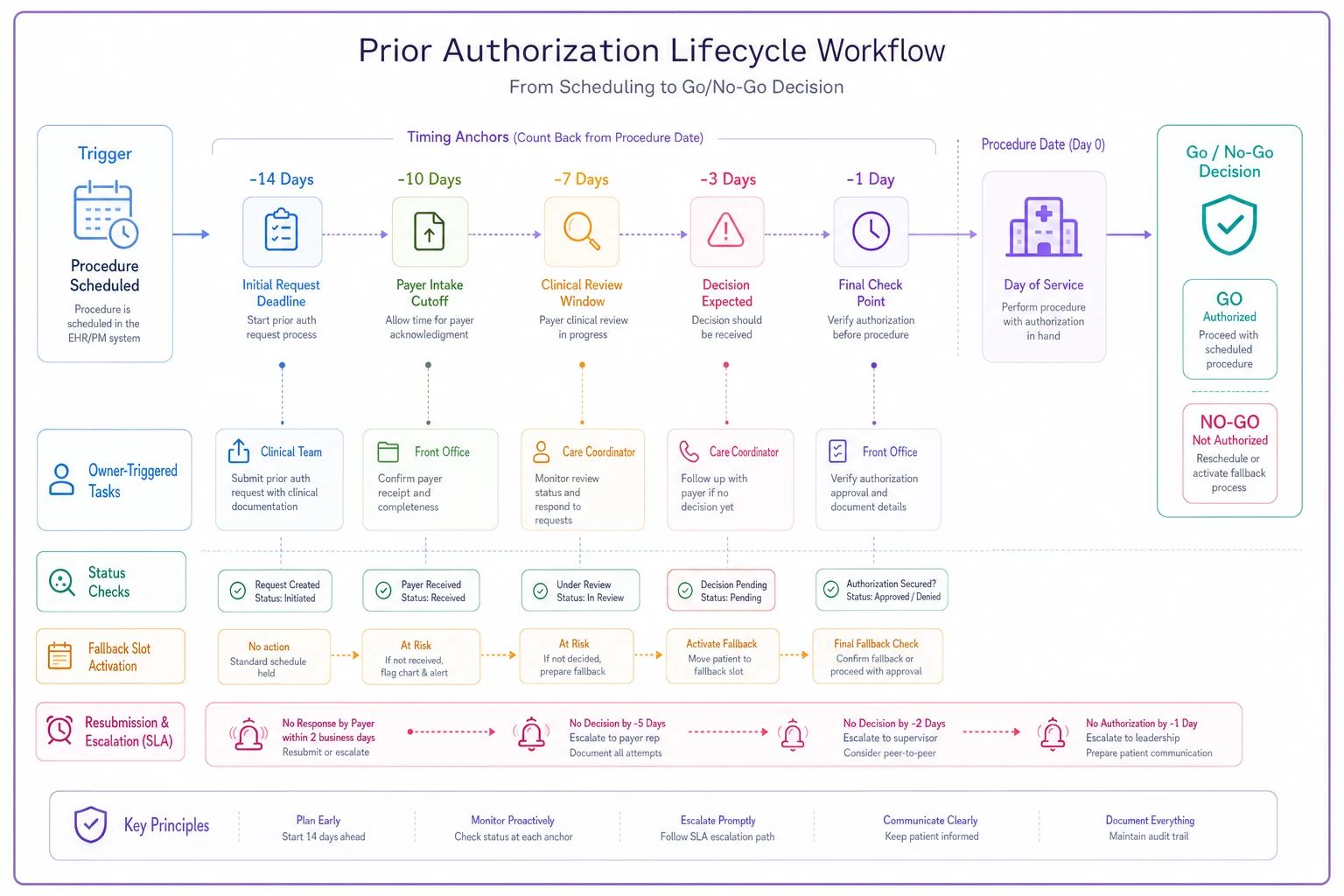
Pulling it together, here's the operational loop for a single procedure:
-
Schedule → procedure date set, timing anchors auto-calculated backward.
-
Assemble → coordinator pulls the procedure+payer template, builds a complete packet.
-
Submit by T-21 → status logged; if not submitted by anchor, owner task fires.
-
Confirm receipt by T-14 → payer reference number captured.
-
Status call at T-10 if no decision → outcome logged.
-
Escalate at T-7 if still pending → auth lead owns it.
-
Danger flag at T-5 → surgeon and scheduler notified; fallback shortlist prepped.
-
Go/no-go at T-3 → approved patient confirmed, or fallback slot activated and patient rebooked.
-
On any denial/RFI → resubmission SLA fires based on days remaining; root cause logged back to the template.
No step relies on someone remembering to check. Every action is either triggered by a checkpoint or by a status that failed to advance. The difference between this and a spreadsheet isn't sophistication — it's that the spreadsheet waits for someone to open it.
When this level of structure is worth it — and when it isn't
This whole system is built for volume and for procedures where a lost slot is expensive. It makes sense when:
-
You're running 100+ authorizations a month across multiple payers.
-
A canceled procedure means a hard-to-refill block, not just a bumped office visit.
-
Your denial or delay rate on auth-required procedures is noticeably hurting throughput.
It's overkill if your auth volume is low and genuinely manageable by one person who stays on top of it. A solo practice doing a handful of auth-required procedures a month doesn't need backward-date automation — they need a good checklist and one reliable person.
Who should not do this: practices trying to fix a submission-quality problem with better tracking. If half your auths bounce because the clinical documentation is thin or the codes are wrong, no timing anchor will save you. Fix the packet first, then add the timing discipline on top. This connects directly to the broader revenue-cycle picture — auth delays are one of the RCM mistakes that quietly sink clinics, and they compound with downstream denials when the front end is sloppy.
Real scenario: an ortho practice that stopped bleeding OR time
An orthopedic group running roughly 90–110 auth-required procedures a month had a recurring problem: somewhere between 6–8 procedures a month were delayed or canceled last-minute because the auth wasn't back in time. Each cancellation meant a half-empty block and a patient rebooked 4–5 weeks out.
The tracking was the classic setup — shared spreadsheet, one coordinator, sorted by patient name. Cases were visible; time pressure was not. The coordinator was working hard but always reacting to whatever caught fire that morning.
They rebuilt the process around backward-dated anchors and owner-triggered tasks, added procedure+payer templates for their top five procedure combinations, and stood up a fallback list of pre-approved patients for each surgery day. Within a couple of months, last-minute delays dropped to about 1–2 a month, and most of those got absorbed by a fallback slot instead of leaving an empty block. The coordinator's day shifted from "hunt for what's overdue" to "work the handful of exceptions the board flagged."
Nothing exotic happened. They stopped organizing auths by patient name and started organizing them by time, with a named owner at every checkpoint.
The one thing to change first
If you do nothing else from this, change the unit of tracking. Stop asking "what's pending" and start asking "where should each pending auth be, given its procedure date, and who owns the gap."
Everything else — templates, fallback slots, resubmission SLAs — hangs off that single shift. High-volume procedure practices don't lose surgeries because payers are slow. They lose them because nobody owned the specific days between "we submitted" and "we should have heard back by now." Close that gap, and the last-minute cancellations mostly stop being a thing.
Everything else — templates, fallback slots, resubmission SLAs — hangs off that single shift. High-volume procedure practices don't lose surgeries because payers are slow. They lose them because nobody owned the specific days between "we submitted" and "we should have heard back by now." Close that gap, and the last-minute cancellations mostly stop being a thing.
Ready to transform your practice workflow?
Join 2,000+ healthcare providers using GoCliny to increase efficiency, improve patient satisfaction, and grow revenue.