


You're sitting on $47,000 in unpaid claims. Three months old. The denial letters keep piling up—incorrect modifiers, unbundling errors, missing documentation requirements. Your biller is overwhelmed, your providers are frustrated about delayed payments, and you're hemorrhaging cash because nobody caught these coding mistakes before submission.
This isn't about hiring a certified coding auditor or buying expensive compliance software. Most small practices can't afford either. What you need is a practical coding quality control workflow that catches the obvious mistakes killing your revenue—without adding hours to your week.
Why coding errors multiply in smaller practices
Small practices face a unique coding quality challenge. Your medical assistant who handles coding probably learned on the job. They're juggling front desk duties, prior authorizations, and patient callbacks while trying to code 40 encounters before the billing deadline. No dedicated coder, no formal training program, just someone doing their best with limited resources.
The errors compound quickly. A family practice I worked with discovered their MA had been using 99213 for every established patient visit for six months straight. Never 99214, never 99212—just the middle code because "it seemed safest." They left roughly $28,000 on the table from undercoding complex visits.
Another clinic had the opposite problem. Their provider insisted every visit with multiple complaints qualified as 99215. The audit flagged 67% of their high-level codes as unsupported. The recoupment demand came to $41,000.
When inexperienced coders meet rushed workflows and zero quality checks, coding errors become inevitable. The denials just confirm what's been broken all along.
The hidden cost calculation most practices miss
Every denied claim costs you approximately $25–$32 to rework. That includes staff time for review, correction, resubmission, and follow-up. A practice submitting 800 claims monthly with a 12% initial denial rate faces 96 denials. At $28 per rework, that's $2,688 monthly in pure administrative waste—before counting the cash flow impact.
Eliminate appointment gaps and no-shows.
GoCliny streamlines every patient interaction from booking to billing—seamlessly.
- Unified appointment scheduling
- Automated patient reminders
- Staff calendar & task management
No credit card required
About 35% of denied claims never get successfully resubmitted. Staff get overwhelmed, deadlines pass, documentation goes missing. That $180 claim for a 99214 visit? Gone forever.
The opportunity cost hits harder than the direct losses. While your biller spends three hours daily fighting denials, they're not working on clean claims, following up on aging AR, or catching upcoming filing deadlines. The dysfunction cascades through your entire revenue cycle.
Building your sampling strategy without drowning in audits
Full coding audits aren't realistic for small practices. You need a sampling approach that catches patterns without reviewing every single claim.
Start with 5% sampling for established workflows, 15% for new providers or service lines. That means checking 5 claims per 100 for your regular family medicine visits, but 15 per 100 when you add a new PA or start offering trigger point injections.
Your sampling priorities:
-
New provider's first 30 days
review 20% of all claims
-
High-dollar procedures over $400
review every claim
-
Modifier-heavy services (PT, injections)
10% sample
-
Routine follow-ups under $150
3% sample
-
Previously denied code combinations
100% pre-review for 60 days
A dermatology practice using this approach caught a critical pattern in week two. Their new provider was billing destruction codes (17000-17004) incorrectly, counting each lesion as a separate primary code instead of using add-on codes. The sampling caught $4,200 in potential recoupments before submission.
Critical error checks that prevent 80% of denials
Most coding denials stem from a handful of predictable errors. Your quality control doesn't need to catch everything—just the patterns that consistently trigger rejections.
Modifier mishaps Check every claim with modifiers -25, -59, or -51. These generate more denials than all other modifiers combined. Your QC should verify:
-
Is the E/M truly significant and separately identifiable from the procedure (-25)?
-
Does the operative note support distinct procedural services (-59)?
-
Are multiple procedures listed in descending RVU order (-51)?
One orthopedic practice reduced modifier-related denials by 71% just by requiring documentation of "separate and significant" in the assessment when billing -25 modifiers.
Time-based code validation For codes dependent on time (99354-99357, 99406-99407, certain E/M codes), your QC must confirm:
-
Total time is documented
-
Time exceeds minimum threshold
-
Provider personally performed the time-based service
Practices lose $15,000+ annually from incorrectly billing prolonged service codes without proper time documentation.
Bundling violations Your EHR might not catch CCI edits. Manual QC should flag:
-
E/M services billed with minor procedures (often included)
-
Bilateral procedures without -50 modifier
-
Component codes billed with comprehensive codes
Create a "frequent offenders" list specific to your specialty. For primary care, that might include 36415 (venipuncture) with 80053 (comprehensive metabolic panel), or double-billing injection admin codes.
The remediation loop that actually gets followed
Finding errors means nothing if they don't get fixed. You need a remediation workflow that happens automatically, not through heroic effort.
The 24-hour rule Flagged claims get held for maximum 24 hours. No endless review cycles, no perfectionism. The reviewer has one business day to either:
-
Approve with documentation
-
Fix and release
-
Return to provider for clarification
-
Cancel and rebill correctly
After 24 hours, claims go out as-is. This prevents the backlog that kills most QC programs.
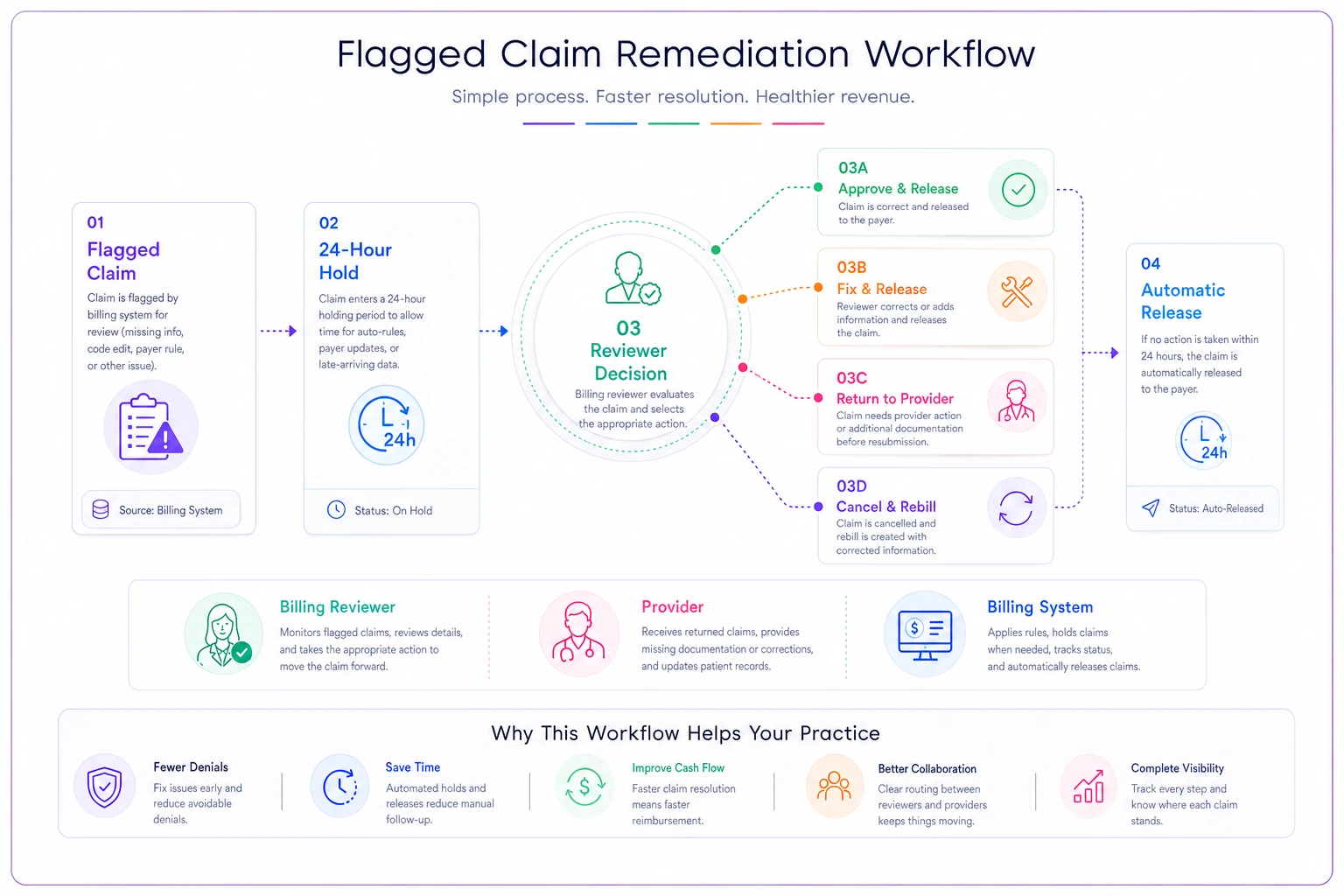
Here's a compact flowchart that clinics can pin to their workflow.
Feedback that changes behavior Monthly error reports don't work. By the time a provider sees their coding mistakes from four weeks ago, they've repeated the error 50 more times.
-
Text the provider
"Quick note - your chronic pain visits (3+ stable problems) support 99214, not 99213. I've updated yesterday's visits."
-
Email screenshot
"See attached - when billing injection + E/M, always add -25 modifier to E/M code"
-
Sticky note on desk
"Remember: 20-29 minutes = 99213, 30-39 minutes = 99214"
A cardiology practice implemented this micro-feedback system and saw coding accuracy improve from 76% to 91% within six weeks.
Documentation prompts that prevent coding mismatches
Most coding errors trace back to documentation gaps. The visit might support a 99214, but the note doesn't prove it. Build prompts that force better documentation.
Pre-visit prompts
-
"Patient has 4+ chronic conditions - document status of each"
-
"New symptom + chronic disease management - specify time spent on each"
-
"Procedure planned - document separate E/M decision-making"
Real-time alerts
-
"You selected 99215 - have you documented 40+ minutes or high complexity MDM?"
-
"Injection performed - if billing E/M separately, document distinct service"
-
"Multiple procedures - specify order and laterality"
Post-visit catches
-
"Time-based billing selected but no duration documented"
-
"High-level code chosen - complexity elements not met"
-
"Modifier used without supporting documentation"
These prompts feel annoying initially but prevent the downstream chaos of denials and audits. Getting providers to actually use them takes persistence.
Tracking metrics that show if QC actually works
You can't just implement QC and hope. You need proof it's catching errors and improving outcomes.
Track these weekly:
-
First-pass denial rate (should drop 30-40% within 60 days)
-
Coding change rate (what % of sampled claims need correction)
-
Average reimbursement per visit type (catches systematic under-coding)
-
Provider-specific error patterns
Monthly deeper dives:
-
Which codes generate most denials?
-
Which providers need additional training?
-
Are certain payers rejecting clean claims?
-
Is documentation improving over time?
One internal medicine practice discovered through tracking that their denial rate dropped from 11% to 7%, but their average reimbursement per visit increased $12. The QC was catching both over-coding and under-coding errors.
Automation opportunities without complex systems
Small practices don't need enterprise coding software, but basic automation can eliminate repetitive QC tasks.
Rule-based flags
-
Flag any 99215 without time or complexity documentation
-
Alert when vaccine codes lack corresponding admin codes
-
Highlight missing modifiers on bilateral procedures
-
Warn about global period violations
Pro-tip: Start with simple spreadsheet rules to flag provider-level outliers before investing in dashboards.
Batch checking
-
Pull all injection visits from the week
-
Extract every preventive visit with additional services
-
List all telehealth encounters for modifier verification
Pattern detection
-
Provider using same code >70% of time
-
Sudden spike in high-level coding
-
Unusual code combinations appearing repeatedly
A pediatric practice built a simple spreadsheet that flagged whenever well-child visits included problem-focused codes without modifier -25. Caught 23 potential denials in the first month.
Modern operational software can centralize these checks into dashboards that automatically flag outliers and track improvements over time, turning manual spot-checks into systematic quality improvement.
Creating accountability without adding bureaucracy
QC fails when it becomes another layer of bureaucracy. You need accountability that feels natural, not punitive.
Rotating responsibility
Don't make one person the permanent "coding police." Rotate QC duty monthly among qualified staff. This spreads knowledge and prevents the adversarial dynamic of permanent auditor vs. providers.
Transparent scorecards
-
Clean claim rate by provider
-
Days in AR by coder
-
Weekly denial count with top reasons
Not to shame, but to create shared ownership. When Dr. Smith sees she has the lowest denial rate, she'll help Dr. Jones improve his documentation.
Skin in the game
-
$100 monthly bonus for <5% denial rate
-
Pizza lunch when clean claim rate hits 95%
-
Half-day Friday if no coding returns this week
Small rewards that make quality feel like a team sport, not a compliance burden.
Who should skip formal QC (and why that's okay)
Some practices genuinely don't need structured coding QC:
Direct primary care models: If you're cash-only or membership-based with no insurance billing, complex coding QC wastes resources.
Single-provider practices billing <300 claims monthly: The volume doesn't justify formal QC. Spot-check your highest dollar claims and move on.
Specialties with narrow code sets: If you're a therapist using five CPT codes total, extensive QC adds little value.
Practices with outsourced billing including audit services: Your billing company should handle this. Just verify they're actually doing it.
For everyone else—multi-provider practices, surgical specialties, anyone billing 500+ claims monthly—skipping QC is like driving without insurance. You'll save time until the accident happens.
The implementation timeline that actually sticks
Week-by-week breakdown of what actually works when implementing coding QC across different practice sizes and specialties.
| Week | Action Item | Expected Outcome |
|---|---|---|
| 1 | Pick sampling percentages and assign claim reviewer | Initial baseline established |
| 2-3 | Run first samples, document findings only | Pattern identification begins |
| 4 | Implement 24-hour hold for flagged claims | Error correction workflow active |
| 5-6 | Launch micro-feedback system | Provider behavior starts changing |
| 7-8 | Add documentation prompts for biggest error category | Prevention measures in place |
| Month 3 | Evaluate metrics, adjust sampling, celebrate wins | System optimization and team buy-in |
The practices that succeed don't try to fix everything at once. They start small, build momentum, then expand. Perfectionism kills more QC programs than laziness does.
Beyond survival mode
Coding quality control isn't about perfection. It's about catching the expensive mistakes before they hit your bank account. The practices that thrive long-term aren't the ones with perfect coding—they're the ones with systems that catch errors quickly and fix them cheaply.
This framework won't eliminate denials entirely. You'll still fight some claims, still lose some revenue to coding mistakes. But you'll catch the patterns that matter, fix the workflows that break repeatedly, and stop hemorrhaging cash to preventable errors.
Start with sampling. Add simple checks. Build feedback loops. Track what matters. The practices implementing even basic coding QC see denials drop by a third within 90 days.
Start with sampling. Add simple checks. Build feedback loops. Track what matters. The practices implementing even basic coding QC see denials drop by a third within 90 days.
Ready to transform your practice workflow?
Join 2,000+ healthcare providers using GoCliny to increase efficiency, improve patient satisfaction, and grow revenue.