



Most clinics renegotiate payer contracts about as often as they replace the waiting room carpet. It happens when someone finally notices things look bad, not on any schedule, and definitely not with data. The contract renews on autopilot, the fee schedule gets a 1.5% bump nobody argues with, and everyone moves on.
The problem is that the money leaking out of a bad contract doesn't show up as one big number. It shows up as denial rates that creep up two points a year, prior-auth requirements that eat 20 minutes of staff time per patient, and reimbursement rates that fell behind inflation four years ago and never caught up. None of it screams. It just quietly compounds.
A payer contract health check is the fix — but only if it's reproducible. A one-time analysis done by a consultant who leaves with the spreadsheet isn't worth much. What you want is a repeatable audit you can run every quarter, that pulls the same data the same way, so you can walk into a renegotiation with a brief that says exactly what's wrong, how much it's costing you, and what you're asking for.
This is how to build that.
Start with the contracts that actually matter, not all of them
The first mistake clinics make is trying to audit every payer at once. If you have 14 active contracts, you don't need 14 negotiation briefs. You need to find the three or four that are quietly underperforming and actually worth the effort of reopening.
Ranking them isn't just about volume. A payer that represents 30% of your visits but pays cleanly and fast is not your problem. Your problem is the payer that represents 12% of your revenue but generates 40% of your denials and takes 55 days to pay.
-
Revenue share — what percent of total collected revenue comes from this payer
-
Denial rate — denied claims as a percent of submitted claims, by payer
-
Days in AR — how long this payer actually takes to pay, not what the contract says
-
Prior-auth burden — how often this payer requires auth relative to others
-
Rate position — where their fee schedule sits vs. Medicare and vs. your other commercial payers
The payers that score badly on denials, AR days, and rate position simultaneously go to the top. Those are the ones where a negotiation brief pays for itself.
What shows up across a lot of practices is that the worst contract is rarely the one people complain about. Staff complain loudest about the payer with the annoying portal. The payer actually costing you money is usually the one nobody thinks about because the claims mostly go through — they just go through at a rate that's 18% below your next-best commercial contract.
The data pulls that make the audit reproducible
If you want this to be something you can run again in three months and trust the comparison, the data pulls need to be defined precisely. "Denial rate" means nothing until you've decided whether you're counting first-pass denials, all denials, or denials net of appeals that eventually paid.
Eliminate appointment gaps and no-shows.
GoCliny streamlines every patient interaction from booking to billing—seamlessly.
- Unified appointment scheduling
- Automated patient reminders
- Staff calendar & task management
No credit card required
Pick definitions and freeze them. Here's a starting set that holds up:
| Metric | Precise definition | Where it comes from |
|---|---|---|
| First-pass denial rate | Claims denied on initial submission ÷ total claims submitted, by payer | Clearinghouse / PM system |
| Net denial rate | Claims never paid after appeals ÷ total submitted | PM system + appeals log |
| Prior-auth frequency | % of claims for this payer requiring prior auth | Auth tracking + claim data |
| Prior-auth turnaround | Avg. business days from auth request to decision | Auth log |
| Days in AR (payer-specific) | Avg. days from submission to payment posting | PM system |
| Effective reimbursement rate | Actual paid amount ÷ Medicare allowable for same code | Remit data + fee schedule |
| Revenue-at-risk | Annualized $ tied to denials, delays, and below-market rates | Calculated |
The effective reimbursement rate is the one people skip and shouldn't. Contracts are written as fee schedules, but what you actually collect is different — because of denials, downcoding, and bundling rules. A contract can look fine on paper and pay 12% below what the paper says once you measure real remits.
Revenue-at-risk is what turns this from a report into a negotiation tool. It's the number that goes in the brief. For each underperforming term, you want a dollar figure attached: "This payer's 9.4% first-pass denial rate on prior-auth-required procedures represents roughly $47k–$54k a year in delayed or lost revenue and about 340 staff hours in rework."
Getting these pulls consistent is where a lot of clinics stall, because the numbers live in three different systems and someone has to reconcile them by hand every time. This is exactly the kind of thing worth centralizing once. If your KPI definitions and owners aren't already nailed down, the groundwork in building a single source of truth with a clinic KPI taxonomy makes this audit repeatable instead of a from-scratch scramble every quarter.
Benchmarking: the numbers only mean something in context
A 7% denial rate sounds bad or fine depending entirely on what you compare it to. Without benchmarks, your negotiation brief is just complaining with decimals.
There are three benchmarks worth building against, and they do different jobs.
Internal cross-payer benchmark. Compare each payer against your own other payers for the same service mix. This is the most persuasive number in a negotiation because it's undeniable — you're doing the exact same work and getting paid meaningfully less. "Your denial rate on office visits is 8.1%; across our other three commercial payers for the same codes it's 3.2%."
Medicare-relative benchmark. Express commercial rates as a percentage of Medicare allowable. This is standard language payers understand and can't wave away. If they're paying you 108% of Medicare while a comparable regional plan pays 125%, that gap is your ask.
Operational-cost benchmark. This one gets ignored and it's a mistake. A payer with a 15-business-day prior-auth turnaround isn't just slow — it's imposing a real labor cost on you. Roughly quantify it: hours per auth × auth frequency × loaded staff cost. That becomes a legitimate line in the brief, especially when you're asking for reduced prior-auth requirements rather than just higher rates.
Something worth noticing: clinics almost always ask for rate increases and almost never ask for administrative simplification. But administrative asks — fewer codes requiring prior auth, faster auth turnaround, tighter payment timelines with interest penalties — are often easier wins because they don't directly hit the payer's medical-loss ratio the way a rate bump does. And they're worth real money on your side.
When this audit actually makes sense — and when it doesn't
Running a full health check isn't free. It takes analyst time and, if you're serious, some negotiation prep. So it's worth being honest about when it's actually worth doing.
It makes sense when:
-
A contract is coming up for renewal in the next 6–9 months
-
One payer's denials or AR days have visibly drifted worse over a few quarters
-
You've added a service line and aren't sure the rates reflect it
-
You have enough claim volume with a payer to make renegotiation worth their attention
It's probably not worth it when:
-
The payer represents under roughly 4–5% of revenue and pays cleanly — the leverage isn't there
-
You're inside a multi-year locked term with no reopener clause
-
You genuinely lack the volume to move a payer's position; smaller practices sometimes have to accept take-it-or-leave-it terms and focus energy on denial prevention instead
That last point matters. If you don't have negotiating leverage, the higher-return move is tightening your own operations — cleaner claims, better coding QC, faster appeals — rather than a renegotiation that won't move. The broader operational picture in avoiding the RCM mistakes that sink clinics is often where a low-leverage practice should focus first.
The negotiation brief template
Once the audit is done, everything funnels into a single document. The brief is what makes a negotiation feel like a business conversation instead of a plea. Keep it to two or three pages. Payers respond to specificity, not volume.
-
Contract snapshot. Payer name, current term dates, renewal/reopener date, your revenue share with them, current rate position vs. Medicare.
-
The three underperforming terms. Don't list ten. Pick the three with the biggest revenue-at-risk. For each: what the term is, how it performs vs. benchmark, and the dollar impact.
-
Quantified asks. For each problem term, a specific, numeric ask. Not "raise our rates" — instead "move E/M codes 99213–99215 from 108% to 122% of Medicare." Not "improve prior auth" — instead "remove prior-auth requirement for [3 specific codes] with denial rates under 2%."
-
Impact assessment. What each ask is worth to you annually, and — this is the underused part — how it's neutral or low-cost to them. Framing an ask as low-friction for the payer gets it granted more often.
-
Fallback positions. Know your walk-back before you're in the room. If they won't move rates, will they cut auth requirements? If they won't do either, what's your BATNA — can you afford to go out of network with a payer at 4% of revenue?
> Ask 1: Increase office-visit E/M reimbursement from 108% to 120% of Medicare allowable. Impact: ~$38k annually. Rationale: our other three commercial payers average 121% for identical code mix. > > Ask 2: Remove prior-auth requirement on codes with historical approval rates above 97%. Impact: ~$14k in recovered staff time, ~4-day faster access for patients. Cost to payer: negligible — these are near-universally approved already. > > Ask 3: Add a 30-day clean-claim payment clause with 1% monthly interest. Impact: reduces our payer-specific AR from ~52 days toward contract terms.
That's a brief a payer's contracting rep can actually respond to, line by line. Vague grievances get vague answers.
A real scenario
A three-provider primary care practice in the Midwest hadn't touched two of its commercial contracts in over five years. Front-desk and billing staff assumed everything was "fine" because most claims paid.
The health check pulled six quarters of remit data and found one payer — about 13% of revenue — sitting at a 9% first-pass denial rate and paying 106% of Medicare, while the practice's two other commercial payers paid 119–124% for the same code mix. Prior auth was required on a batch of routine imaging codes that were approved 98% of the time anyway, burning somewhere north of 300 staff hours a year on paperwork that almost never changed the outcome.
Total revenue-at-risk on that one contract came to somewhere around $60k–$70k annually between the rate gap and the denial rework.
They built the brief, led with the internal cross-payer benchmark, and asked for a Medicare-relative rate increase plus removal of prior auth on the high-approval imaging codes. They didn't get the full rate ask — they landed around 116% instead of the 120% they requested — but they got the prior-auth requirement dropped entirely on those codes. Net effect over the following year was somewhere in the mid-five figures, most of it from rate, with a noticeable drop in billing-staff frustration on top.
Worth underlining: the practice had been "fine" for five years while leaving that on the table every single year. The money was invisible until someone pulled the data the same way twice and compared.
Make it a schedule, not an event
The single biggest reason contract health checks don't stick is that they're treated as a one-off. Someone does a heroic analysis, wins a renegotiation, and then nobody looks at it again for four years — and drift starts over.
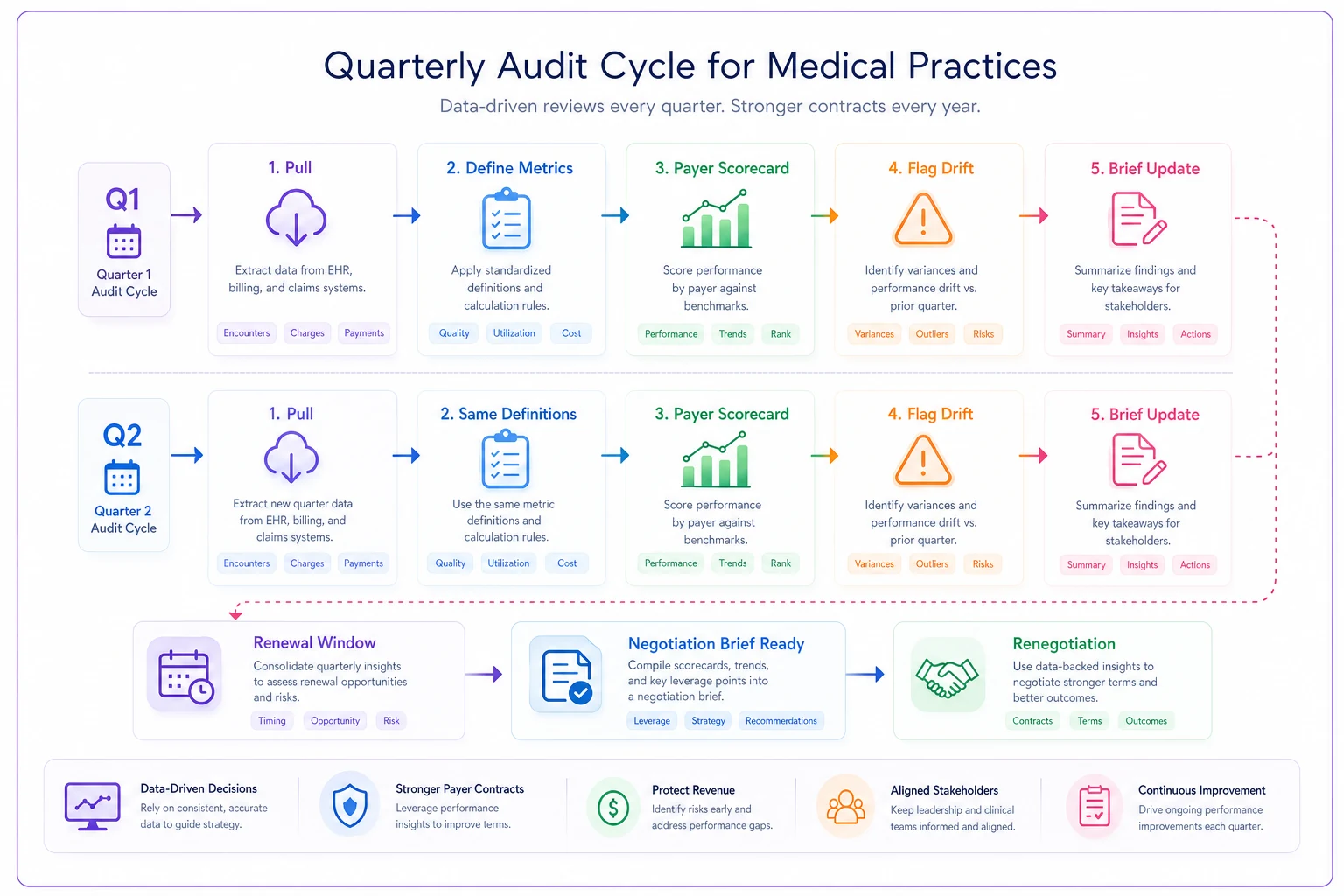
Put the quarterly audit on the calendar and assign an owner for the data pulls.
The version that works is boring on purpose. Same data pulls, same definitions, run once a quarter, feeding a running view of denial rates, AR days, prior-auth burden, and rate position by payer. When a metric drifts, you catch it in a quarter, not in year four. And when a contract comes up for renewal, the brief practically writes itself because the numbers are already there and already trended.
That's the real value of making the audit reproducible — not the single big renegotiation win, but never again being surprised by a contract that's been quietly underpaying you the whole time.
Ready to transform your practice workflow?
Join 2,000+ healthcare providers using GoCliny to increase efficiency, improve patient satisfaction, and grow revenue.