

Most clinics are drowning in feedback they never use. Google reviews pile up. The quarterly patient satisfaction survey gets emailed to 1,200 people, 80 respond, someone exports it to a spreadsheet, and then nothing. The scores get presented at a staff meeting, everyone nods, and three months later the same complaints show up again.
The gap isn't collecting feedback. Almost every practice does that. The gap is the pipeline between a patient telling you something's broken and someone actually fixing it. That pipeline is where a real closed loop patient feedback clinic process lives — and it's almost never built.
This post is about that pipeline specifically. Not survey design theory, not NPS philosophy. The actual mechanics of turning "the phone tree is awful" into a prioritized, owned, time-boxed fix that you can measure later.
Where most feedback dies
Long surveys are where good intentions go to die. A 22-question satisfaction survey gets you a 6% response rate and data so vague it's useless. You learn that "communication" scored 3.8 out of 5, which tells you exactly nothing about what to do Monday morning.
What we've seen across a lot of practices is that the feedback actually driving change is short, specific, and tied to a moment. A patient who just finished a visit and gets a two-question text — "Did we start your appointment on time? Anything frustrating today?" — gives you something you can act on. A patient who gets a long survey two weeks later gives you averages.
The second place feedback dies is ownership. Comments come in, but nobody owns them. "The portal is confusing" — is that the front desk's problem? IT's? The practice manager's? When everyone could own it, nobody does, and it sits in a spreadsheet forever.
The third place — the quiet killer — is severity blindness. A comment about cold coffee in the waiting room gets the same attention as a comment about a patient who couldn't get a callback for three days about a medication question. Without triage, your team spends energy on trivia while the stuff that actually drives patients away sits untouched.
The compact funnel, start to finish
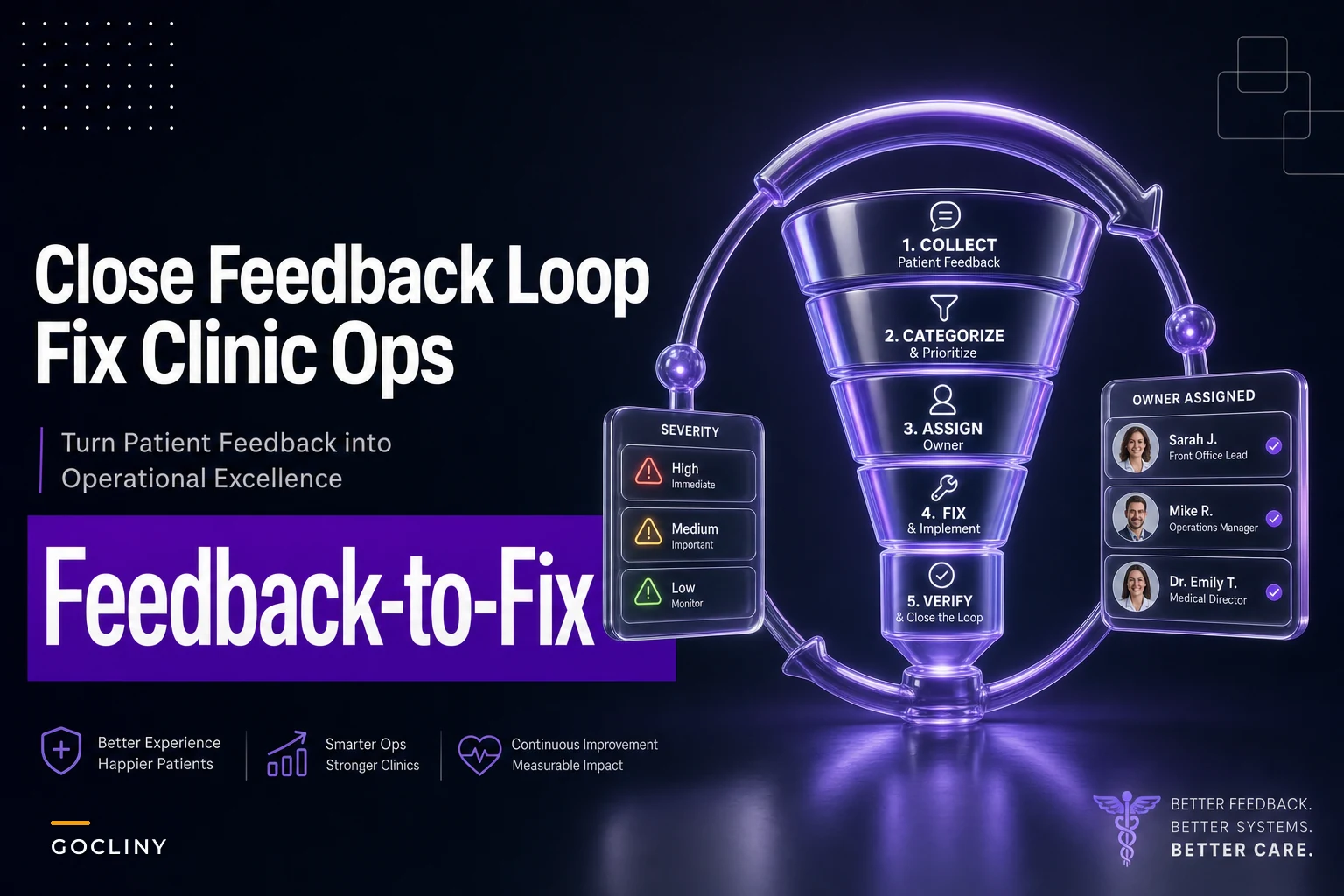
The whole point is a narrow, fast loop. Feedback comes in short, gets sorted by severity, lands on a named owner's desk, gets worked in a sprint, and gets measured. Five stages. That's it.
Eliminate appointment gaps and no-shows.
GoCliny streamlines every patient interaction from booking to billing—seamlessly.
- Unified appointment scheduling
- Automated patient reminders
- Staff calendar & task management
No credit card required
Here's how each one actually runs in a clinic — not how it looks on a slide.
Here's a visual of that pipeline.
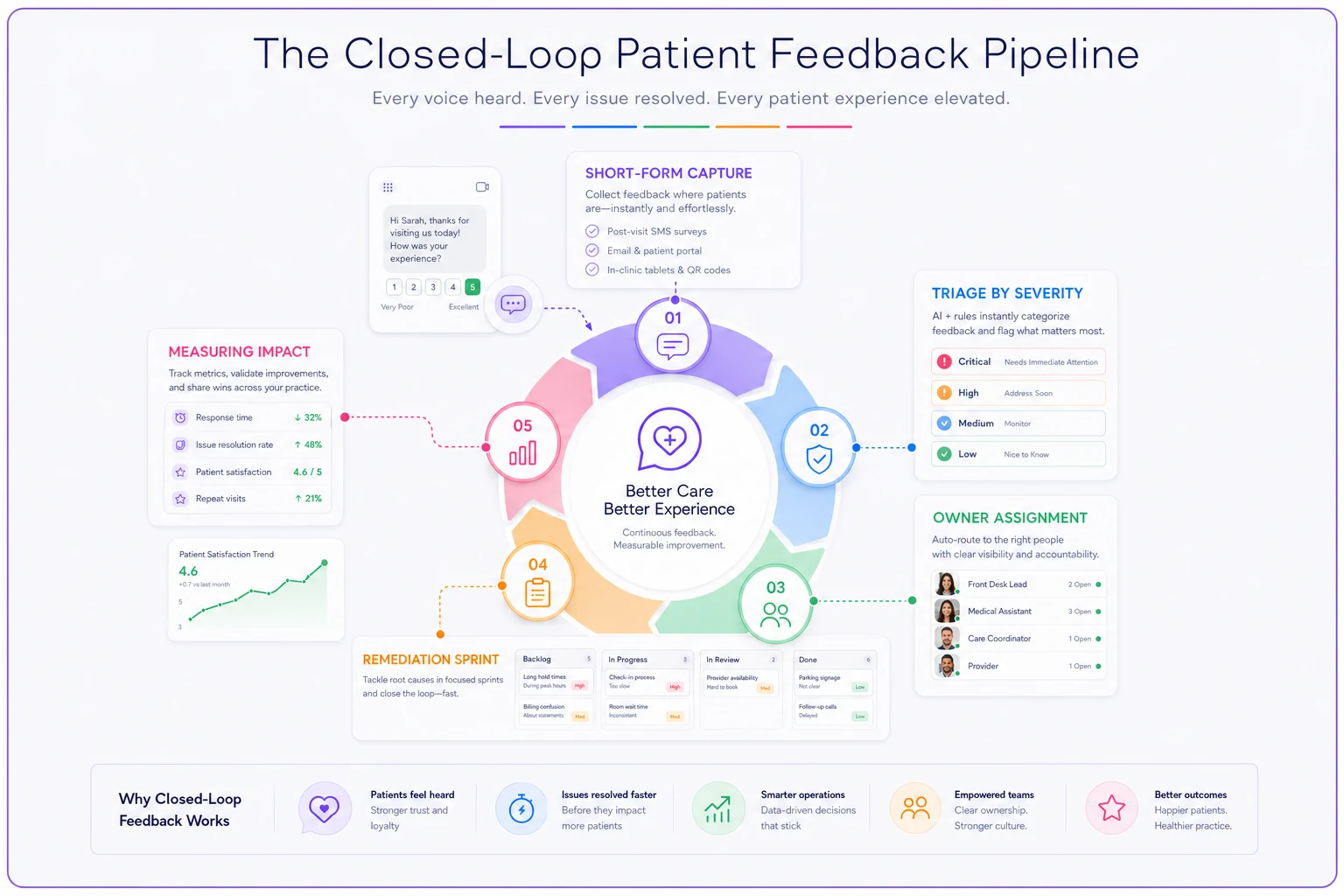
1. Short-form capture (the two-to-four question rule)
Stop asking everything. Pick the two or three things you can actually change and ask about those while they're still fresh.
-
Did your visit start close to the scheduled time? (Yes / A little late / Very late)
-
Was anything frustrating about today's visit? (open text, optional)
-
How easy was it to reach us before today? (1–5)
Three questions. Sent by text an hour after checkout. Response rates on this format tend to land somewhere in the 25–40% range — night-and-day compared to the long annual survey.
The access question matters more than people realize. "How easy was it to reach us" is a leading indicator of churn. Patients who can't get through on the phone or can't book online don't complain — they just quietly find another practice. Pairing short post-visit capture with a look at your waitlist and access prioritization rules gives you a much clearer picture of where access is actually breaking.
2. Triage by severity
Every piece of feedback needs a severity tag the moment it arrives. Keep the scale simple — three tiers, not seven.
| Tier | What it means | Example | Target response |
|---|---|---|---|
| Critical | Clinical risk, safety, or access failure | Couldn't reach anyone about a post-op symptom | Same day, escalate to provider/manager |
| Erosion | Repeatable friction that drives patients away | Portal login fails, 20-min hold times, no callback on refills | Into next remediation sprint |
| Polish | Comfort and experience, low urgency | Waiting room temperature, magazine selection | Backlog, batch quarterly |
The mistake clinics make is treating every negative comment as equally urgent, which burns out whoever's reading them. The opposite — treating everything as "we'll get to it" — buries the critical stuff. The tiers force a decision at intake.
One rule worth locking in: anything tagged Critical gets a human looking at it within hours, not at the weekly meeting. A patient reporting they couldn't reach the clinic about worsening symptoms is a safety issue, not a satisfaction data point.
3. Owner assignment
This is the stage that fixes the "everyone and no one" problem. Every Erosion and Critical item gets a named owner — a person, not a department.
-
Phone access / hold times / callbacks → Front office lead
-
Portal, online booking, reminders → Practice manager (or whoever owns the PM system)
-
Clinical communication / results delays → Lead provider or nurse manager
-
Billing confusion / estimate disputes → RCM lead
The owner doesn't have to personally fix it. They're accountable for it moving. That distinction matters. In real operations, what stalls fixes isn't lack of effort — it's that the item is nobody's job to push.
An owner-assignment board — even a shared doc with columns for each tier and each owner — makes the stalls visible. When you can see that the front office lead has nine open Erosion items and the RCM lead has one, you know where the pressure is.
Use a shared owner-assignment board to make stalls visible and balance workload.
4. Remediation sprint cadence
This is where feedback becomes fixes. Instead of ad-hoc "we'll look into it," you run short, fixed cycles. A two-week remediation sprint works well for most clinics.
-
Sprint planning (Monday, week 1) Pull the top Erosion items by frequency. Pick 3–5. Not more. A clinic trying to fix twelve things fixes zero.
-
Assign + scope Each item gets its owner and a rough definition of "done." "Reduce average phone hold from 4 min to under 2 min during peak" is a done you can test. "Improve phones" is not.
-
Work the sprint (two weeks) Owners make the changes. Daily or every-other-day 10-minute check-ins, not hour-long meetings.
-
Sprint review (Friday, week 2) What shipped, what didn't, what rolls to next sprint. Items that keep rolling for three sprints get escalated — they're either harder than expected or nobody actually owns them.
Picking only 3–5 items per sprint feels slow. It isn't. A clinic that closes five friction points every two weeks fixes more in a quarter than one maintaining a running list of forty things it's "planning to address."
5. Measuring impact
If you can't measure whether the fix worked, you're guessing. The two metrics that matter most are retention and access.
-
Access metrics average phone hold time, call abandonment rate, time-to-callback on messages, percentage of patients who booked online without calling, third-next-available appointment.
-
Retention metrics percentage of active patients with a visit in the last 18 months, no-show trends, reactivation of lapsed patients.
The trick is tying specific fixes to specific metrics before the sprint starts. If the sprint item was "cut phone hold times," you watch hold time and abandonment for the following month. If abandonment dropped from 14% to around 8%, the fix worked. If it didn't move, you didn't actually fix the root cause.
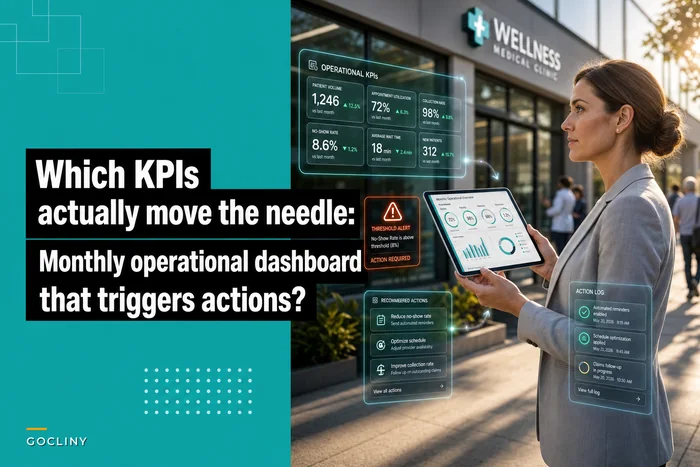
This is where feedback stops being a soft, feel-good exercise and becomes operational. Folding these numbers into your regular review — the kind described in a monthly operational dashboard that triggers actions — keeps feedback from drifting back into the "nice to know" pile.
A real scenario
A three-provider primary care practice was getting steady complaints buried in Google reviews and the occasional angry phone call — mostly about reaching the office. Their annual survey showed "access" scoring poorly, but they couldn't tell what to fix.
They switched to a three-question post-visit text and started tagging responses by severity. Within the first few weeks, a clear pattern emerged: the single most common Erosion item was callbacks on medication questions. Patients left two or three messages and heard nothing for days.
They ran it as one sprint item, owned by the nurse manager, with a defined target: every clinical message gets a response within one business day. They set up a simple shared queue instead of the old voicemail-to-sticky-note process and added a midday check so messages didn't pile up overnight.
Over the next couple of months, time-to-callback dropped from roughly three days to under 24 hours on most messages. The access score on their post-visit survey climbed noticeably, and — the part the owners actually cared about — the number of patients quietly lapsing started to level off. Nothing dramatic or overnight. Just a friction point that had been costing them patients, closed and measured.
Where software quietly helps
You can run this whole pipeline on a spreadsheet and a shared board, and plenty of small clinics do. But the manual version has two predictable failure points: things fall off the dashboard, and triage tagging gets slow when volume picks up.
This is where AI-assisted operational tooling earns its spot without any hype. Short-form responses can be auto-tagged by severity as they arrive — flagging anything that reads like a clinical or access risk straight to a human for same-day review. Open-text comments can be clustered automatically so you see "17 people mentioned phone wait times this month" instead of reading 200 comments one by one. And an owner-assignment dashboard that nudges stale items keeps the loop from quietly breaking.
The point isn't to automate the fixing — people fix things. It's to automate the sorting and the reminding so the pipeline doesn't clog. The clinics that struggle aren't the ones without feedback; they're the ones where feedback volume outpaces the team's ability to route it.
When this is worth building — and when it isn't
When it makes sense: You're getting more feedback than you can track by memory, patients are complaining about the same handful of things repeatedly, or you suspect access problems are quietly driving attrition but can't prove it. A structured loop pays for itself fast in these situations.
When it's overkill: A very small solo practice with a tight patient panel and almost no complaint volume probably doesn't need sprints and dashboards. A shared notebook and genuine attention might be enough. Don't build process for problems you don't have.
Who should not do this half-heartedly: Any practice that collects feedback but won't commit owners to it. Launching surveys and then ignoring the results is worse than not asking — patients notice when their input goes nowhere, and it erodes trust faster than the original problem did.
The real shift
The difference between clinics that improve and clinics that stagnate isn't how much feedback they gather. It's whether a complaint has a path — a severity tag, an owner, a sprint, and a metric that tells you later whether you actually fixed it. Keep the capture short, triage ruthlessly, assign to people not departments, work in small cycles, and measure retention and access on the other side.
That loop, run consistently, does more for patient experience than any annual survey ever will — because it ends with something changing instead of something being noted.
The difference between clinics that improve and clinics that stagnate isn't how much feedback they gather. It's whether a complaint has a path — a severity tag, an owner, a sprint, and a metric that tells you later whether you actually fixed it. Keep the capture short, triage ruthlessly, assign to people not departments, work in small cycles, and measure retention and access on the other side.
That loop, run consistently, does more for patient experience than any annual survey ever will — because it ends with something changing instead of something being noted.
Ready to transform your practice workflow?
Join 2,000+ healthcare providers using GoCliny to increase efficiency, improve patient satisfaction, and grow revenue.