

Most no-show strategies treat every patient the same. Reminder cadences, confirmation texts, cancellation policies — all broadcast to the full panel. That approach works fine for the occasional one-off miss, and if you haven't built that foundation yet, the experiment-backed playbook for cadence, channels and cancellation policies is the right place to start.
But blanket reminders don't touch the patients actually wrecking your schedule. In almost every clinic, a small slice of the panel — usually somewhere between 4% and 9% — accounts for a wildly disproportionate share of no-shows. These are the repeat offenders. The patient who's missed four of their last six appointments. The one who books, cancels two hours out, rebooks, and does it again next month.
Sending that person a fifth polite reminder text isn't a strategy. It's a shrug. What you need is a graduated response — something that escalates consequences based on actual behavior, gives patients a clear path back, and holds up if someone ever questions whether you treated them fairly. That's what this playbook is.
Why "one policy for everyone" quietly fails
A clinic sets a cancellation policy, posts it, maybe charges a flat fee, and assumes the problem is handled. Then they look at the data six months later and the same twenty names keep appearing.
The reason is simple. A single flat policy is calibrated for the average patient, but no-shows don't come from the average patient. They come from a behavioral cluster. And a one-size rule either punishes everyone — annoying the 90% who rarely miss — or doesn't hit hard enough to actually change anything for the chronic 10%.
There's also a fairness trap hiding in the flat approach. When front-desk staff get frustrated, they start applying the policy inconsistently — waiving fees for patients they like, enforcing hard for patients they don't. That inconsistency is exactly what creates complaints, and worse, it's where real bias creeps in. A staged, score-based system is actually more fair than discretion, because the rules are written down and the same thresholds apply to everyone.
The core idea: score behavior, then escalate in stages
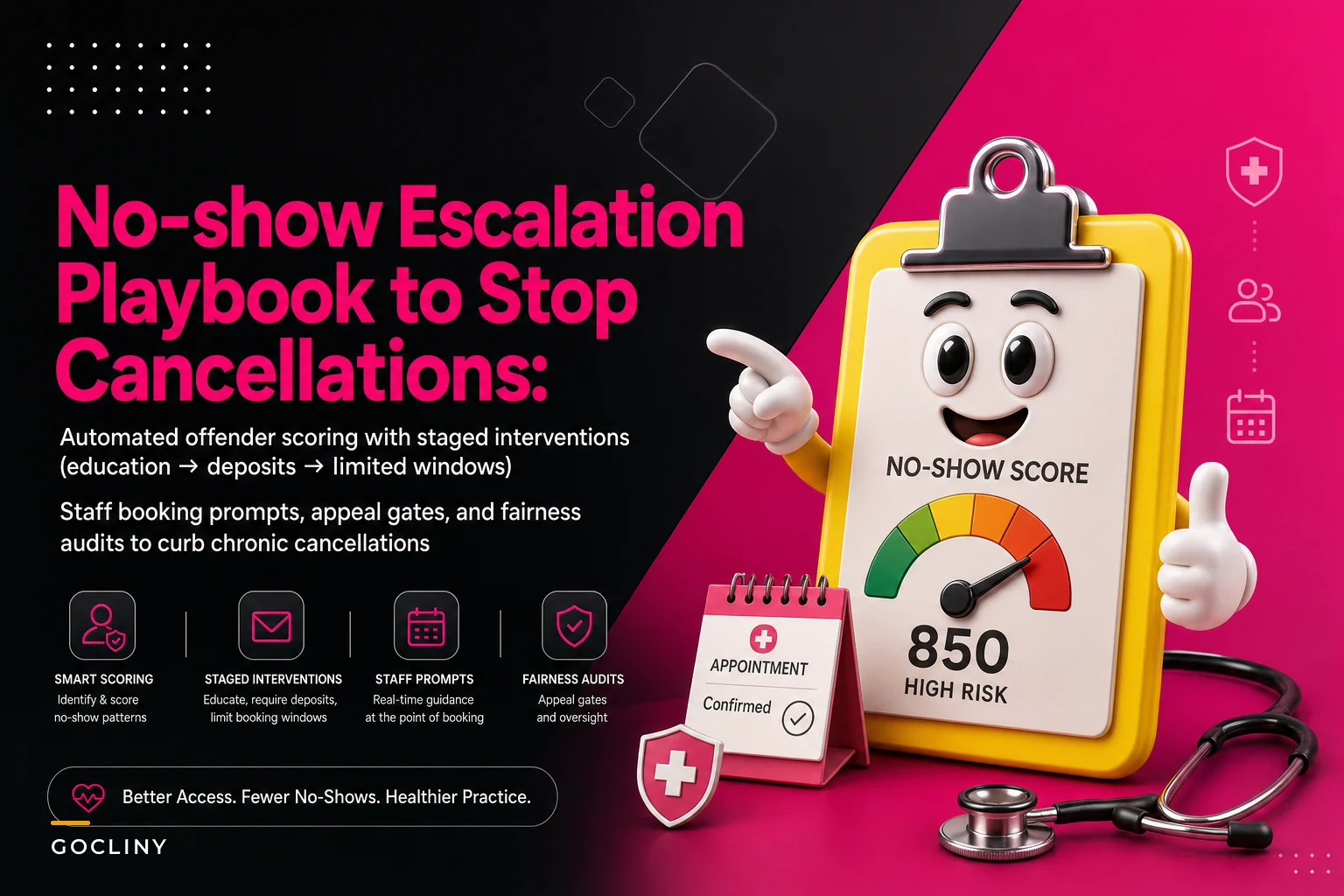
The system has two moving parts. First, a reliability score that reflects recent behavior. Second, a staged pathway where each tier triggers a specific, pre-defined response.
Eliminate appointment gaps and no-shows.
GoCliny streamlines every patient interaction from booking to billing—seamlessly.
- Unified appointment scheduling
- Automated patient reminders
- Staff calendar & task management
No credit card required
Keep the score simple. Something a front-desk person can understand at a glance beats a clever weighted model nobody trusts. A workable version:
-
Start every patient at a neutral baseline.
-
A completed appointment is a small positive.
-
A late cancellation (inside your window — say 24 hours) is a moderate negative.
-
A full no-show with no contact is a heavier negative.
-
Weight recent behavior more than old behavior. Someone who missed three times two years ago but has been perfect since is not your problem.
The point isn't precision. It's consistency. Once you have a score, you map ranges to stages.
The escalation ladder
| Stage | Trigger (rolling 12-month behavior) | Response |
|---|---|---|
| 1 — Education | 2 recent misses | Direct conversation + written policy reminder |
| 2 — Deposit | 3rd miss after education | Refundable booking deposit required |
| 3 — Limited windows | Continued misses despite deposit | Booking restricted to specific low-impact slots |
| 4 — Discharge review | Pattern persists across all stages | Formal review, with appeal, before any dismissal |
The key principle: nobody skips stages. You don't jump a patient to limited windows because a staff member is annoyed. The ladder is the ladder. That discipline is what protects you later.
Stage 1 — Education (most people stop here)
The surprising thing about chronic no-shows is how many of them genuinely don't realize they're a problem. They think calling to reschedule counts, not understanding that a 90-minute-notice cancel left a slot you couldn't fill. Or they assumed the reminder text was optional noise.
A real conversation at Stage 1 resolves a meaningful share of cases — not because you threatened anything, but because you made the impact concrete and the expectation clear.
Front-desk script, Stage 1:
> "Hi [Name], before we book your next visit I wanted to flag something. Our records show two recent appointments that didn't happen as scheduled. When a slot opens up last-minute, we usually can't fill it, which pushes out other patients waiting to be seen. I'm not charging anything today — I just want to make sure our reminders are reaching you. What's the best number and time for us to confirm?"
That script is factual, not accusatory. It surfaces a possible fix — wrong contact info is shockingly common. And it documents that the patient was informed, which matters if this ever escalates.
Log the conversation. Date, who spoke to the patient, what was said. That log is the backbone of the whole system.
Stage 2 — Refundable deposits
If someone misses again after a clear Stage 1 conversation, a deposit changes the math. Not a punishment — a commitment device. The deposit is fully refunded when they show up, so a reliable patient never actually loses money. Only the no-show pattern triggers a cost.
Script for introducing a deposit:
> "Because we've had a few missed visits, we'll hold a small refundable deposit to confirm this appointment. You get it back automatically when you come in. If you need to reschedule, just give us 24 hours and it carries over. This just helps us hold your time."
-
Make the refund genuinely automatic. If patients have to call and fight for their own money back, you've created a worse problem than the one you solved.
-
Decide in advance how deposits interact with insurance and financial-hardship situations. Build the exception into the rule so it's applied consistently, not case-by-case.
Two operational notes that prevent headaches:
Stage 3 — Limited booking windows
This is the stage most clinics never formalize, and it's the most useful. Instead of refusing to see a patient, you restrict when they can book — steering them toward slots where a no-show costs you the least.
In practice that means:
-
Same-day or near-same-day slots only, where the risk window is short.
-
Low-demand times (the historically soft Tuesday 2pm) rather than your fully-booked Monday mornings.
-
Slots that are easy to backfill from a waitlist if they fall through.
The logic is risk containment. You're not denying care. You're declining to hand your most contested, hardest-to-fill inventory to the patient statistically least likely to use it. This pairs naturally with how you manage access more broadly — if you've already built prioritization rules and auto-allocation thresholds for your waitlist, limited windows for chronic no-shows slot right into that same framework.
Script, Stage 3:
> "We want to keep you as a patient, so here's how we'll book going forward. We'll schedule you into same-week openings, and I'll call you personally the morning of to confirm. If that visit goes smoothly, we can go back to normal booking. Does a weekday afternoon work better for you?"
Note the off-ramp built into the script. Every stage should have a visible path back to normal. A system that only escalates and never rewards improvement feels like a trap, and patients respond to it like one.
Stage 4 — Discharge, and why it should almost never happen
Discharge is the nuclear option and should be rare — not because chronic no-shows don't deserve it, but because a clinic that discharges casually is one lawsuit or board complaint away from a very bad week. There are continuity-of-care obligations, and dismissing a patient incorrectly carries real risk.
By the time someone reaches Stage 4, you should have:
-
Documented Stage 1 education with dates.
-
A record of deposits and missed appointments after.
-
A trial of limited windows that still didn't change behavior.
Only then does a formal review make sense — ideally with a provider signing off, not just front-desk staff. And discharge should follow whatever your state and professional guidelines require for proper notice and transition.
A well-run ladder rarely gets here. Most chronic patterns break at Stage 1 or 2. Stage 4 exists mainly so the earlier stages have teeth.
Appeal gates: the part that keeps you out of trouble
Every stage needs an appeal gate. Not a bureaucratic maze — just a defined point where a patient can say "wait, that's not right," and a human reviews it.
Life happens. The patient who missed three appointments might have been in the hospital. The deposit that triggered might have hit someone in genuine financial hardship. Without an appeal gate, a fair system becomes rigid and cruel, and that's exactly when complaints turn into escalations.
A simple appeal structure:
-
Patient flags a disputed escalation (to front desk or a form).
-
A designated staff member — not the one who applied the escalation — reviews the log and the patient's reason.
-
Valid reasons (documented medical emergency, hospitalization, clear clinic error) reset the relevant stage.
-
The decision and reasoning get logged.
That last step matters. You want a record of how appeals were decided, because patterns in appeal decisions are where unfairness hides.
The fairness audit (run it quarterly, it takes an hour)
A behavior-based system can unintentionally punish patients for things outside their control — unreliable transportation, inflexible hourly jobs, language barriers that make your reminders useless. If your escalation ladder is quietly funneling certain groups toward discharge, you have a problem that's both ethical and legal.
So audit it. Pull the list of everyone currently at Stage 2 or higher and check:
-
Distribution check Are escalated patients clustered in any demographic, ZIP code, insurance type, or language group beyond what you'd expect? A skew doesn't automatically mean bias, but it means you look closer.
-
Contactability check For escalated patients, were reminders actually reaching them? A huge share of "no-shows" are really "never got the reminder." If someone's phone number was wrong the whole time, their score is garbage.
-
Appeal outcome check Are appeals being granted at wildly different rates by staff member? That signals inconsistent discretion sneaking back in.
-
Stage-exit check Are patients ever moving back down the ladder after improving? If nobody ever de-escalates, your system is a one-way street — and that's a red flag.
The audit isn't about perfection. It's about catching drift before it becomes a pattern someone else catches for you.
A real scenario
A three-provider primary care practice was running around 320–340 visits a week with a no-show rate hovering near 11% — brutal for a clinic that size. When they broke it down, roughly 18 patients accounted for close to a third of all missed slots.
They rolled out the staged ladder. Stage 1 conversations alone cleared about half of those 18 — several turned out to have wrong phone numbers on file, and a couple genuinely hadn't understood what "late cancel" meant. A handful moved to deposits; two of those stopped missing within a month. Three ended up on limited windows, and over the following quarter two of them stabilized enough to earn their way back to normal booking.
Only one patient ever reached a discharge review, and the appeal gate caught that it was tied to a transportation issue the clinic could partly solve. Overall no-show rate settled into the 6–7% range over about four months. Not zero — nobody hits zero — but a noticeable, durable drop, and the front desk stopped making one-off judgment calls because the ladder made the decision for them.
When this makes sense — and when it doesn't
This is worth building if:
-
A small group of patients drives a large share of your misses.
-
Your front desk is applying cancellation rules inconsistently.
-
You've already got solid baseline reminders and still have a chronic tail.
This is probably overkill if:
-
Your no-show rate is already low and evenly spread across the panel.
-
You're a tiny practice where the manager already knows every repeat offender by name and handles it directly.
Who should be careful: Clinics serving high-vulnerability populations — Medicaid-heavy panels, behavioral health, patients with significant transportation or housing instability. The ladder can still work, but the fairness audit and appeal gates aren't optional there. For some of these populations, high "no-show" rates reflect barriers, not defiance, and your system needs to distinguish the two or it'll do real harm.
Making it sustainable
The hard part isn't designing the ladder — it's running it consistently without burying your front desk in manual tracking. Someone has to calculate scores, remember who's at which stage, surface the right script at booking time, and keep the log current. Done by hand across hundreds of patients, it collapses within a few weeks and everyone reverts to gut feel.
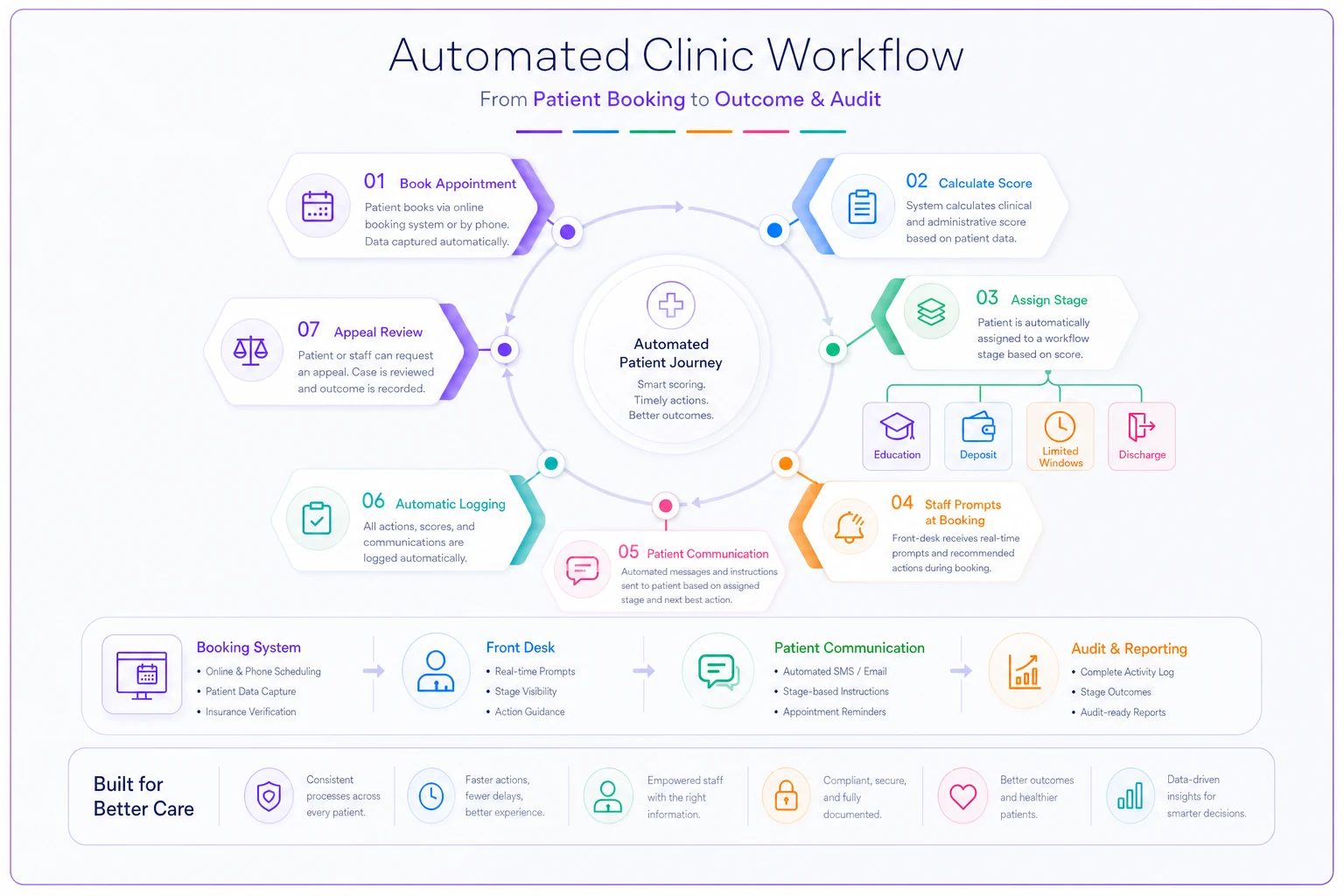
This is where having scheduling data and patient history in one connected workflow earns its keep. When the system can flag a patient's stage automatically at the moment of booking, prompt the right script, and maintain the escalation log without anyone re-typing it, the ladder actually holds. The automation isn't the strategy — the staged, fair pathway is. The tooling just keeps it from quietly falling apart the way manual tracking always does.
Here's a quick visual of how the automated workflow ties scoring, stage assignment, staff prompts, and logs together.
Start with Stage 1 and the log.
Start with Stage 1 and the log. Get the conversation and documentation habit solid before adding deposits or windows. A ladder with a strong first rung and honest records will outperform a fancy scoring model that nobody maintains — every time.
Start with Stage 1 and the log. Get the conversation and documentation habit solid before adding deposits or windows. A ladder with a strong first rung and honest records will outperform a fancy scoring model that nobody maintains — every time.
Ready to transform your practice workflow?
Join 2,000+ healthcare providers using GoCliny to increase efficiency, improve patient satisfaction, and grow revenue.