

Most clinics don't find out a provider is burned out until they're sitting across from you giving two weeks' notice. By then the damage is done — you're scrambling to cover their panel, the front desk is bracing for angry patients, and you're looking at 3–6 months of recruiting and ramp-up before you're whole again.
The frustrating part is that burnout almost never arrives without warning. The signals are usually there for weeks, sometimes months. They're just scattered across timesheets, the scheduling grid, and hallway conversations nobody wrote down. Nobody's job is to connect them.
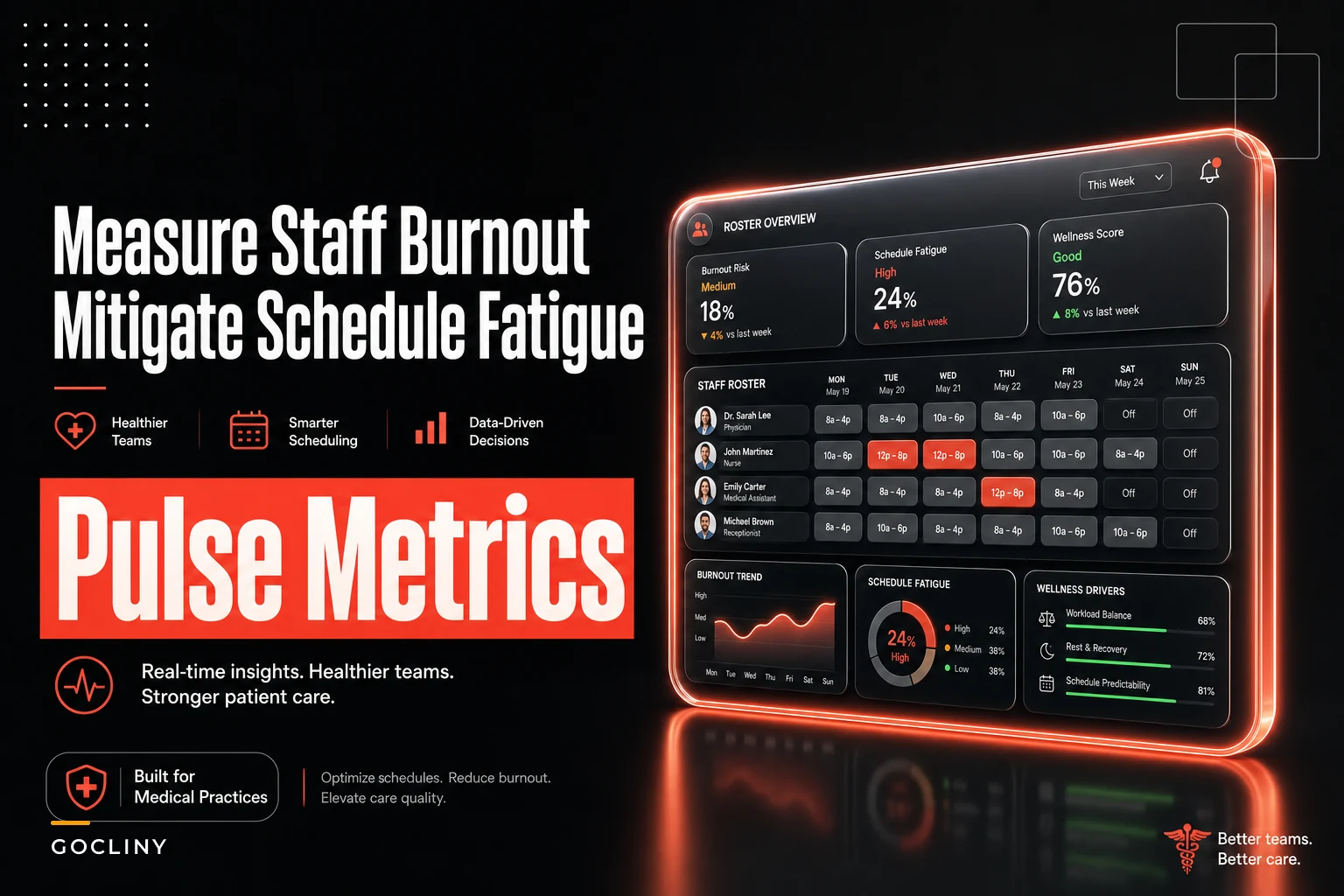
This is a piece about building a measurement layer for staff burnout in a clinic setting — the specific metrics worth collecting, how to run short pulse surveys without annoying everyone, and the scheduling rules that reduce fatigue risk before it turns into turnover. Staff burnout measurement in a clinic isn't about a big annual engagement survey. It's about a handful of leading indicators you watch every week.
Why burnout stays invisible until it's a resignation
The core problem is that burnout is a slow variable and most clinic dashboards only track fast ones — visit volume, collections, no-show rate. Those numbers can look great right up until the moment a key provider taps out.
A typical example: a mid-sized primary care office has one provider who quietly absorbs the overflow. She takes the double-books, stays late to close notes, covers when someone calls in sick. On paper she's your best performer — highest productivity in the group. So nobody flags her, because every metric you're watching says she's fine.
-
She's worked 11 of the last 14 clinic days without a real break
-
Her documentation is drifting later and later into the evening
-
She's declined the last two optional trainings
-
Her average visit is running 4–5 minutes long, a sign she's compensating for fatigue with extra time
None of that shows up on a revenue dashboard. And that's exactly why your highest performers are often your highest flight risks — the system quietly routes stress toward the people who don't complain.
The metrics worth collecting
You don't need a research-grade instrument. You need a small set of numbers that, tracked over time, tell you where fatigue is accumulating. Think of these as the vital signs of your staffing. Here's a practical breakdown of what to collect, why it matters, and roughly how often to look at it.
Eliminate appointment gaps and no-shows.
GoCliny streamlines every patient interaction from booking to billing—seamlessly.
- Unified appointment scheduling
- Automated patient reminders
- Staff calendar & task management
No credit card required
| Metric | What it tells you | Cadence | Rough warning threshold |
|---|---|---|---|
| Consecutive clinic days worked | Recovery deficit building up | Weekly | 6+ without a full day off |
| Overtime hours (OT) per person | Chronic overload vs. one-off crunch | Weekly | >5 hrs/wk for 3+ weeks running |
| After-hours documentation time | "Pajama time" — a strong burnout signal | Weekly | Notes closing past 8pm regularly |
| Same-day coverage requests absorbed | Who's silently carrying the team | Monthly | One person taking >40% of fills |
| PTO taken vs. accrued | People who never actually unplug | Quarterly | <50% utilization |
| Optional training declines | Early disengagement signal | Monthly | 2+ consecutive skips |
The point isn't to sound an alarm every time someone crosses a threshold. It's that two or three of these lighting up on the same person means you look closer before the exit interview.
Log consecutive clinic days as a separate metric so you can query and trend it weekly.
One pattern worth naming: consecutive clinic days is probably the single most underused metric in clinic operations. Everyone tracks hours. Almost nobody tracks stretch — how many days in a row someone shows up without a genuine recovery window. Two people can work the same 40 hours a week, but the one doing it as 6-on/1-off is degrading faster than the one doing 4-on/3-off. That distinction matters a lot more than total hours.
Short surveys that people actually answer
Annual engagement surveys are mostly useless for burnout because the lag is too long and the results are too diluted. By the time you read them, the person who was struggling in March has already left in June.
What works better is a very short pulse — two or three questions, every two weeks or monthly, that take under 30 seconds. The trick is keeping it short enough that answering isn't itself a chore. A pulse that works looks something like:
-
"On a scale of 1–5, how sustainable did the last two weeks feel?"
-
"Did you have enough recovery time between shifts?" (yes / mostly / no)
-
One open box
"Anything you'd change about the schedule?"
That's it. Resist the urge to add more.
-
Response rate is the real signal. When your MA who always answers suddenly stops, that silence is data. Disengagement often shows up as non-response before it shows up in the answers.
-
Trend beats snapshot. A single "3 out of 5" means nothing. The same person sliding from 4 to 3 to 2 over six weeks is a conversation you need to have now.
-
Anonymous kills accountability, named kills honesty. For small teams, a middle path works — responses go to a manager who isn't their direct clinical lead, so people speak more freely.
The mistake most managers make is treating the survey as the whole system. The survey is just a cheap way to catch what the scheduling metrics miss. Neither one alone is enough.
Schedule-rotation rules and minimum recovery windows
Measurement tells you where fatigue is building. Rotation rules are how you prevent it from building in the first place. This is the part most clinics skip because the schedule is almost always built around coverage needs, not human recovery needs — and those two goals quietly compete.
A few rules that hold up in real clinic operations:
Cap consecutive clinic days. Set a hard ceiling — most clinics land somewhere around 5–6 days before a mandatory full day off. "Full" matters; a half-day of admin isn't recovery. The cap should be a scheduling rule, not a suggestion, because the moment it's optional, your most reliable people will volunteer past it every time.
Enforce a minimum recovery window between demanding shifts. If someone closes a late clinic day with a stack of documentation, they shouldn't open the next morning at 7am. Even guaranteeing 12+ hours between the end of documentation and the next start prevents the compounding sleep debt that drives fatigue.
Rotate the hard slots. Every clinic has undesirable blocks: the Monday morning post-weekend surge, the late Friday, the double-booked walk-in day. If the same two people always eat those, they'll burn out on schedule. Rotate them deliberately and track the rotation so it stays fair.
Balance the panel load, not just the hours. Two providers with identical hours can have wildly different loads if one carries the complex, high-touch patients. Recovery windows should account for intensity, not just clock time.
The operational reality: none of this works if you're building the schedule by hand in a spreadsheet, because the rules quietly break under pressure. Someone calls out, you fill the gap with whoever's available, and three weeks later you realize one person has worked nine days straight. This is exactly where operational scheduling software with fatigue rules built in earns its keep — not by making decisions for you, but by flagging when a fill violates your own recovery rules before you commit to it. The system catches the drift that a busy manager misses at 7am on a chaotic Monday.
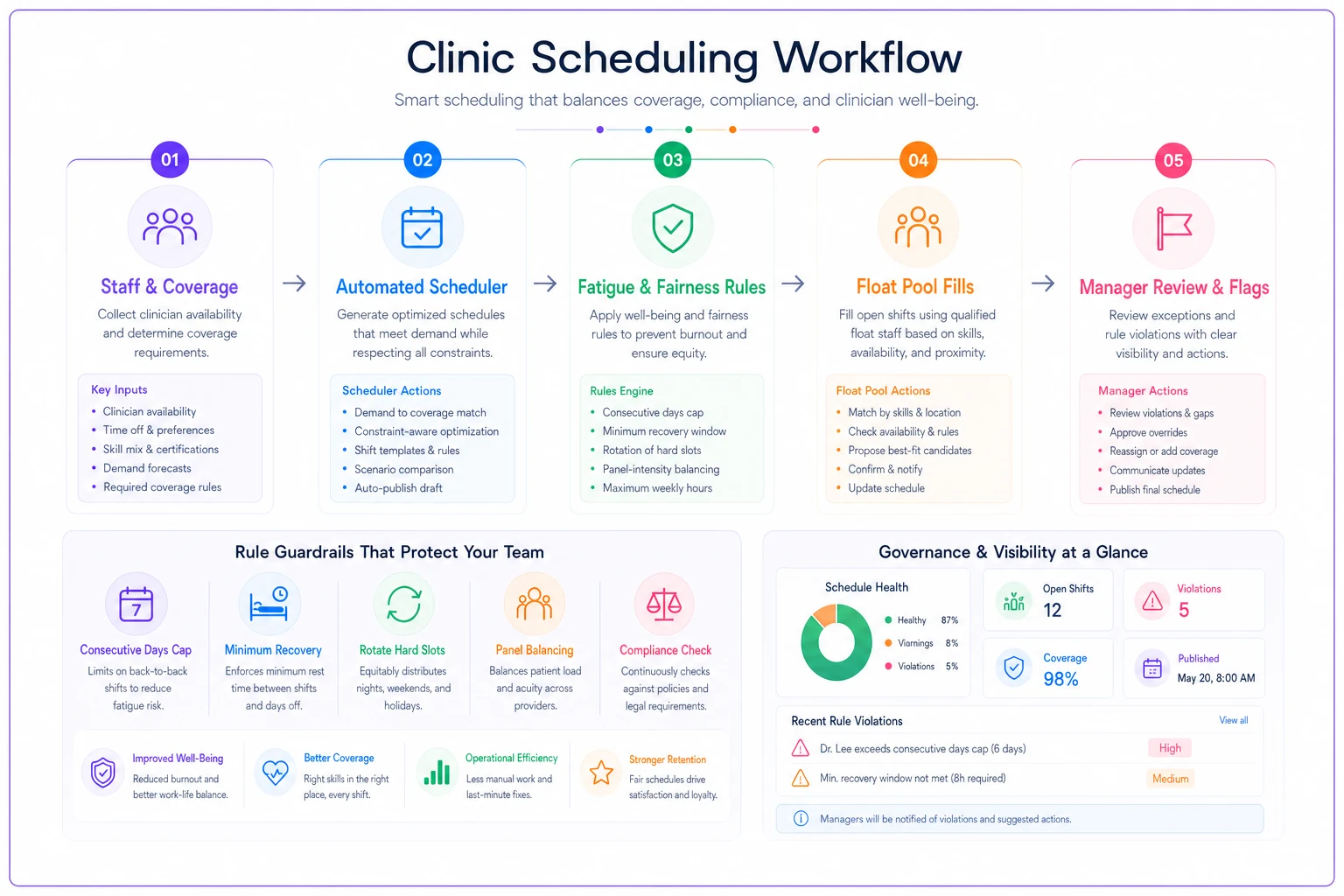
This diagram shows how scheduling rules, fatigue checks, rotation, and float-pool fills interact to prevent fatigue.
When the float pool becomes your safety valve
The reason recovery rules break is almost always the same: someone called out and there was nobody else, so the rule got bent. This is where a well-run float pool changes the math entirely.
If you have a bench of cross-credentialed staff who can step in, you can enforce your consecutive-day caps and recovery windows without leaving a slot empty. Without that bench, every callout forces a choice between coverage and burnout — and coverage wins every single time, which is how fatigue quietly accumulates.
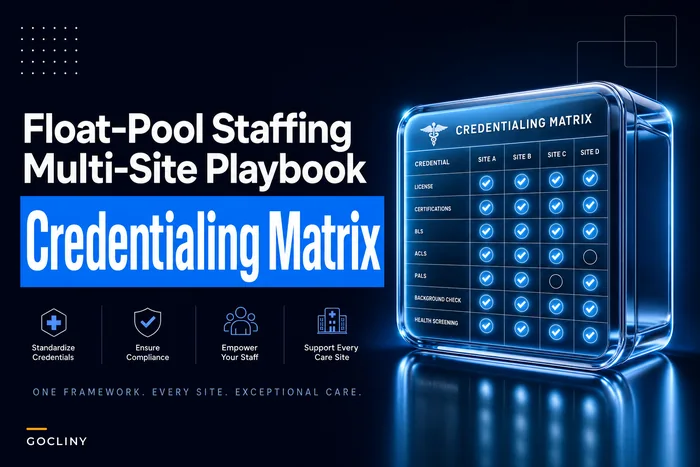
Building that bench is its own discipline, and cross-site credentialing plus shift-fill priority rules are what make it actually usable in the moment. We've covered the mechanics of that in the float-pool staffing playbook for multi-site clinics, which pairs directly with the fatigue rules here — the float pool is what lets you keep your recovery rules instead of abandoning them the first time someone gets sick.
One caution worth taking seriously: a float pool only reduces burnout if the float staff themselves aren't being ground down. If your bench is three people covering every gap across four sites, you've just relocated the burnout, not solved it. Track consecutive days on your float staff too. They're the easiest group to overwork because they're built to be flexible.
Manager check-in scripts that tie to KPIs
Metrics and rules tell you where to look. The check-in is where you actually find out what's going on and do something about it.
-
Open with what you observed, not what you assume. "I noticed you've worked seven days straight and your notes have been closing late — I want to make sure that's not becoming the norm." Anchoring to specific data makes it real and removes the vagueness.
-
Ask about recovery directly. "Are you getting enough time to actually recover between shifts?" Then stop talking and let them answer.
-
Surface the invisible load. "You've been covering a lot of the last-minute gaps. Is that working for you, or is it wearing you down?"
-
End with a specific adjustment, not a vague promise. "Let's block you a real day off next week and rotate the Friday closes." A concrete change is the only thing that rebuilds trust.
Tie each check-in back to two things: a retention signal (are they thinking about leaving?) and a capacity signal (can we sustain their current load?). If a check-in surfaces that someone's fried, that's not just an HR note — it's a capacity forecast. It tells you a slot may open, which lets you get ahead of recruiting instead of scrambling.
Worth noting: check-ins on newer staff need a different lens. Early-tenure burnout is often onboarding overload, not chronic fatigue — someone drowning because they were pushed to full load too fast. If you're seeing fatigue signals in your first-90-day people, the fix is usually in the ramp, which is why a structured onboarding system with staged competency milestones prevents a lot of avoidable early burnout before it starts.
A real scenario
A three-provider family practice was losing roughly one clinical staff member a year — not dramatic, but each departure cost them somewhere in the range of $18k–$25k in coverage, recruiting, and lost productivity, plus the morale hit to whoever was left.
When they finally dug into their scheduling data, the pattern was obvious in hindsight. One MA had absorbed about 45% of all same-day coverage requests over six months and had worked stretches of 8–9 consecutive days multiple times. She was the one who quit next.
They put in three changes: a hard cap of six consecutive days, a biweekly two-question pulse, and a monthly check-in for anyone crossing the fatigue thresholds. Nothing fancy.
Over the following year, they caught two people trending toward burnout early — one flagged by consecutive-day creep, one by a sliding pulse score — and adjusted their schedules before either got to resignation. Turnover for that stretch dropped to zero. The pulse response rate itself became a useful gauge; when it dipped, they knew something was off even before the scores told them anything.
When this is worth building — and when it isn't
This makes sense for any clinic where losing one clinical staff member genuinely hurts — which is most small and mid-sized practices. If a single departure means months of scrambling, the measurement layer pays for itself the first time it prevents one exit.
It's probably overkill for a very small, stable team of two or three people who talk constantly and already know when someone's fried. A formal survey there can feel patronizing. An honest standing conversation does the job.
And it's a bad idea to roll this out as a surveillance tool. The moment staff feel like consecutive-day tracking exists to squeeze more out of them rather than protect them, you've destroyed the trust the whole system depends on. Frame it as "we're watching this so you don't burn out," and mean it — because they'll know within a month whether you do.
Burnout measurement isn't about catching problems after they surface. It's about making the invisible load visible early enough that you still have room to fix it. The clinics that do this well aren't the ones with the fanciest tools — they're the ones who decided that "who's about to break" deserved a number, and then actually looked at it every week.
Ready to transform your practice workflow?
Join 2,000+ healthcare providers using GoCliny to increase efficiency, improve patient satisfaction, and grow revenue.