
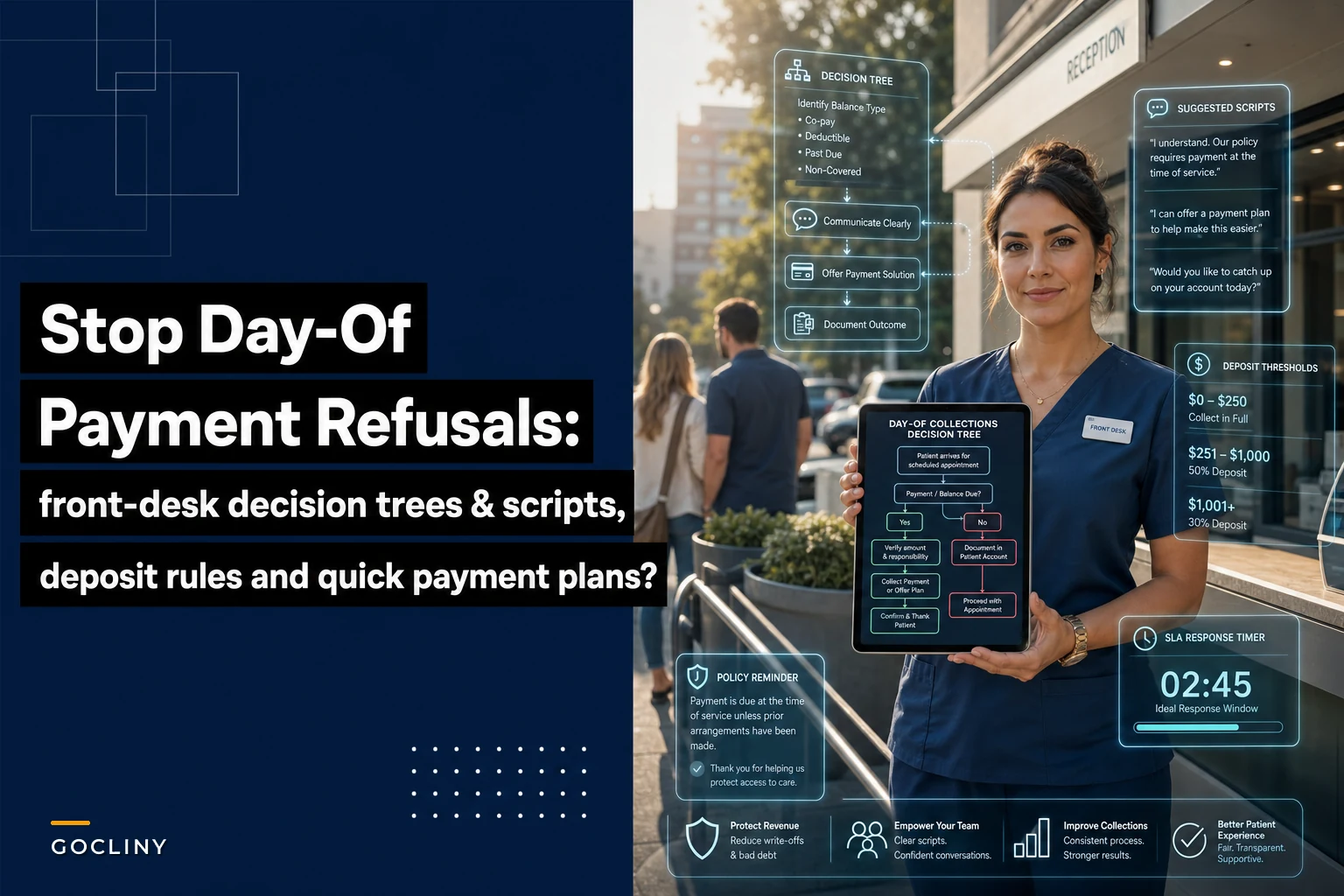

A patient checks in for a 9:15 follow-up. There's a $180 balance from a prior visit plus a $40 copay. The front desk staff member glances at the screen, sees the flag, and quietly decides not to bring it up because the waiting room is full and the patient looks annoyed already. The patient goes back, sees the provider, and walks out the door. That $220 now enters a statement cycle that will cost you two mailings, a phone call, and maybe a call to your billing service before it either gets paid or written off.
Multiply that across a busy schedule and the leak becomes real money. The issue is almost never that patients flatly refuse to pay. It's that your front desk has no consistent, low-friction way to ask, and no clear script for what to do when someone pushes back. So they don't ask at all, or they ask badly and cave the second there's any resistance.
This post is about that exact moment: the day-of collections refusal. What to say, when to escalate, when to offer a payment plan versus a reschedule, and how to keep all of it from turning into a scene that damages the patient relationship or blocks access to care.
Why day-of refusals actually happen (it's rarely about the money)
If you listen to a dozen real check-in conversations, most "refusals" aren't refusals. They're one of these:
-
"I didn't know I owed this." The patient was never told about the balance, so being asked at the desk feels like an ambush.
-
"I thought insurance covered it." Real confusion about copay vs. coinsurance vs. deductible.
-
"I can't pay all of it today." Not unwilling, just genuinely short on cash this week.
-
"I'll take care of it later." A soft brush-off that works because staff don't have a follow-up line.
The front desk problem is that all four of these get treated the same way — with an awkward pause and a "no problem, we'll bill you." That single default response is what quietly kills collections. Staff aren't trained to hear the difference between can't pay today and won't engage at all, and those two situations need completely different responses.
There's also a fear factor. New front desk hires are terrified of creating a confrontation in a full lobby. Nobody wants to be the person who made a patient cry over $60. Without a script that removes the personal judgment from the ask, they route around the discomfort by not asking. That's the real root cause, and no amount of "please collect at check-in" signage fixes it.
The decision tree, in plain language
The goal is to give the person at the desk a branch to follow so they're never improvising. Here's the logic before we get into exact wording.
Eliminate appointment gaps and no-shows.
GoCliny streamlines every patient interaction from booking to billing—seamlessly.
- Unified appointment scheduling
- Automated patient reminders
- Staff calendar & task management
No credit card required
-
State the balance plainly and offer to collect. No apology, no hedging.
-
If yes → collect, receipt, done.
-
If "I didn't know" → explain the source in one sentence, then re-ask.
-
If "I can't pay all today" → offer partial today + a templated plan for the rest.
-
If "not today / later" → offer the smallest reasonable deposit, then a plan.
-
If clinical urgency or hardship → do NOT block care. Flag for manager review, still document.
-
If flat refusal with no hardship → escalate to manager per SLA, patient still seen.
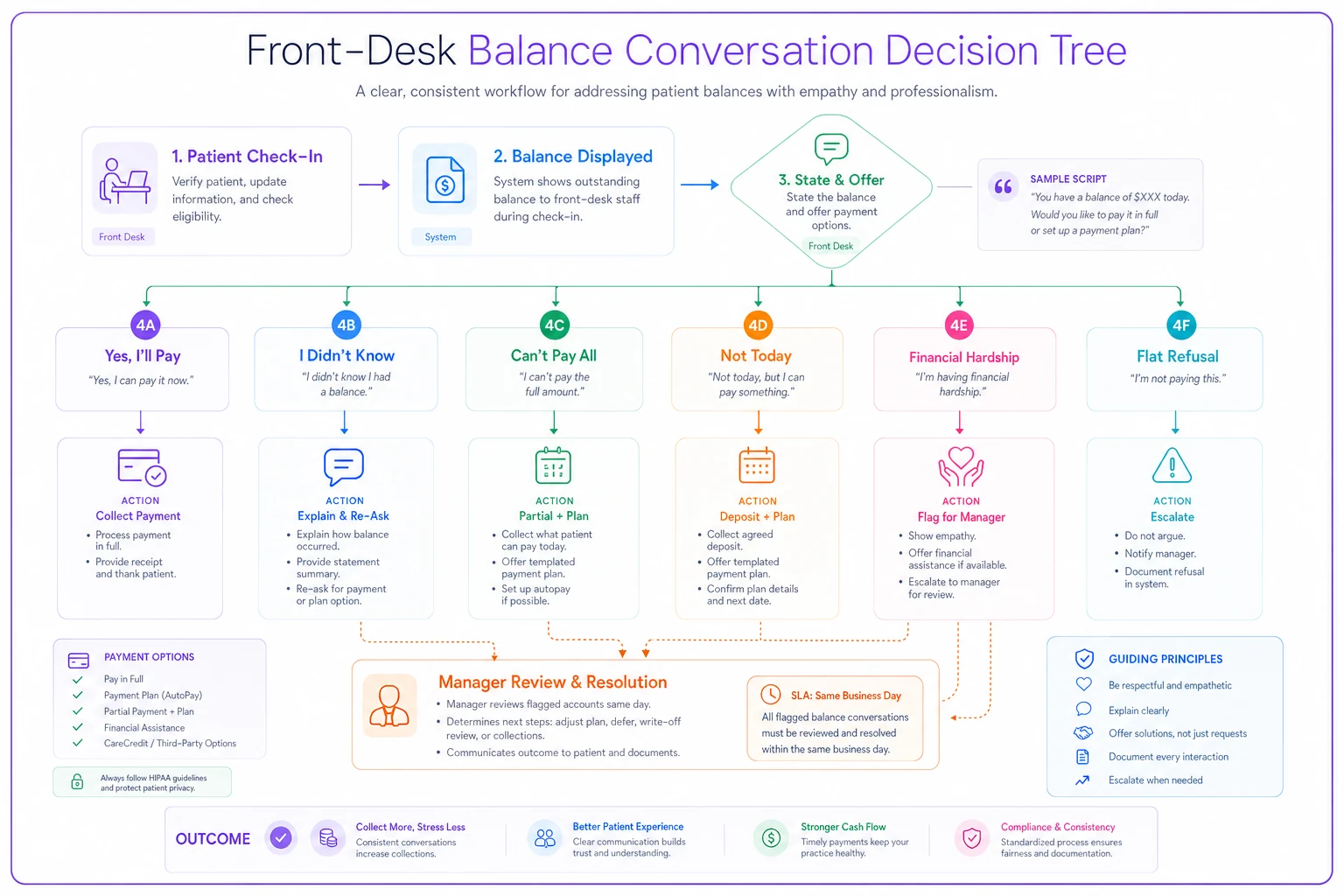
A simple flowchart like this makes it clear which branch to take in under 10 seconds at check-in.
The non-negotiable rule sitting under all of this: billing status never determines whether a patient gets clinically necessary care. The decision tree recovers revenue around access, not by holding care hostage. If you're triaging urgency at the desk at the same time, your front-desk triage SOPs should always take priority over the collections branch.
Exact scripts your desk can use today
Scripts matter because they take the personality out of the ask. When it's "our process" instead of "me demanding money from you," staff relax and patients don't feel singled out.
Opening ask (every patient with a balance): > "Good morning — before I get you back, I see a balance of $180 plus today's $40 copay. Would you like to take care of that on card or would you prefer we split it up?" Notice it presents paying as the default and quietly offers the plan option in the same breath. "Would you like to" already assumes yes.
If "I didn't know I had a balance": > "Totally understand — this is from your visit on the 12th, after insurance applied your deductible. I can text you an itemized copy right now. Want to knock out part of it today and we'll set up the rest?"
If "I can't pay all of it today": > "No problem at all, that's really common. Could you do $50 today and we'll set the remaining $130 across three months? I can set that up in about a minute."
If "I'll just get billed / pay later": > "Happy to send a statement — most folks like to put down even a small deposit now so it doesn't pile up. Could you do $40 today? Then I'll send the rest as a plan."
If genuine hardship comes up: > "Thanks for telling me. I don't want cost to get in the way of your care today. Let me flag this for our office manager to look at your options — you're all set to be seen."
That last one is the release valve. It gives the staff member permission to stop pushing, protects access, and routes the account to someone who can decide on a discount, financial-assistance application, or write-off.
Deposit vs. reschedule: how to decide in the moment
This is the branch that trips people up most. When someone won't pay the full amount, should you take a deposit and see them, or reschedule? Here's a clean way to think about it.
| Situation | Take a deposit & see them | Reschedule |
|---|---|---|
| Established patient, small unpaid balance | Yes — collect deposit, plan the rest | No |
| Genuine urgency or symptomatic | Yes — see them, sort billing after | Never reschedule for money |
| Large self-pay procedure, elective | Deposit toward estimate | Reschedule if no deposit possible |
| No-show risk history + won't commit to anything | Deposit as commitment signal | Reschedule only if clinically safe |
| New patient, cosmetic/elective, no deposit | — | Reasonable to reschedule |
The pattern worth internalizing: reschedule is only appropriate for elective, non-urgent visits where no deposit is offered. Everything else leans toward "see them and collect what you can."
A patient who puts down even $30 is dramatically more likely to complete the rest of the plan than one who was sent home — sending people away tends to convert a partial collection into zero.
Escalation thresholds and manager review SLAs
Front desk staff need to know the exact dollar line and the exact situation that triggers a handoff. Vague guidance like "use your judgment" is how you get inconsistent collections and frustrated patients.
-
Under ~$150 balance, patient engages Front desk handles fully — collect, partial, or set standard plan. No escalation needed.
-
$150–$500, patient wants a custom arrangement Front desk offers the standard templated plan first; escalate only if patient needs different terms.
-
Over ~$500, or any hardship claim Flag for manager review. Patient is still seen.
-
Flat refusal, no hardship, established balance Escalate to manager, log the interaction verbatim.
The manager review SLA is the piece most practices skip, and it's what makes the whole system credible. If a front desk person flags an account and nothing happens for two weeks, they stop flagging and go back to "we'll bill you." Set a hard SLA:
-
Flagged accounts reviewed within 1 business day
-
Patient contacted about resolution (plan, discount, assistance) within 2 business days
-
Outcome logged so the front desk sees it closed
That fast loop is what keeps staff bought in. They flag confidently because they know it goes somewhere. How these handoffs fit into the broader money side of the practice connects directly to the roles and remediation logic covered in an operational revenue-cycle framework.
Templated quick payment-plan offers
The reason payment plans don't get offered is usually friction — staff don't want to negotiate terms on the spot with a line forming. So remove the negotiation. Pre-build three plan templates and let the desk pick one:
-
Plan A (small balance) Balance under $200 → split across 3 monthly auto-charges, no interest.
-
Plan B (mid balance) $200–$600 → 25% today, remainder over 4 months.
-
Plan C (large balance) Over $600 → route to manager, but default offer is 6 months with a card on file.
The keys that make plans actually collect:
-
Card on file, auto-charged. Manual monthly billing on a plan collects far worse than an auto-charge. This is the single biggest lever.
-
Small deposit today. Any amount collected in person raises follow-through dramatically.
-
One-minute setup. If it takes five minutes and three screens, staff won't offer it during a rush.
-
Written confirmation. Text or email the schedule immediately so there's no dispute later.
Use auto-charges with a card on file; manual monthly billing collects far worse.
A quick real-world example: a two-provider primary care office was writing off roughly $2k–$3k a month in small day-of balances that never got asked for. After rolling out the opening script, three plan templates, and a one-day manager review SLA, point-of-service collections climbed somewhere around 30–40% within a couple of months, and balances aging past 90 days dropped noticeably. Nothing dramatic in any single interaction — it was just that the desk started asking every time, with a script that gave them an out when things got tense.
Where software quietly removes the friction
None of this requires software to work — the scripts and thresholds are the actual system. But the reason day-of collections fail in practice is usually operational drag: the balance isn't visible at check-in, the plan takes too long to set up, flagged accounts don't get reviewed, and nobody can tell whether the front desk is following the tree.
This is where an AI-assisted operational platform earns its keep. A good setup surfaces the exact balance and the recommended script branch the moment a patient checks in, so staff aren't hunting through screens. Plan templates can be applied and confirmation texts sent in one action. Flagged accounts route automatically to the manager's queue with the SLA clock running, and if a review is aging past the one-day window, it nudges. Over time, the platform can even help flag which balances are worth an in-person ask versus which are better sent straight to a statement — so your desk spends its limited attention where it actually converts. The point isn't to replace the conversation; it's to make sure the right conversation happens every single time without adding work at the desk.
When to skip the ask entirely
A few situations where pushing this system backfires:
-
Skip the day-of ask when a patient is in visible distress, or there for an urgent or emotionally heavy visit — new serious diagnosis, grief, acute pain. Collect nothing, don't flag aggressively. Protect the visit.
-
Don't reschedule for money on anything that could be clinically time-sensitive. That's both an ethical line and a liability one.
-
Don't run this rigidly on tiny balances (under ~$25) where the awkwardness and collection cost aren't worth it — fold those into a plan or a statement.
The system exists to catch routine, recoverable balances. Not to squeeze every dollar out of every interaction regardless of context.
Pulling it together
Day-of payment refusals drain revenue not because patients won't pay, but because the front desk has no consistent way to ask and no safe branch to follow when someone hesitates. Give them the opening script, the deposit-vs-reschedule table, clear escalation thresholds, a fast manager review SLA, and three ready-made payment plans — and most of what you're currently writing off becomes collectible without a single tense standoff.
Start small. Roll out the opening ask and one payment-plan template this week, set the one-day review SLA, and listen to a handful of real check-ins to hear where staff still cave. Refine the scripts from what you actually hear at the desk. The revenue you recover here was never lost to refusal — it was lost to silence.
Day-of payment refusals drain revenue not because patients won't pay, but because the front desk has no consistent way to ask and no safe branch to follow when someone hesitates. Give them the opening script, the deposit-vs-reschedule table, clear escalation thresholds, a fast manager review SLA, and three ready-made payment plans — and most of what you're currently writing off becomes collectible without a single tense standoff.
Start small. Roll out the opening ask and one payment-plan template this week, set the one-day review SLA, and listen to a handful of real check-ins to hear where staff still cave. Refine the scripts from what you actually hear at the desk. The revenue you recover here was never lost to refusal — it was lost to silence.
Ready to transform your practice workflow?
Join 2,000+ healthcare providers using GoCliny to increase efficiency, improve patient satisfaction, and grow revenue.