

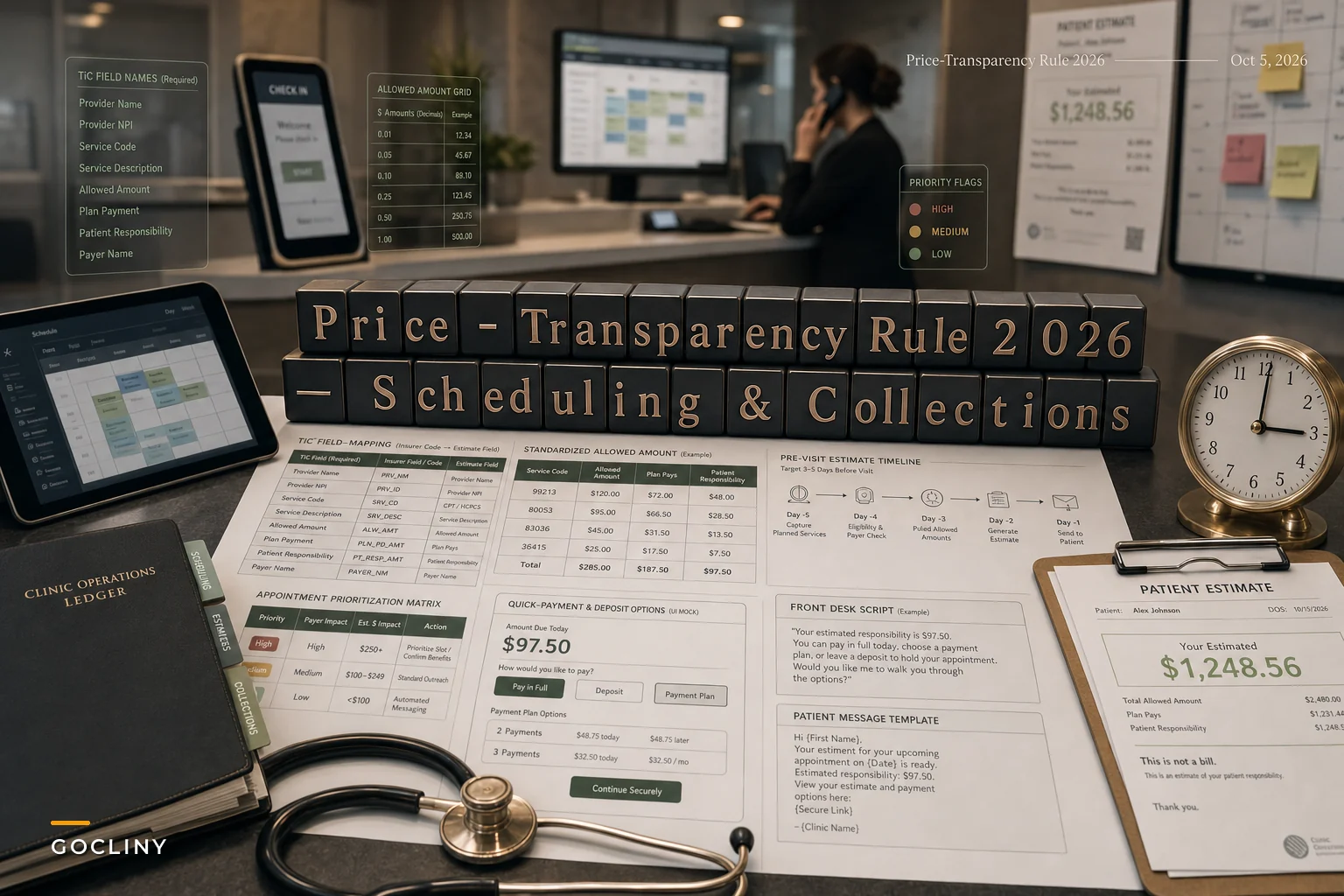

On October 5, 2026, CMS finalized a reworked price-transparency rule that tightens how insurers report pricing data. The short version: insurer disclosure files get more standardized, out-of-network reporting thresholds drop, and allowed amounts have to be shown as actual dollar figures instead of the vague percentage-of-charge language that made older files nearly useless for day-to-day operations. Healthcare Dive covered the overhaul of insurer price-transparency reporting in detail, and HHS laid out the phased rollout in its announcement on the final rules.
Most coverage frames this as a consumer win — patients can shop, compare, see real prices. Fair enough. But that's not what should be on your whiteboard Monday morning. The part that actually matters for a clinic is quieter and more operational: the allowed-amount data you've been guessing at for years is about to become machine-readable and, for the first time, reconcilable. That changes what a good estimate looks like, what your front desk can confidently collect, and how much revenue you leave on the table every day.
This isn't a compliance article. Plenty of law firms will send you those. This is about what the rule quietly exposes in how clinics build estimates and collect money — and five concrete moves to make before the data starts flowing.
The Thing the Rule Actually Exposes
The uncomfortable truth most practices won't say out loud: the estimates we give patients today are often educated guesses dressed up as numbers.
Front desks pull a fee schedule, apply a rough deductible status from a 270/271 eligibility check, make an assumption about the allowed amount, and hand the patient a figure. Half the time the allowed amount baked into that estimate is stale — pulled from last year's remittance patterns or a payer portal that hasn't been updated since the contract renewed. The patient pays based on that number, or doesn't, and the real reconciliation happens weeks later when the EOB arrives and everyone's surprised.
The new rule removes the excuse. Once standardized, dollarized allowed amounts are available in machine-readable files, the gap between "what we told the patient" and "what the payer actually allows" becomes visible and auditable. That's good for patients. It's also a liability if your estimate process is loose, because the delta becomes obvious — to the patient, and to anyone reviewing your collections accuracy.
What shows up repeatedly across multi-provider practices is that estimate accuracy quietly drives everything downstream: point-of-care collection rates, A/R aging, patient complaints, even no-show behavior. A patient who gets a $240 estimate and later sees a $410 bill doesn't just pay slowly — they stop trusting the next estimate, and they hesitate to pre-pay anything. The whole financial-engagement flywheel seizes up.
So the rule isn't really about transparency in the consumer-shopping sense. For operators, it's about accuracy becoming measurable. And measurable accuracy means the sloppy parts of your workflow stop being invisible.
Where the Money Actually Leaks Today
Before the five actions, it's worth being honest about where clinics lose revenue in this area, because the fixes only make sense once you see the leak.
Eliminate appointment gaps and no-shows.
GoCliny streamlines every patient interaction from booking to billing—seamlessly.
- Unified appointment scheduling
- Automated patient reminders
- Staff calendar & task management
No credit card required
| Leak point | What it looks like in practice | Rough impact |
|---|---|---|
| Stale allowed amounts | Estimate uses last year's contracted rate; patient underpays or overpays | Underbilling or refunds; erodes trust |
| No pre-visit estimate window | Estimate happens at check-in, patient unprepared to pay | 15–30% of expected POC collections slip to billing |
| Generic deductible assumptions | "You've probably met your deductible" guesses | Over-collection, refund processing cost |
| No reconciliation loop | Estimate vs. actual allowed amount never compared | Systematic estimate drift nobody catches |
| Front desk improvising scripts | Collections conversation varies by who's working | Inconsistent collection rate across staff |
The reconciliation row is the one almost nobody runs today, and it's the one the new data makes finally possible. If you never compare your estimate to the actual allowed amount, you have no idea whether your estimates run 8% high or 20% low. You just know collections "feel inconsistent."
Action 1: Rebuild Your Estimate Window Around the Data Cadence
Most estimates get generated too late — at check-in, or the day before at best. That timing made sense when the underlying data was unreliable anyway. Why invest in a precise estimate three days early when the allowed amount was a guess?
With dollarized, standardized data, early estimates become worth building. The move is to shift estimate generation to a pre-visit window of roughly 3–5 days out, so patients have time to react — ask questions, set up a payment plan, or just budget for the visit.
A workable pre-visit estimate workflow looks like this:
-
At scheduling, capture the planned service codes (even provisional ones).
-
Run eligibility and pull current deductible/OOP status.
-
Pull the standardized allowed amount for those codes under the patient's plan.
-
Generate a dollarized estimate 3–5 days before the visit.
-
Send it through the patient's preferred channel with a clear "what you'll owe" line.
-
Flag any estimate above a threshold (say, $300) for a proactive front-desk call.
A simple visual of the pre-visit estimate workflow:
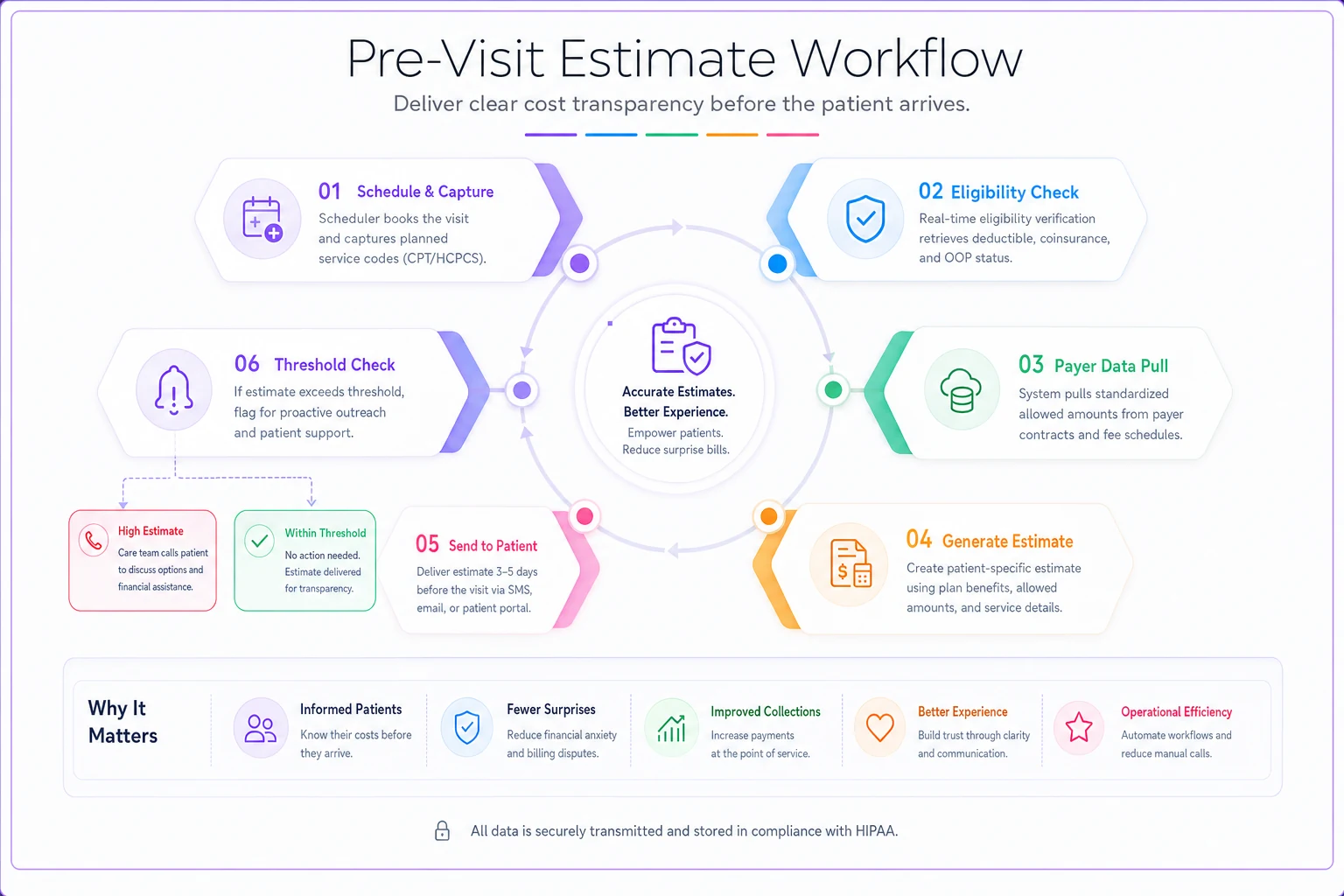
The threshold call in step six is where the revenue actually gets protected. A patient who learns about a $650 responsibility three days early and gets offered a plan shows up and pays. The same patient surprised at the counter either walks or pays nothing that day.
When this makes sense: practices with meaningful patient responsibility — specialists, procedures, high-deductible plan populations.
When it's overkill: a clinic where 90% of visits are low-copay primary care under $40 responsibility. Don't build a 5-day estimate machine to communicate a $25 copay. Keep that simple.
Action 2: Install an Estimate-vs-Actual Reconciliation Loop
This is the single highest-leverage thing the new data enables, and most clinics will skip it because it feels like back-office housekeeping.
The idea is boring and powerful: every time an EOB comes back, compare the actual allowed amount to what you estimated. Track the variance. Watch for patterns.
You're not hunting for individual errors — you're hunting for systematic drift. If your orthopedic consults consistently estimate 12% below the actual allowed amount for one payer, that's not bad luck, that's a fee-schedule mapping error you can fix once and recover on every future visit.
-
Payer A, E/M codes
estimates running ~6% high → minor over-collection, refund volume up
-
Payer B, injections
estimates ~18% low → systematic underbilling at point of care
-
Payer C, new patient visits
within 3% → accurate, leave alone
The 18%-low row is where real money hides. On a service you do 40 times a month, an 18% estimate gap compounds into thousands in delayed or missed point-of-care collections over a quarter.
Start your reconciliation with your top 20 billed services to surface the biggest revenue gaps quickly.
Running this manually in spreadsheets is painful, which is exactly why clinics don't do it. This is the kind of repetitive, rules-based comparison where operational software with AI-assisted reconciliation earns its keep — ingesting the standardized files, matching estimates to actual allowed amounts, and surfacing the drift patterns instead of making a staff member eyeball hundreds of EOBs. The point isn't automation for its own sake; it's that you finally see the leak you've been paying for silently.
Practices that build this loop early tend to find one or two systematic gaps that were invisible before — and fixing them doesn't require new contracts or new staff, just correcting the data feeding the estimates.
Action 3: Rewrite Front-Desk Scripts Around Certainty, Not Apology
When estimates were guesses, front-desk staff hedged. "This is just an estimate, it could change, we'll bill you for the rest." That language trains patients to not pay at the counter, because why pay a number that might be wrong?
> "Based on your plan's allowed amount and your deductible status, your responsibility today is $180. Would you like to put that on the card we have on file?"
That's a different conversation. It assumes payment. It's grounded in a real number, not a maybe.
A tight front-desk collections checklist for the new environment:
-
[ ] Confirm the pre-visit estimate was sent and acknowledged
-
[ ] State the dollar amount plainly, no hedging language
-
[ ] Default to collecting full responsibility at the visit
-
[ ] Offer a payment plan only if the patient hesitates — not upfront
-
[ ] Note any estimate the patient disputes for the reconciliation loop
-
[ ] Never promise "it won't change" — but stop implying it's a wild guess
The subtle mistake here is scripting too confidently. The data is better, not perfect, especially during the phased rollout. Train staff to be confident about the number and honest that final claims adjudication is the source of truth. Overpromising certainty just creates a different trust problem.
If you're overhauling how your team talks about money at the counter, it's worth revisiting the broader patient financial engagement workflow with estimates, point-of-care collections and payment-plan scripts — the new data makes that whole system more effective, but only if the scripts and point-of-care flow are already solid underneath.
Action 4: Use the Disclosure Data for Slot and Contract Decisions, Not Just Estimates
Most practices will miss this angle entirely: the standardized, lower-threshold disclosure data isn't only about patient estimates. It's competitive intelligence about your payers.
When allowed amounts across payers become visible and comparable at the service level, you can finally answer questions you've been guessing at:
-
Which payers reimburse meaningfully below the others for your highest-volume procedures?
-
Are you prioritizing schedule slots for payers whose dollarized allowed amounts don't justify the chair time?
-
Where does your contracted rate sit relative to what the standardized files show for comparable services?
This feeds two decisions. First, slot prioritization — if two patients want the same high-demand procedure slot and one payer's allowed amount is materially lower, that's a real data point for how you fill capacity (within fairness and access rules, obviously). Second, contract renewal prep — walking into a payer negotiation with standardized, dollarized comparison data is a very different conversation than walking in with your own remittance guesses.
A realistic pattern: a practice discovers one payer's allowed amount for a common imaging-adjacent service runs noticeably below the others, while that payer eats up a disproportionate share of prime morning slots. That's not something you'd act on recklessly — access and continuity matter — but it's exactly the kind of insight that was invisible before the data standardized.
Who should be careful here: solo and small practices with thin payer leverage. Having the data doesn't mean you can renegotiate overnight. But it means you finally know where you stand, which is the prerequisite for any move at all.
Action 5: Ingest the Standardized Files Before You Need Them
The rule phases in over months, not years. The clinics that benefit won't be the ones scrambling when the data's fully live — they'll be the ones who already have a pipeline to pull it, map it to their fee schedules, and feed it into estimates and reconciliation.
The practical steps:
-
Identify which standardized TiC files cover your top payers.
-
Confirm your billing or operational platform can ingest machine-readable files (many older ones can't without help).
-
Map the standardized allowed amounts to your service codes and payer contracts.
-
Stand up the reconciliation loop from Action 2 using that mapped data.
-
Run estimates in parallel for a few weeks — old method vs. data-driven — and compare accuracy before you fully switch.
That parallel-run step matters. Don't flip the whole clinic to data-driven estimates on day one. Run both, watch where they diverge, build trust in the new numbers, then retire the old process. Clinics that big-bang this end up with front-desk staff who don't trust the estimates and quietly revert to guessing.
This is also where a centralized operational platform earns its place — pulling the standardized files, keeping the fee-schedule mapping current, and surfacing estimate accuracy in one view so a practice manager isn't stitching together three exports to answer "are our estimates getting better?" The value isn't the technology. It's that the information stops living in five disconnected places.
A Quick Real Scenario
A mid-size specialty practice — three providers, mostly commercial payers with high-deductible plans — ran point-of-care collections at roughly 55% of expected patient responsibility. Not terrible, not good. The rest trickled in through billing over 45–60 days, and a chunk aged out entirely.
Two things dragged it down: estimates generated at check-in (too late for patients to prepare), and a systematic gap where one major payer's allowed amounts ran well above what the front desk assumed, so they chronically under-collected.
They shifted estimates to a 4-day pre-visit window and started reconciling estimates against actual allowed amounts monthly. The reconciliation caught the payer gap within the first cycle. Front-desk scripts moved from hedging to assuming payment.
Over the next quarter, point-of-care collections climbed into the high-60s to low-70s percent range. Not a miracle — just the combination of patients knowing their number early, more accurate estimates, and a front desk that stopped apologizing for the figure. A/R aging improved alongside it, mostly because less was slipping to the slow billing cycle in the first place.
They didn't add staff. They changed when the estimate happened and started checking whether it was right.
The Underlying Point
The new price-transparency rule will get written up as a consumer-shopping story. For practice managers, the real story is narrower and more useful: the allowed-amount data you've been approximating for years is about to become standardized, dollarized, and checkable. That removes the cover that let loose estimate processes survive — and it rewards the clinics that treat estimate accuracy as an operational discipline rather than a guessing game at the counter.
None of the five actions require waiting for the full rollout. Rebuild the estimate window, stand up a reconciliation loop, rewrite the front-desk posture, use the disclosure data for contracts and slots, and get your ingestion pipeline ready. The clinics that do this early won't just comply — they'll collect more of what they're actually owed, with fewer surprised patients at the desk. That's the quiet revenue the rule makes available, if you're set up to catch it.
The new price-transparency rule will get written up as a consumer-shopping story. For practice managers, the real story is narrower and more useful: the allowed-amount data you've been approximating for years is about to become standardized, dollarized, and checkable. That removes the cover that let loose estimate processes survive — and it rewards the clinics that treat estimate accuracy as an operational discipline rather than a guessing game at the counter.
None of the five actions require waiting for the full rollout. Rebuild the estimate window, stand up a reconciliation loop, rewrite the front-desk posture, use the disclosure data for contracts and slots, and get your ingestion pipeline ready. The clinics that do this early won't just comply — they'll collect more of what they're actually owed, with fewer surprised patients at the desk. That's the quiet revenue the rule makes available, if you're set up to catch it.
Ready to transform your practice workflow?
Join 2,000+ healthcare providers using GoCliny to increase efficiency, improve patient satisfaction, and grow revenue.