

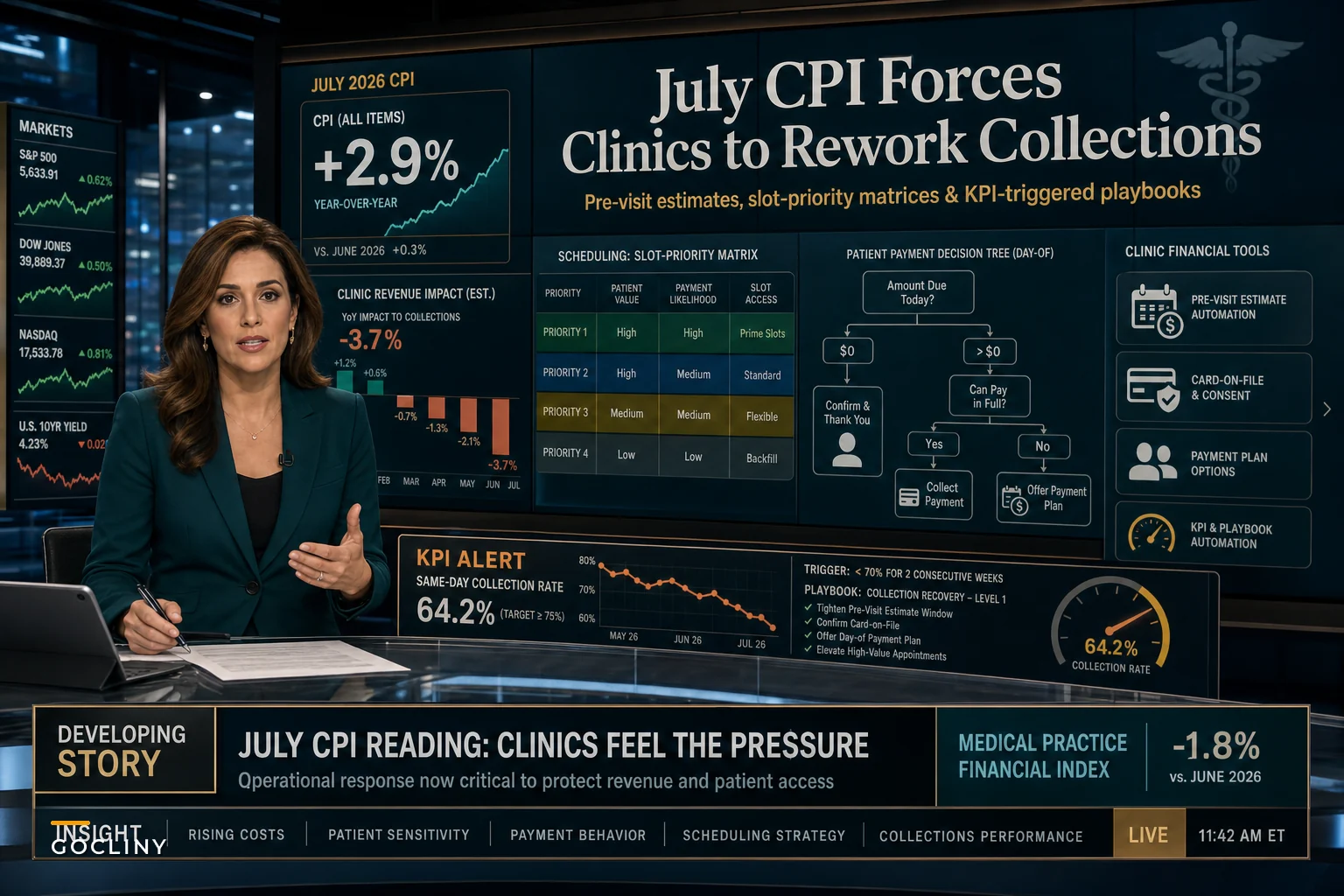

The July 2026 CPI print landed on August 12, and on paper it looked almost boring: prices up just 0.1% month-over-month, 3.4% year-over-year. But the boring headline is hiding the part that matters for clinics. As CNBC's coverage of the report pointed out, shelter and energy volatility kept the annual rate stubbornly elevated — meaning the average patient walking through your door is still absorbing higher housing and utility costs than they were a year ago.
That's the operational signal. Not the 0.1%. It's the fact that households have been squeezed long enough that the cushion many patients used to have for medical out-of-pocket costs is basically gone. And when that cushion disappears, the pressure shows up at your front desk on the day of service — declined cards, "can I just be billed," and quiet last-minute cancellations.
The fix isn't "collect harder." It's more subtle than that.
The delayed-reaction problem most clinics miss
Inflation data and clinic revenue don't move on the same clock. Prices rise for months, but the effect on collections shows up as a slow drift you almost don't notice until a quarter closes badly.
The pattern tends to follow a predictable sequence. First, patients stop pre-paying deductibles the way they used to. Then day-of card declines tick up — not dramatically, maybe from 4% to 7% of point-of-care attempts. Then the "just bill me" requests climb, which quietly shifts revenue from a same-day payment into a 60-to-90-day accounts-receivable gamble. By the time it lands in your aging report, it's three months old and much harder to recover.
The AP's analysis of the July inflation environment noted that even with the annual rate cooling, prices remain elevated and household budgets stay tight. For a clinic, "elevated but stable" is arguably worse than a sharp spike — a spike triggers action, a slow grind gets absorbed until it hurts.
The underlying problem this exposes isn't patient willingness to pay. It's that most clinics still treat collections as a front-desk event instead of a scheduling and estimation decision that starts days before the patient arrives.
Why your slot allocation is now a revenue decision, not just a calendar decision
Most schedulers fill slots on a first-come, first-served basis with a rough sense of which providers run behind. That worked fine when collections were predictable. In a high-price-sensitivity environment, it quietly costs you money.
Eliminate appointment gaps and no-shows.
GoCliny streamlines every patient interaction from booking to billing—seamlessly.
- Unified appointment scheduling
- Automated patient reminders
- Staff calendar & task management
No credit card required
-
Patient A
established, insurance verified, small copay, history of paying same-day.
-
Patient B
new patient, high-deductible plan, no estimate on file, no card on file.
Booking Patient B into that slot without any upstream financial prep is how you manufacture a day-of payment refusal. Not because Patient B is a bad payer — because you gave them no chance to prepare for a number they didn't know was coming.
Slot prioritization in this climate means matching the financial readiness of a booking to the slot, and flagging bookings that need work before they show up. Here's a simple frame worth adopting:
| Booking type | Financial risk | Pre-visit action needed | Slot handling |
|---|---|---|---|
| Established, verified, low OOP | Low | Reminder only | Book normally |
| Established, high-deductible | Medium | Estimate + card-on-file offer | Book, tag for pre-visit outreach |
| New patient, high-deductible | High | Estimate + payment-plan pre-offer | Book only after estimate sent |
| Procedure/high-cost service | High | Written estimate + deposit conversation | Requires financial clearance before confirming |
The point isn't to turn patients away.
Flag bookings that need pre-visit estimates so schedulers avoid assigning them prime slots.
It's to stop letting high-risk, zero-prep bookings quietly consume your prime slots and then blow up at checkout.
The estimate gap is where the money leaks
If there's one place the July numbers should force a change, it's your upfront estimates. When patients had more budget slack, a vague "your portion will be around a hundred dollars" was tolerable. Now, an inaccurate estimate is a trust breaker — and on money, that usually turns into a refusal, a chargeback, or a patient who just doesn't come back.
The estimate gap typically looks like this: the front desk quotes a copay, but the patient's deductible hasn't reset in the system, or a secondary service gets added during the visit that nobody priced. The patient hears "$40" at booking and sees "$180" at checkout. Under budget pressure, that $140 surprise doesn't get paid — it gets disputed, delayed, or walked out on.
Tightening estimates isn't glamorous, but it's probably the highest-leverage change available right now. A written estimate delivered before the visit, refreshed against current benefits, does two things: removes the checkout surprise, and gives the patient time to arrange payment or ask about a plan without a line forming behind them.
We broke down the full sequence in our guide to making patient payments predictable — the estimate → point-of-care collection → payment-plan flow is the backbone here. What the July data changes is the urgency and the tolerance for error. There's less room to be sloppy with numbers now.
Rewriting your payment-plan rules for a tighter household budget
A lot of clinics have payment-plan policies written for a different economy. Something like "plans available for balances over $500, three months, manager approval required." In a high-price-sensitivity environment, those thresholds are set too high and the approval friction is too slow.
Patients under budget pressure will pay — they just need it broken into pieces before the balance feels overwhelming. A plan offered proactively at $180 keeps the money on autopay. A plan offered reactively at $600 after two failed statements is a collections problem.
A few adjustments that fit the current environment:
-
Lower the plan threshold. If plans only kick in above $500, you're missing the $150–$400 balances that are now the ones getting refused.
-
Pre-authorize a card on file for anything above a set amount. With consent, this quietly eliminates most day-of declines for known balances.
-
Make the first plan offer proactive, not reactive. The best time to offer a plan is when you deliver the estimate, not after the patient has already balked at checkout.
-
Standardize the script so it isn't a negotiation. Front-desk staff shouldn't be improvising terms under pressure. Same terms, same tiers, every time.
-
Route only exceptions to a manager. If every plan needs approval, none get offered during a busy morning.
The goal is to convert "I can't pay that today" from a lost dollar into a scheduled one.
A short checklist to run before the next CPI cycle
You don't need a project plan. A few concrete moves you can complete in the next couple of weeks:
-
Pull the last 90 days of day-of declines and "bill me instead" requests. Establish your baseline before it drifts further.
-
Add a financial-risk tag to your booking process (low / medium / high) so schedulers can see it.
-
Set a rule
no high-risk new-patient booking is confirmed without an estimate sent.
-
Refresh benefit verification timing so estimates reflect current deductible status, not last quarter's.
-
Lower your payment-plan threshold and pre-write the offer script.
-
Enable card-on-file with consent for balances above a set line.
-
Add a single KPI trigger
if same-day collection rate drops more than a few points month-over-month, it goes on the ops agenda immediately — not at quarter close.
That last one matters more than it looks. The whole problem with the inflation drift is that it's slow. A trigger that surfaces a 3-point drop in same-day collections turns an invisible quarterly surprise into a visible weekly signal you can actually act on.
Where scheduling software quietly carries the load
None of this works if it depends on staff remembering to do it during a packed Monday. The financial-risk tag, the "estimate must be sent before confirming" rule, the proactive plan offer — these are exactly the steps that get skipped when the phones are ringing and there's a line at the desk.
This is where AI-assisted scheduling and collections tooling earns its place, not by replacing judgment but by making the right step the default one. A platform that automatically flags high-deductible bookings, pushes an estimate request into the pre-visit workflow, and surfaces a same-day-collection alert when numbers slip means the drift gets caught by the system instead of by a bad quarter. Staff still makes the calls — the workflow just stops letting the important-but-easy-to-skip steps fall through.
Here's a quick visual of the ideal scheduling-to-collections workflow.
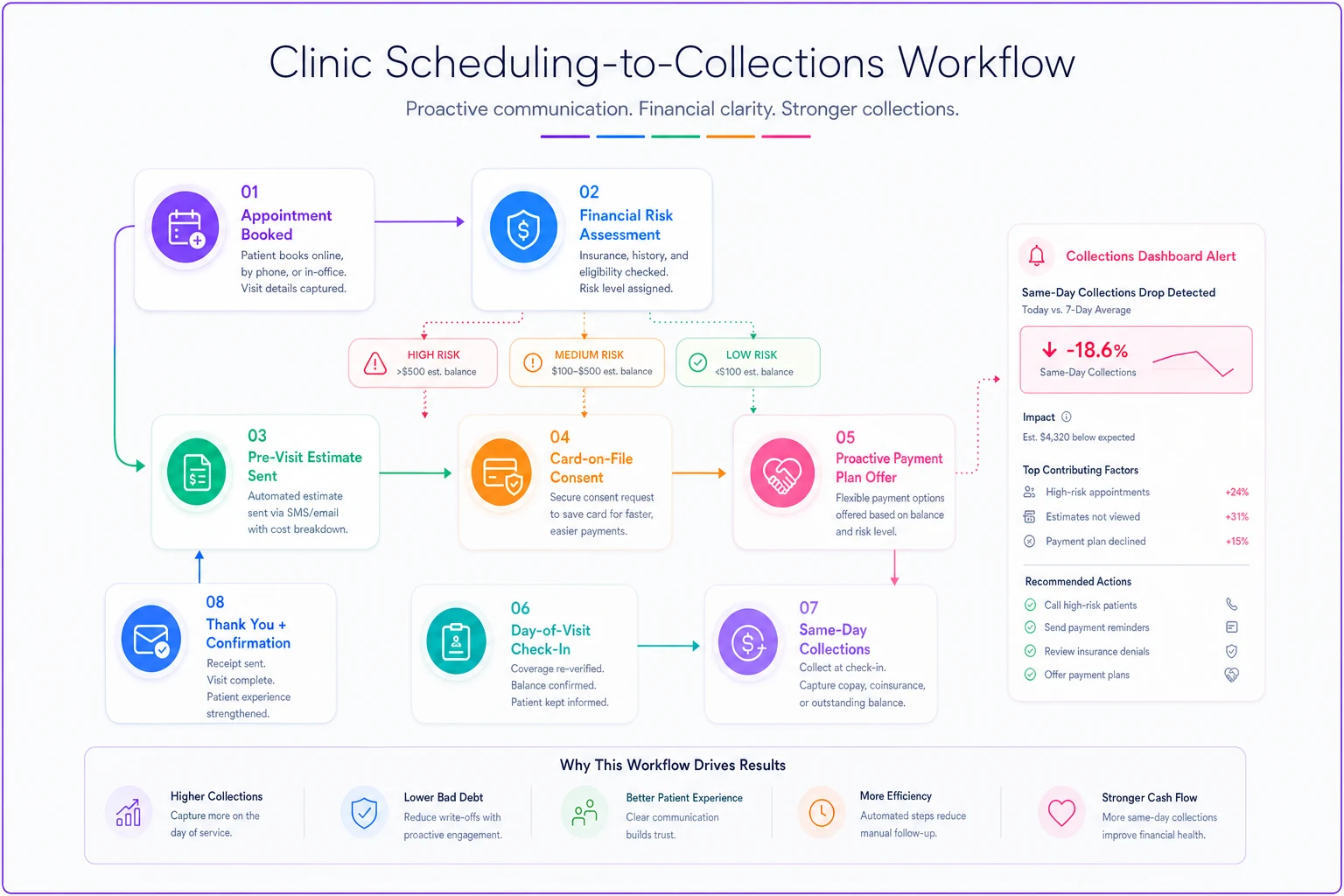
The value isn't automation for its own sake. It's that these tasks are precisely the ones human attention drops first under pressure, which is exactly when price-sensitive patients are most likely to refuse.
A quick real-world scenario
A three-provider family practice running roughly 320–360 visits a month came into the summer with their same-day collection rate slipping from around 82% to the mid-70s, and "bill me later" requests climbing. Nobody flagged it until the AR aging report looked ugly.
The fix wasn't dramatic. They started sending estimates 48 hours ahead for any high-deductible visit, lowered the payment-plan threshold to $150 with a pre-written script, and added card-on-file consent for balances over a set amount. Within about two months, same-day collections recovered back toward the low 80s, and the volume of aged small balances — the ones that usually never get chased — dropped noticeably. No new staff, no aggressive collections. Just moving the financial conversation upstream of the checkout desk.
When this is worth it — and when it isn't
Tightening all of this makes the most sense for practices with meaningful patient out-of-pocket exposure: high-deductible patient mixes, procedure-heavy service lines, or heavy new-patient volume. If your revenue is almost entirely insurer-side with minimal patient responsibility, the ROI on aggressive estimate workflows is lower, and you're better off focusing energy on denials and coding.
One caution worth stating plainly: don't let "financial readiness" become a barrier to care. The point of scoring bookings is to prepare patients, not screen them out. A clinic that starts refusing appointments over payment risk has completely misread the situation. The move is to remove surprises and offer clear paths to pay — not to ration access.
The July report didn't tell us anything shocking. What it confirmed is that elevated prices aren't a spike to wait out — they're the operating environment for a while. Clinics that treat collections as a scheduling and estimation problem, solved days before the visit, will hold their revenue steady. The ones still treating it as a checkout-desk event will keep absorbing the drift until a quarter forces the conversation.
Ready to transform your practice workflow?
Join 2,000+ healthcare providers using GoCliny to increase efficiency, improve patient satisfaction, and grow revenue.