



On October 28, 2026, the FOMC left the target federal funds rate at 3.75%–4.00% and leaned into "patient" language while still flagging sticky inflation. If you read the official FOMC statement, the tone is pretty clear: nobody's rushing to cut. Reuters described it as the Fed moving into a wait-and-see posture while watching more data pile up.
For a clinic manager, that single phrase — rates holding higher for longer — quietly reshapes three things you actually control: what your capital costs, what your staff costs, and how reliably patients can pay you. None of that shows up in a press release. It shows up six to ten weeks later in your aging report and your overtime line.
So skip the macro commentary. Here's what a prolonged higher-rate environment actually does inside a small outpatient practice, and the specific moves worth making before the end of the quarter.
First, understand what "higher for longer" actually touches in your clinic
A lot of practice owners hear "the Fed held rates" and assume it doesn't affect them because they're not taking out a loan this month. That's the wrong lens. The rate environment leaks into clinic operations through four channels, and most of them don't require you to sign anything new:
-
Your line of credit. If you carry a working-capital line — and most multi-provider practices do — the interest on it is usually variable. Higher-for-longer means that cushion you use to bridge payroll during slow collection weeks keeps costing more.
-
Equipment and buildout financing. That ultrasound upgrade or second-location buildout you were modeling? The financing math just stayed expensive. Deals that penciled at 5% don't pencil the same at 8–9%.
-
Labor cost expectations. When borrowing stays tight across the economy, wage pressure doesn't just evaporate. Your MAs and front-desk staff still feel cost-of-living strain, and competing employers are still bidding.
-
Patient wallet behavior. This is the big one, and the most underestimated. When household credit gets more expensive and savings get thinner, patients delay, dispute, and default on their portion more often. Your self-pay and high-deductible balances feel it first.
The pattern across small practices is that owners react to the first three — they renegotiate a lease, freeze a hire — but completely miss the fourth until the receivables already slipped. By then you're chasing money instead of preventing the gap.
Move 1: Re-forecast cash on a rolling 13-week basis, not a monthly one
Monthly P&L reviews are fine for accounting. They're useless for surviving a tight-rate quarter, because they tell you what happened after it's too late to steer.
Eliminate appointment gaps and no-shows.
GoCliny streamlines every patient interaction from booking to billing—seamlessly.
- Unified appointment scheduling
- Automated patient reminders
- Staff calendar & task management
No credit card required
A 13-week rolling cash forecast is the operational tool that matters here. You project cash in (expected collections by payer, point-of-care payments, payment-plan installments) and cash out (payroll, rent, the LOC interest that just got pricier) week by week, rolling it forward every Friday.
What this exposes almost immediately is the mismatch between when you deliver care and when you actually get paid for it. In a normal environment that lag is annoying. When your credit line costs more to draw against, that lag is expensive.
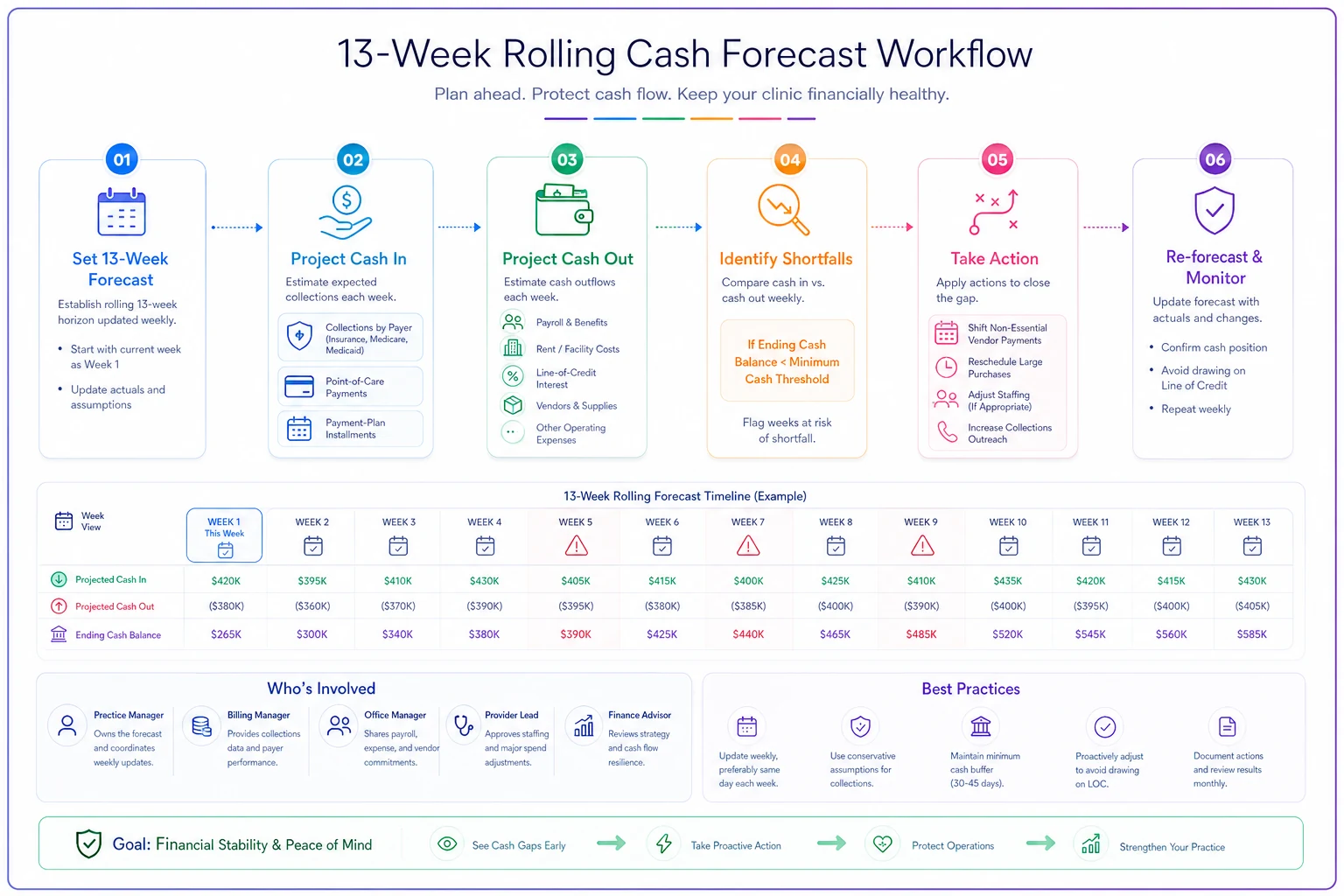
This visual outlines the weekly steps of a 13-week cash forecast and the decision points it surfaces.
Update the forecast every Friday and use conservative collection assumptions.
A realistic example: a three-provider primary care clinic doing somewhere around $160k–$180k in monthly charges found their average collection lag on commercial claims sitting near 38 days, with patient-responsibility dragging past 55. On a 13-week view, they spotted two specific weeks in the quarter where cash out exceeded cash in by roughly $22k each — both landing right when a quarterly tax payment hit. Knowing that six weeks ahead let them shift a vendor payment and avoid drawing on the line at all.
You don't need fancy software for the first version. A spreadsheet works. What you need is the discipline to update it weekly and the honesty to use conservative collection assumptions.
Move 2: Tighten the patient-pay side before you touch staffing
The reflex to cut hours or freeze hiring the moment the economy feels uncertain is one worth pushing back on hard. Staffing is the slowest thing to rebuild and the fastest way to tank patient access. Cut it prematurely and you create no-shows, longer waits, and leakage that costs more than the payroll you saved.
The faster lever is the patient-pay workflow — and it's the one most directly hit by a higher-rate environment, because that's where household cash stress shows up first.
-
Estimate quality is weak. Patients show up not knowing what they owe, so collecting at the point of care turns into a negotiation.
-
Front desk has no standard response when someone says "I can't pay today." So they either waive it, defer it, or create an awkward standoff.
-
No structured payment-plan offer exists, so balances that could have been captured in installments just age into bad debt.
Fixing this is less about being aggressive and more about being predictable. When patients get a clear estimate before the visit and a calm, scripted set of options at check-in, upfront collection rates climb without anyone feeling squeezed. The full workflow for this — estimates, point-of-care collection, and the payment-plan scripts that actually convert — is laid out in this breakdown on making patient payments predictable. Worth reading alongside this piece because it's the single highest-leverage response to tighter patient wallets.
Move 3: Stress-test your capital decisions against a rate that doesn't drop
If you've been sitting on an equipment purchase or a buildout "waiting for rates to come down," October's signal is a nudge to stop waiting on that assumption. Model the decision as if rates stay where they are for the next 12–18 months, because that's now the base case, not the bear case.
The question isn't "can we afford the monthly payment." It's "does this investment generate enough new collected revenue to clear its financing cost and leave margin." At higher rates, the bar is higher, and a surprising number of equipment deals that looked fine at lower financing costs no longer clear it.
Here's a simplified way to frame the two paths:
| Factor | Finance now (higher-for-longer) | Delay 12 months |
|---|---|---|
| Financing cost | Locked in at today's elevated rate | Unknown; may not drop meaningfully |
| Revenue capture | Starts generating immediately | Delayed — you forgo a year of volume |
| Working-capital strain | Higher monthly outflow now | Preserves cash short-term |
| Risk if rates stay high | Already absorbed | You waited for a cut that didn't come |
When delaying actually makes sense
-
The equipment isn't tied to a clear, near-term revenue line (it's a "nice to have").
-
Your 13-week forecast shows no cushion for the added monthly outflow.
-
You're mid-transition on staffing or systems and can't absorb new volume anyway.
When waiting is the wrong call
-
The investment directly unblocks appointments you're currently turning away.
-
You're leaking referrals to competitors because you lack the capability.
-
The financing terms available now are likely as good as they'll get.
The point of the table isn't to push you toward buying. It's to kill the fantasy that patience is free. Delay has a cost too — forgone revenue — and in a flat-rate environment that cost can quietly exceed the interest savings you were holding out for.
Move 4: Put guardrails on overtime and agency spend
Labor is usually the largest line in a clinic budget, and it's the one that drifts silently. In a higher-rate stretch where every dollar of borrowed working capital costs more, uncontrolled overtime and last-minute agency coverage are where margin leaks fastest.
The problem is rarely the hours themselves — it's that nobody's watching them in real time. OT gets approved reactively, shift-by-shift, by whoever's covering the floor that day. By the time it hits payroll, it's locked in.
-
Set a weekly OT threshold per role, and require a named approver above it — not "the manager," an actual person.
-
Track agency and float usage as a percentage of total hours, reviewed weekly, not monthly.
-
Flag any provider or MA trending toward repeated OT, because that's usually a scheduling or panel-sizing problem wearing an overtime costume.
What this pattern usually reveals: a chunk of "necessary" overtime is actually downstream of poor coordination — a gap in the schedule nobody filled until the last minute, a no-show that cascaded, a handoff that broke. Fix the upstream coordination and the OT line shrinks without anyone working harder.
Move 5: Rebuild your collections rules around slower patient payment
When household borrowing stays expensive, the patient-responsibility portion of your revenue gets slower and flakier. The practices that stay healthy don't wait to see it in the aging report — they adjust their collections rules in advance.
-
Shorten the window before a balance moves to a payment-plan offer. If you currently wait 60 days before reaching out, that's 60 days of a balance getting less collectible. Move the outreach earlier, framed as help, not pressure.
-
Default to structured plans for balances over a threshold. Rather than hoping for a lump sum that won't come, offer a 3- or 4-installment plan automatically on balances above a few hundred dollars.
-
Collect more at or before the visit. Every dollar collected at check-in is a dollar you don't chase. This is where strong estimates and a trained front desk pay for themselves.
A realistic outcome: a two-location specialty practice that moved payment-plan outreach from day 60 to day 20, and started defaulting balances over $250 into installments, saw its patient-responsibility aging-over-90 bucket drop from roughly 31% to the low 20s over a single quarter. No new staff. Just earlier, more structured rules.
The underlying insight is that collections health is mostly about timing and defaults, not effort. The clinics chasing hardest are usually the ones whose rules let balances age too long before anyone acted.
Move 6: Protect patient access so revenue doesn't quietly erode
This is the one that gets lost in rate-driven cost anxiety. When owners tighten everything, access suffers — longer waits, fewer open slots, a front desk that's harder to reach — and patients drift to whoever can see them sooner. That erosion doesn't show up as a line item. It shows up as a gradually shrinking schedule three months later.
-
Fill cancellations fast. An empty slot is lost revenue you can't recover, and in a tight quarter you can't afford to leak it.
-
Keep phone and intake response times short. A patient who can't get through calls the next clinic. That's referral leakage you created yourself.
-
Don't let cost-cutting hollow out the front desk. The front desk is where both access and collections live. It's the last place to under-staff.
The quiet pattern across struggling practices: they protect the P&L line items they can see and neglect the access metrics they can't. By the time the revenue drop registers, the patients who left aren't coming back.
A short real scenario
A four-provider family medicine clinic doing somewhere around $2.1M in annual collections went into the fall nervous about rates and their variable credit line. Their first instinct was to cut a part-time front-desk role to save roughly $18k a year.
Instead, they ran the numbers differently. They built a 13-week cash forecast, spotted two tight weeks coming, and shifted a vendor payment to avoid drawing on the line. They kept the front-desk role but retrained it around estimates and point-of-care collection. They moved payment-plan outreach earlier and set an OT approval threshold.
Over the following quarter, upfront collection rates improved noticeably, their aged patient balances tightened, and they avoided somewhere around $4k–$5k in line-of-credit interest they'd otherwise have paid during the tight weeks. The part-time role they almost cut turned out to be one of the reasons collections improved. The lesson wasn't "spend more." It was "cut the right thing — which was usually a process, not a person."
Bringing it together
The October rate hold doesn't change your clinic overnight. What it does is confirm that the expensive-money environment isn't temporary, which means habits built for cheaper credit — loose overtime, lazy collection timing, waiting-for-a-cut capital decisions — quietly cost more every week they continue.
None of the six moves here require a big system overhaul. A rolling cash forecast, tighter collection rules, OT guardrails, honest capital math, and a protected front desk will do more for a small practice this quarter than any macro forecast. The practices that come through flat-rate stretches in good shape aren't the ones that cut hardest. They're the ones that got their timing right — on cash, on collections, and on the decisions they chose not to delay.
The practices that come through flat-rate stretches in good shape aren't the ones that cut hardest. They're the ones that got their timing right — on cash, on collections, and on the decisions they chose not to delay.
Ready to transform your practice workflow?
Join 2,000+ healthcare providers using GoCliny to increase efficiency, improve patient satisfaction, and grow revenue.