

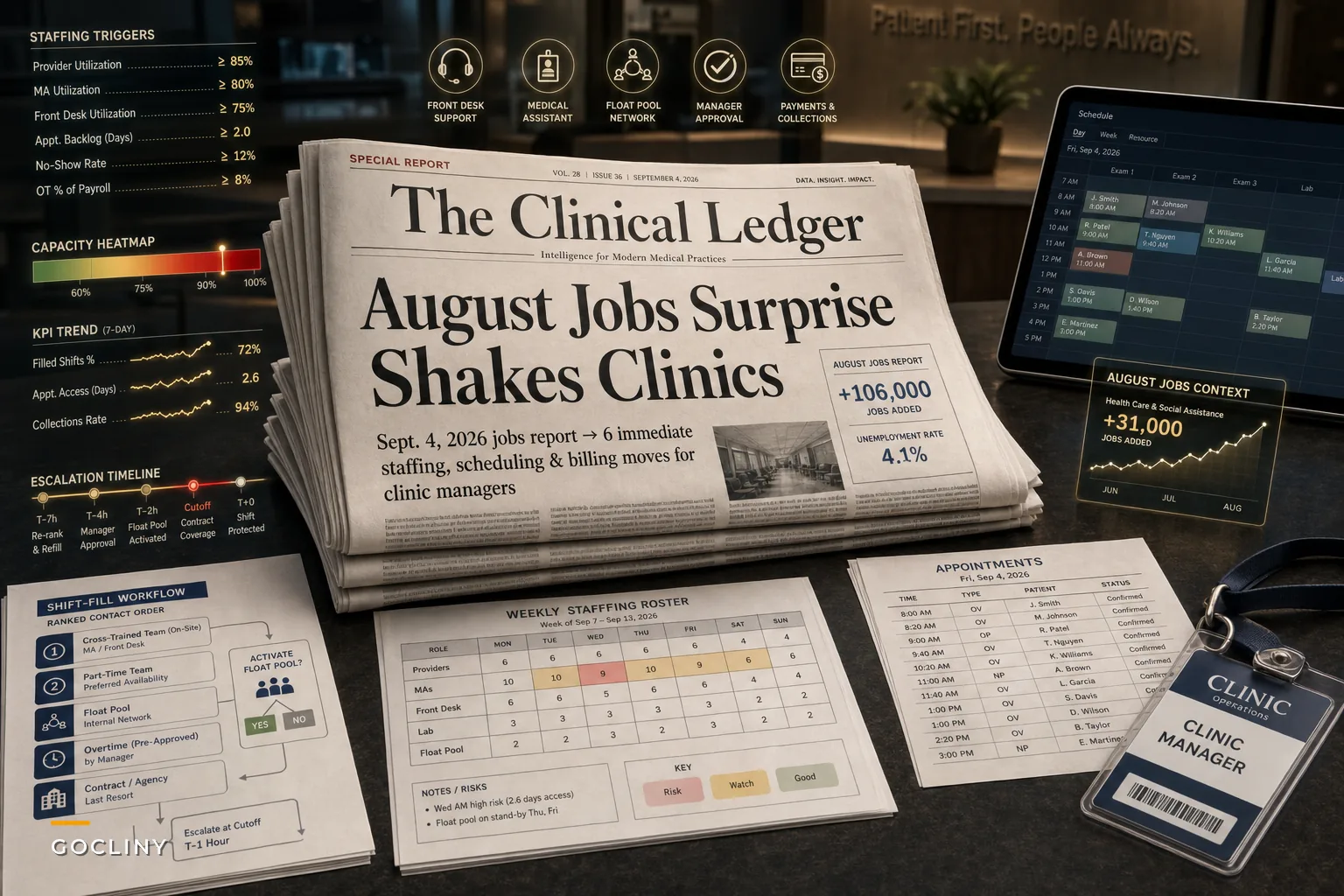

The August payrolls print landed harder than most people expected. Nonfarm payrolls rose by 162,000, unemployment held at 4.1%, and wages ticked up 0.3% for the month. Hiring was broad-based — restaurants, education, and a small bump in health care around 13,000 jobs. CNBC's coverage of the stronger-than-expected August numbers framed it as a labor market holding firm despite months of predictions it would cool.
For most people, that's just a headline. For clinic managers, it means the competition for front-desk staff, MAs, nurses, and care coordinators just got harder — and probably more expensive. When restaurants and schools are hiring aggressively, your $19/hr front-desk opening is competing against jobs that require zero clinical vocabulary and zero insurance headaches. That matters more than the raw payroll number.
Rather than breaking down the report line by line, here's what actually shifts on the ground when the labor market tightens, and what you can do in the next five to ten business days without blowing up your budget.
What tighter labor actually does to a clinic (and why it hits faster than you think)
A lot of managers treat a strong jobs report as abstract macro noise. It's not. It shows up in very specific, very local ways — usually within a few weeks.
The first place it hits is your existing staff. When outside options expand, your best front-desk person suddenly has more leverage and more reasons to leave. You don't feel it as a mass exodus. You feel it as one resignation at a slightly worse time than usual, followed by a scramble to backfill a role that now takes three weeks longer to hire for than it did in the spring.
The second place it hits is your schedule. A single open MA slot doesn't stay contained. It bleeds into provider throughput, rooming times, and how long patients sit in the lobby. In real operations, one unfilled clinical support role during a busy week can quietly cut a provider's completed visits by 8–12%, because rooming slows down and the provider starts doing tasks that aren't theirs.
The third place — the one people underestimate — is billing. When you're short-staffed, the work that gets dropped first is almost never clinical. It's the back-office follow-up: unworked claims, delayed charge entry, payment plans nobody set up. Revenue doesn't fall off a cliff. It erodes slowly in ways that don't show up until the aging report gets ugly two months later.
That's the underlying problem a tight labor market exposes: most clinics don't have a defined response that kicks in before the gaps turn into lost capacity and lost revenue. They react role by role, week by week. The clinics that hold up are the ones that already decided what happens when a shift can't be filled.
Move 1: Turn your open shifts into a ranked fill order, not a group text
When someone calls out, the default in most clinics is chaos — a manager texting whoever might pick up and hoping someone bites. That works until it doesn't, and in a tight market it stops working fast.
Eliminate appointment gaps and no-shows.
GoCliny streamlines every patient interaction from booking to billing—seamlessly.
- Unified appointment scheduling
- Automated patient reminders
- Staff calendar & task management
No credit card required
-
Which internal staff are cross-trained and eligible to cover which roles
-
Who gets asked first (based on availability, cost, and skill match — not just who answers fastest)
-
At what point you stop asking internally and activate contract or float coverage
-
What the cutoff time is before it actually affects patient flow
This is where a real float-pool structure pays off, especially if you run more than one site. Instead of each location fighting over the same three reliable fill-ins, you share a credentialed, cross-trained pool with clear priority rules. If you haven't built that yet, our float-pool staffing playbook for multi-site clinics walks through cross-site credentialing and shift-fill priority in detail. In a market like this one, that shared pool is often the difference between covering a gap in an hour versus canceling an afternoon of appointments.
A simple workflow makes the fill order actionable for managers and staff.
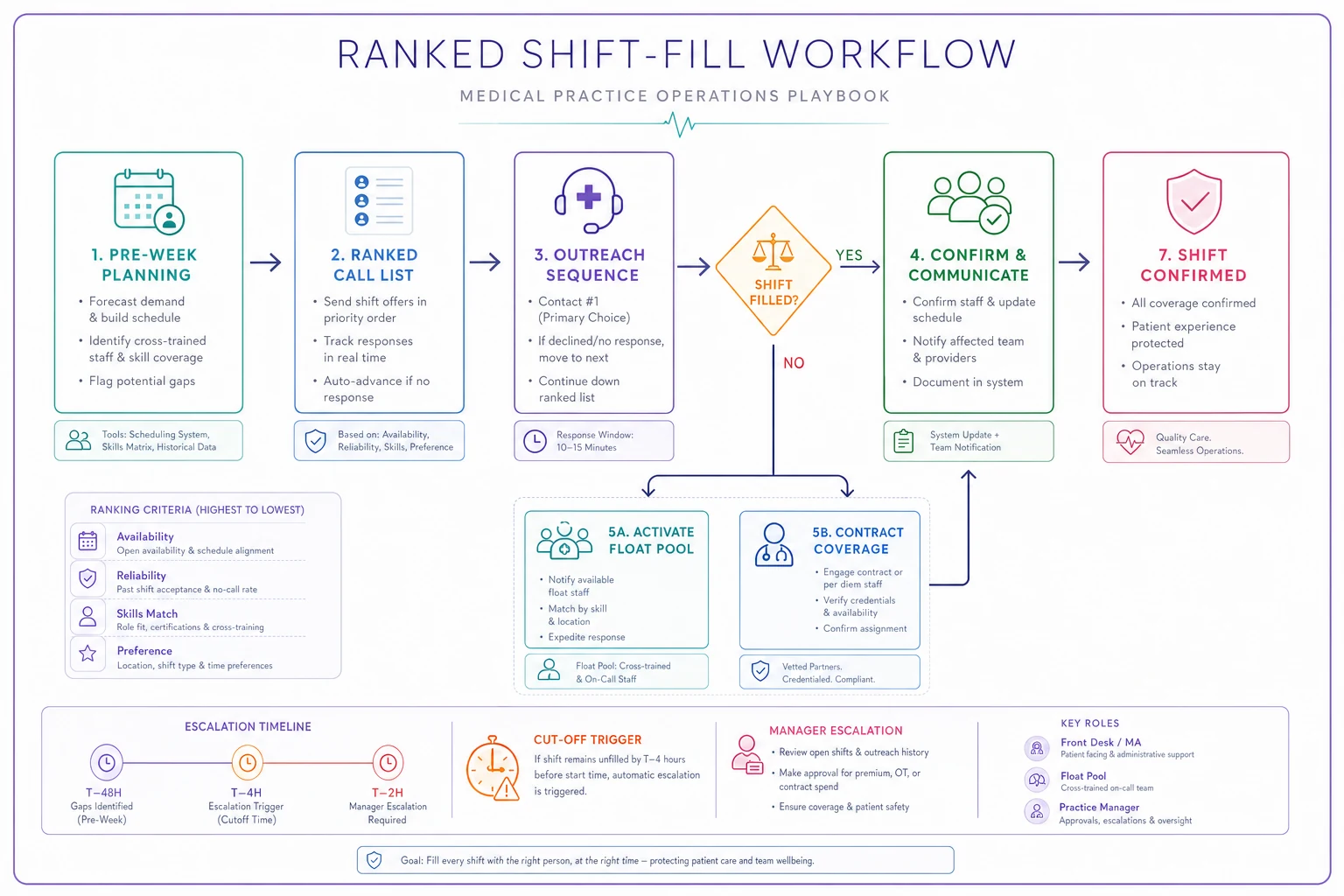
Use the flow to stop scramble-based fill attempts and make coverage predictable.
Move 2: Protect your current people before you fight for new ones
In a tight labor market, retention is cheaper than recruitment by a wide margin. Replacing a trained front-desk or MA role often runs $3k–$5k when you add up posting costs, interviewing time, onboarding hours, and the productivity dip while a new hire ramps. And that's if the hire sticks.
-
Fix the scheduling irritants first. Predictable schedules, protected lunch breaks, and not getting mandatory-overtime'd three Fridays in a row matter more to frontline staff than a lot of managers assume.
-
Target retention spend narrowly. A modest shift differential or spot bonus for your two or three hardest-to-replace people beats spreading a small budget thin across everyone.
-
Ask, then actually act. A 10-minute check-in with each frontline staffer about what would make them stay surfaces cheap fixes constantly — a schedule tweak, a broken workflow, a promise nobody followed up on.
The wage data in Reuters' coverage of the August report showed hourly earnings up 3.1% year-over-year. Your staff can read that too. They know their pay isn't keeping perfect pace, which means the non-cash parts of the job carry more weight right now than usual.
Move 3: Tighten scheduling rules so a lean team still protects access
When you're a person or two short, you can't run the schedule the same way you did when fully staffed. The clinics that struggle keep the old template and just absorb the pain. The ones that adapt temporarily reshape the schedule to match real capacity.
-
Cap the highest-complexity visit types per provider per day during short-staffed stretches so rooming and documentation don't back up.
-
Build in recovery buffers — even one 15-minute gap mid-morning and mid-afternoon keeps a single delay from cascading into a two-hour backlog.
-
Prioritize slots that protect revenue and continuity — follow-ups tied to active treatment plans, post-op checks, anything with a prior-auth clock running.
Even one 15-minute recovery buffer mid-morning and mid-afternoon dramatically reduces cascading delays.
The point isn't to see fewer patients. It's to avoid the trap where a short-staffed day looks full on paper, then falls apart by 11am and produces both lousy patient experience and a pile of unfinished work.
Move 4: Compress onboarding so new hires produce faster
When hiring gets slow and expensive, every extra day a new hire takes to become useful is money. A lot of clinics still run onboarding as an informal shadowing process that stretches until the new person "feels ready" — which is unmeasurable and usually too long.
| Timeframe | Target competency | How you verify it |
|---|---|---|
| Day 30 | Handles core role tasks with light supervision | Direct observation + a short task checklist |
| Day 60 | Runs the role independently at reduced volume | Error rate review, spot checks |
| Day 90 | Full-volume, contributing to team coverage | KPI review against role benchmarks |
The value isn't the table itself — it's that a defined cadence catches a struggling hire at day 30 instead of day 90, when you've already sunk months into someone who quietly isn't going to make it. In a tight market you can't afford to discover that late.
Move 5: Don't let short-staffing quietly leak revenue
This is the move that gets skipped because it's invisible until it's expensive. When the team is stretched, back-office tasks slide. Charges get entered late. Claims sit unworked. Payment plans that should've been set up at check-out never happen.
Real scenario: A two-site primary care group lost a billing coordinator during a stretch when hiring was slow. Nobody flagged it as a revenue problem — they just redistributed the work informally across the front desk. Over about six weeks, unworked claims crept up and clean-claim turnaround stretched by roughly a week and a half. By the time it showed on the aging report, they had somewhere around $18k–$22k sitting in aging buckets that should've been resolved. The fix wasn't dramatic: they set a hard rule that charge entry and claim follow-up got protected time daily, even on short-staffed days, and pulled a cross-trained front-desk person in for two focused hours each morning. Aging normalized within a month.
The lesson: decide in advance which back-office tasks are non-negotiable when you're short. Charge capture and timely claim follow-up should almost always make that list, because skipping them costs you later and hurts more than the original staffing gap did.
Move 6: Set KPI thresholds that trigger action automatically
The clinics that navigate tight labor best don't rely on someone noticing a problem in time. They set numeric thresholds that force a response. When a metric crosses the line, a predefined playbook activates — no debate, no delay.
-
Shift-fill rate drops below ~90% → float-pool activation begins for the affected site
-
Provider completed-visit rate falls more than ~10% below baseline → review support staffing and slot caps
-
Clean-claim turnaround stretches past your normal window → protected billing time gets enforced immediately
-
Overtime hours climb past a set weekly ceiling → escalate to contingency staffing before burnout compounds
Thresholds beat gut feel because during a crunch, everyone's too busy to notice the slow slide. A number that trips on its own removes the dependency on someone being alert enough to catch it mid-scramble.
When these moves make sense — and when they don't
Not every clinic needs all six right now.
When this matters most: multi-provider or multi-site clinics, practices already running lean, and anyone in a market where restaurants, retail, and schools are competing hard for the same hourly talent pool. If the last hiring cycle felt slow, this report says it's not getting easier soon.
When it's overkill: a solo provider with a stable, long-tenured front desk and no near-term hiring plans probably doesn't need formal threshold triggers. Adding heavy process to a tiny, stable team creates friction without payoff.
Who should be careful: clinics tempted to solve everything with overtime. It's the fastest short-term patch and the fastest route to the resignations that started the cycle in the first place. If your overtime hours are climbing week over week, that's not a staffing solution — it's a countdown.
A strong jobs report isn't automatically bad for your clinic. What determines the outcome is whether you've decided ahead of time how you respond when a shift can't be filled, when a hire takes longer than expected, and when back-office work starts sliding. Managers who get caught flat-footed are the ones improvising role by role. The ones who stay steady already ranked their fill order, protected their key people, tightened their schedule rules, and set numbers that trip before the damage compounds.
You don't need to do all six perfectly this week. Pick the two that map to where you're already feeling pressure — probably fill order and back-office protection — and get those defined first. The rest can follow. What you don't want is to wait until the next resignation lands to figure out the plan.
Ready to transform your practice workflow?
Join 2,000+ healthcare providers using GoCliny to increase efficiency, improve patient satisfaction, and grow revenue.