



Most billing teams don't lose money on denials because they can't fix them. They lose money because everything hits the same worklist and gets worked in the wrong order. The $28 copay adjustment gets touched three times while the $1,900 surgical denial sits untouched until it's four days from the timely-filing wall.
That's the real problem. Not "how do I appeal a denial" — payer manuals cover that. The problem is triage: deciding, in the first 15 minutes a denial lands, whether it becomes an appeal, a correct-and-resubmit, or a patient-responsibility transfer. Get that decision wrong and you either burn hours writing appeal letters for claims that just needed a modifier fix, or you write off dollars you could have recovered.
This is a triage playbook. It assumes you already know what a CARC/RARC code is and how to read an 835. What follows is how to route denials fast, with SLA targets that reflect real payer deadlines and staffing math that tells you how many people you actually need.
Why denials get worked in the wrong order
Three patterns show up over and over in small and mid-sized practices.
First, denials are worked chronologically instead of by value and deadline. The oldest denial floats to the top of the queue regardless of whether it's a $40 line or a $2,200 claim about to expire. A first-in-first-out queue feels fair but it's financially backwards.
Second, nobody has decided in advance which denials are correctable vs. appealable. So every denial becomes a judgment call, and judgment calls are slow. A biller stares at a CO-97 bundling denial and isn't sure whether to unbundle and resubmit or appeal with documentation. That five-minute hesitation, multiplied across a few hundred denials a month, is where throughput dies.
Third, the easy wins hide the expensive losses. Registration and eligibility denials are quick to fix, so they get cleared fast, which makes the dashboard look productive. Meanwhile the clinical-necessity and authorization denials — the ones that take real work and carry real dollars — get pushed because they're harder. The queue looks like it's shrinking while recoverable revenue leaks out the bottom.
This usually happens when a practice grows past the point where one person just knows all the payers but hasn't written anything down yet. The knowledge lives in someone's head, and when that person is out sick, denials pile up untouched.
The core decision: appeal, correct-and-resubmit, or patient balance
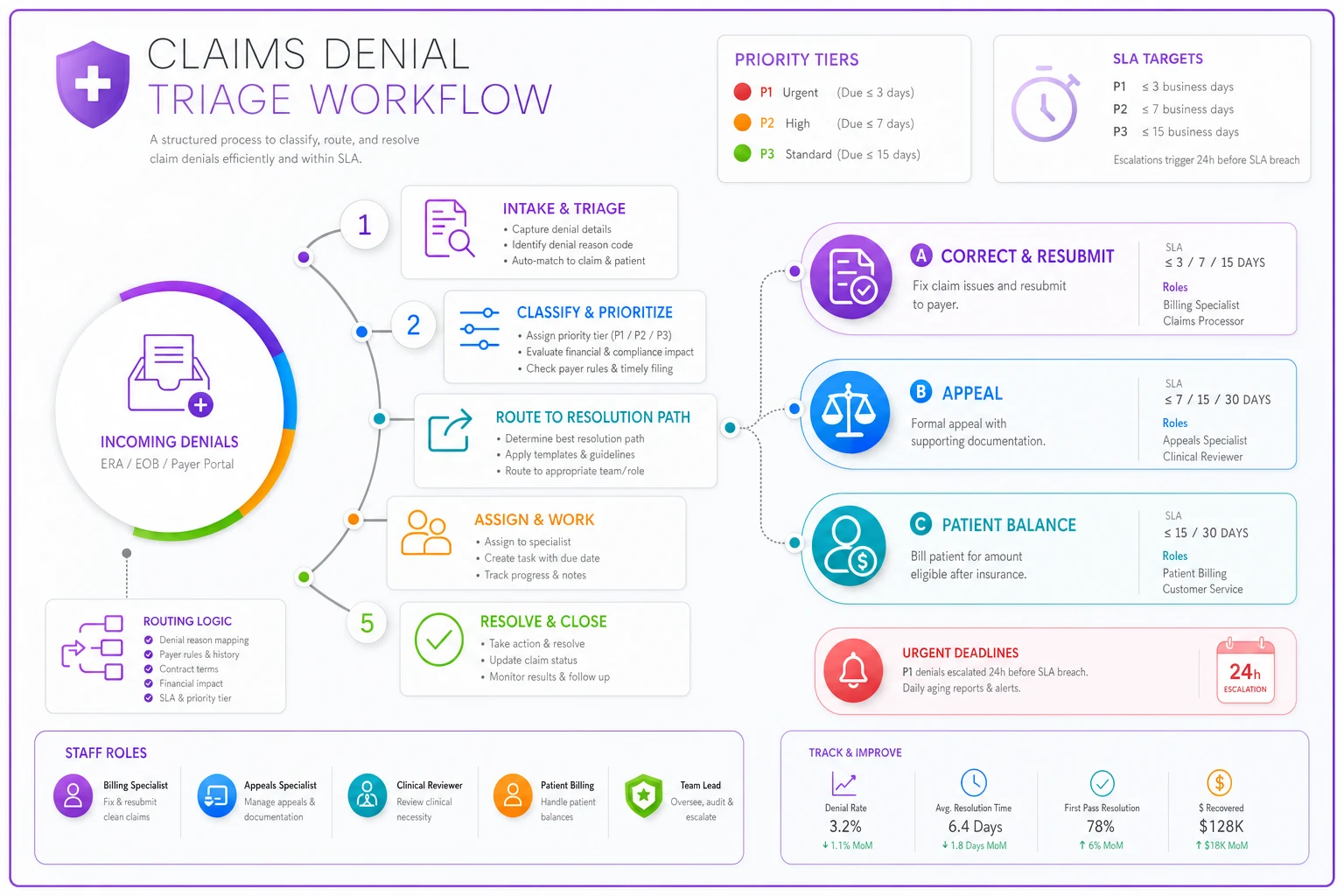
Every denial resolves to one of three paths. The whole game is routing each one quickly and correctly.
Eliminate appointment gaps and no-shows.
GoCliny streamlines every patient interaction from booking to billing—seamlessly.
- Unified appointment scheduling
- Automated patient reminders
- Staff calendar & task management
No credit card required
Correct-and-resubmit is for denials caused by a mistake on your side that you can fix without arguing. Wrong modifier, missing NPI, transposed member ID, incorrect place of service, a diagnosis that doesn't support the CPT but easily could with the right code from the note. These are the cheapest to work and should almost never go through a formal appeal — appealing a correctable error just wastes 30 days waiting for a no.
Appeal is for denials where the payer is wrong, or where the claim was correct but requires documentation to prove it. Medical necessity denials, authorization-obtained-but-not-linked, downcoding disputes, timely filing denials where you have proof of original submission. These take documentation, sometimes a letter, and they carry real deadline pressure.
Patient balance transfer is for denials that are genuinely patient responsibility — deductible not met, non-covered service the patient signed an ABN for, out-of-network cost share. The mistake here is treating these as denials to fight instead of balances to bill. Every day you sit on a legitimate patient balance is a day closer to it becoming uncollectable.
Here's a working triage matrix you can adapt:
| Denial reason (CARC family) | Default path | Why | SLA to first action |
|---|---|---|---|
| Eligibility / coverage terminated (CO-27) | Correct & resubmit OR patient balance | Re-verify; if truly not covered, transfer | 2 business days |
| Missing/invalid data (CO-16, N-codes) | Correct & resubmit | Registration/coding fix, no argument needed | 2 business days |
| Modifier/coding error (CO-4, CO-97 bundling) | Correct & resubmit | Fixable from the note | 3 business days |
| No authorization on file (CO-197) | Appeal if auth existed; else patient balance/write-off | Depends on whether auth was actually obtained | 3 business days |
| Medical necessity (CO-50) | Appeal | Needs clinical documentation | 5 business days |
| Timely filing (CO-29) | Appeal only with proof | Winnable with submission evidence | 2 business days (deadlines are brutal) |
| Non-covered service, ABN signed | Patient balance | Patient agreed to responsibility | 3 business days |
| Duplicate claim (CO-18) | Investigate, usually no action | Often the original paid | 5 business days |
That matrix is meant to be a quick reference for routing decisions, not a replacement for judgment. Keep it visible at triage.
The point of a matrix like this isn't to remove judgment. It's to remove judgment from the 80% of denials that are routine, so your best people spend their brains on the 20% that actually need it.
Prioritization: value and deadline, not date received
Once a denial has a path, it needs a priority. Two variables drive it: dollars at stake and days until the deadline. Build a simple priority score and work the top of the list first.
-
Tier 1 — Urgent Any denial within 10 days of a timely-filing or appeal deadline, regardless of dollar amount. These get worked today. Missing a deadline turns a recoverable claim into a guaranteed zero.
-
Tier 2 — High value Claims above a dollar threshold you set (many small practices use $500) with a comfortable deadline. Work these next.
-
Tier 3 — Standard Mid-value correctable denials. Batch these — they're fast and similar.
-
Tier 4 — Low value / cleanup Small-dollar lines under, say, $40 where the cost to work exceeds likely recovery. Decide a write-off threshold and stop pretending you'll chase them.
That last point matters more than people admit. If it costs roughly $18–$25 in labor to work a denial and the line is $22, chasing it is a loss dressed up as diligence. Set a write-off floor, document it, and free your team to work the claims that actually pay for themselves.
SLA targets that map to real deadlines
SLAs only mean something if they're tied to payer timelines, not internal comfort. Here's a set of targets that leaves margin before the payer's wall closes.
-
Triage / routing every new denial categorized and assigned within 48 hours of hitting the worklist. This is the single most important SLA. Untriaged denials are invisible risk.
-
Correct-and-resubmit submitted within 3 business days of triage.
-
Appeal drafted and submitted within 7 business days of triage for standard appeals; 48 hours for anything flagged Tier 1.
-
Patient balance transfer posted and dropped to a statement within 3 business days.
-
Timely-filing proof gathering same day the denial is identified. This one has no slack.
A useful internal rule: no denial should sit unassigned for more than two days. Aging happens in the assignment gap, not the working gap. The claim someone owns gets worked. The claim nobody owns ages until it's dead.
Documentation checklists per path
The reason appeals take so long in most practices is that the biller has to go hunting for documentation every single time. Pre-defining what each path needs turns a scavenger hunt into a fill-in-the-blank.
Correct-and-resubmit checklist:
-
Original claim number and denial date
-
Specific CARC/RARC and plain-language reason
-
The exact field being corrected (screenshot or note)
-
Confirmation the correction matches the medical record
-
Resubmission date and new claim number logged
Appeal checklist:
-
Copy of original claim and full remittance
-
Copy of the relevant medical record pages (highlighted, not the whole chart)
-
Authorization number and date if applicable
-
Payer-specific appeal form (they differ — using the wrong one gets you rejected on a technicality)
-
Appeal letter referencing the specific policy or medical-necessity criteria
-
Proof of timely original submission if that's the issue
-
Deadline date written at the top of the file
Patient balance checklist:
-
Confirmation the balance is genuinely patient responsibility
-
ABN or financial agreement on file if the service was non-covered
-
Accurate patient-responsibility amount from the EOB
-
Statement generated and payment options attached
If you already run patient-responsibility work, the balance path connects directly to your patient financial engagement workflow — the estimate, the point-of-care conversation, and the payment-plan script. A clean handoff there means denied-to-patient-balance claims don't stall in a separate silo.
Staffing math: how many people this actually takes
This is the part most playbooks skip. You can't run SLAs you're not staffed for.
-
A biller can work roughly 25–35 correct-and-resubmit denials per day once the routing rules are clear.
-
Appeals are far slower
6–10 per day including documentation pull and letter drafting.
-
Triage and routing itself, once matrixed, runs about 60–80 denials per hour because it's mostly categorization.
So if you're pulling in around 400 denials a month and roughly 30% need appeals, that's about 120 appeals. At 8 appeals a day, that's around 15 working days of appeal labor — over half of one full-time biller just on appeals, before touching the correct-and-resubmit volume. Practices that miss this math end up with a "denials person" quietly drowning while management wonders why aging keeps climbing.
A few staffing patterns that hold up:
-
Split by path, not by payer, once you're past 300 or so denials a month. One person batching correct-and-resubmit is much faster than everyone doing a bit of everything.
-
Protect appeal time. Appeals lose to interruptions. Block appeal work so the deadline-sensitive, documentation-heavy claims get uninterrupted attention.
-
Cross-train the triage step. Triage becomes a bottleneck fast if one person owns it and they're out. Two or three people who can route by matrix keeps the front of the pipeline moving.
Protect appeal time.
Triage becomes a bottleneck fast if one person owns it and they're out. Two or three people who can route by matrix keeps the front of the pipeline moving.
A real scenario
A three-provider orthopedics practice was running around 350–400 denials a month with a single biller working them first-in-first-out. Timely-filing write-offs were running roughly $4k–$6k a month, and nobody could explain why — the biller was clearly busy.
The fix wasn't more staff. It was routing. They built a two-page triage matrix, set a 48-hour triage SLA, and pulled every denial within 10 days of a deadline to the top regardless of size. Small-dollar lines under $30 got a documented write-off rule so they stopped eating time.
Within about two months, timely-filing write-offs dropped to under $1k most months, and appeal recovery went up simply because the high-value claims were being worked before their deadlines instead of after. They eventually added part-time help for appeal drafting — but only after the routing fixed the visibility problem. Adding a person before that would have just made the same disorganized queue slightly faster.
When this matrix makes sense — and when it doesn't
When it makes sense: you're above roughly 150–200 denials a month, you have more than one person touching billing, and you're seeing timely-filing write-offs you can't fully explain. That combination means the queue has outgrown informal handling.
When it's overkill: a solo provider with 30–40 denials a month probably doesn't need a tiered matrix. One organized worklist sorted by deadline is enough. Building elaborate SLAs for tiny volume is process for its own sake.
Who should NOT do this yet: practices that haven't fixed their front-end. If most of your denials are eligibility and registration errors, a triage matrix just helps you rework the same mistakes faster. Fix intake and pre-submission QC first, then triage what's left.
Where software takes the manual sting out
None of this requires special tooling to start — a spreadsheet and some discipline get you most of the way. But the parts that quietly consume hours are the ones worth automating: categorizing incoming denials by CARC code, flagging anything near a deadline, and surfacing high-value claims to the top of the queue automatically.
This is where AI-assisted operational platforms earn their place. Instead of a biller reading each remittance and manually deciding a path, the system can pre-tag denials against your matrix, auto-flag Tier 1 deadline risk, and route work to the right person with the documentation checklist already attached. The biller still makes judgment calls on the tricky 20% — the software just stops the routine 80% from clogging the queue and makes sure nothing near a deadline goes invisible. That's the difference between a team that's busy and a team that's actually collecting.
The one thing to fix first
If you change nothing else, put a hard 48-hour triage SLA on every incoming denial and pull deadline-sensitive claims to the top.
Working denials in the wrong order is what turns fixable claims into write-offs. The appeal letters, the documentation, the staffing — all of that matters, but none of it helps a claim that already blew past timely filing because it sat in a first-in-first-out queue nobody was prioritizing. Route first, then work. The recoveries follow.
Route first, then work. The recoveries follow.
Ready to transform your practice workflow?
Join 2,000+ healthcare providers using GoCliny to increase efficiency, improve patient satisfaction, and grow revenue.